Freshly Printed - allow 7 days lead
Couldn't load pickup availability
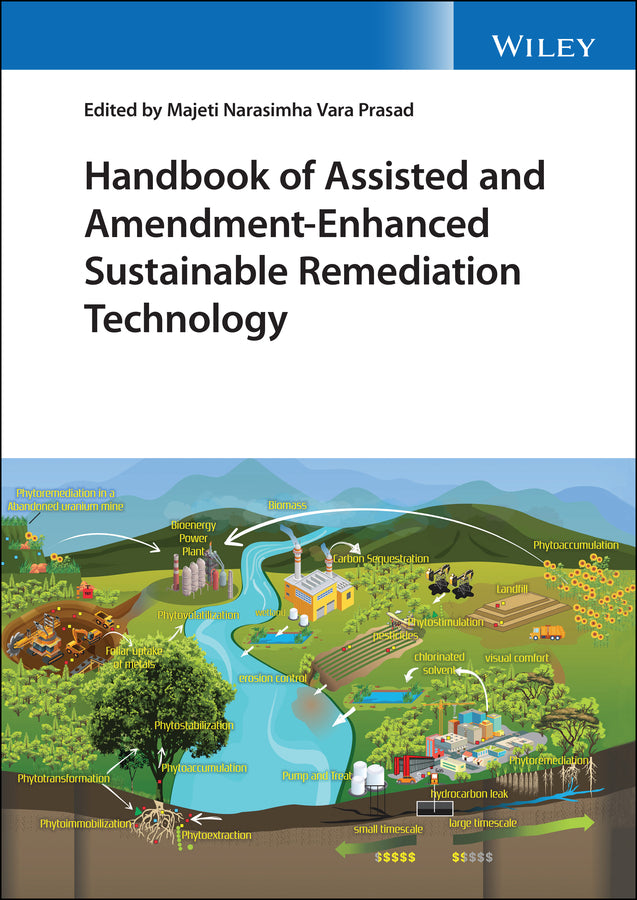
Handbook of Assisted and Amendment-Enhanced Sustainable Remediation Technology
Majeti Narasimha Vara Prasad (Edited by)
9781119670360, Wiley
Hardback, published 10 June 2021
656 pages
25.7 x 18.3 x 3.1 cm, 1.157 kg
Learn more about phytoremediation technology with this state-of-the-art resource from an internationally recognized editor and leader in his field The Handbook of Assisted and Amendment-Enhanced Sustainable Remediation Technology discusses sustainable approaches to the removal of contaminants from the environment or the reduction of their toxicity. The distinguished editor has included resources from an internationally recognized group of academics who discuss strategies to increase the effectiveness of phytoremediation. Special attention is paid to the use of organic amendments to facilitate soil cleanup and the growth of phytoremediation plants. The book includes discussions of new remediation technologies, global trends in the environmental remediation industry, and the future challenges and opportunities likely to arise in the short and long term. The Handbook of Assisted and Amendment-Enhanced Sustainable Remediation Technology provides a compelling case for the cost-effectiveness, aesthetics, and minimal environmental disturbance of phytoremediation. Topics covered include: Perfect for environmental engineers, environmental scientists, geologists, chemical engineers, and landscape engineers, Handbook of Assisted and Amendment-Enhanced Sustainable Remediation Technology is also an indispensable reference for scientists working in the green chemistry and technology industries, biochemical engineers, environmental regulators, and policy makers.
List of Contributors xvii Preface xxv Part I Global Scenario of Remediation and Combined Clean Biofuel Production 1 1 Global Remediation Industry and Trends 3 1.1 Introduction 3 1.1.1 Rise of Phytoremediation 4 1.1.2 The Phytoremediation Industry 5 1.1.3 The Key Players in Global Remediation and Phytoremediation 10 1.1.3.1 Markets by Sector 11 1.1.3.2 Markets by Application 11 1.1.3.3 Sizes of Market Sectors Potentially Available to Phytoremediation 11 1.2 Global 12 1.3 Mining in Latin America and Phytoremediation Possibilities 16 Acknowledgements 23 References 23 2 Sustainable Valorization of Biomass: From Assisted Phytoremediation to Green Energy Production 29 2.1 Introduction 29 2.2 Bioenergy: The Role of Biomass 30 2.3 Assisted Phytoremediation: Valorization of Biomass 33 2.4 Assisted Phytoremediation-Bioenergy: An Integrated Approach 37 2.5 Conclusions 43 References 44 Part II Biochar-Based Soil and Water Remediation 53 3 Biochar – Production, Properties, and Service to Environmental Protection against Toxic Metals 55 3.1 Introduction 55 3.2 How to Produce Biochar 55 3.3 Biochar Properties 57 3.4 Biochar in the Service of Environmental Protection 59 3.5 Soil Characteristics 59 3.6 Environmental Hazards Caused by Heavy Metals 60 3.7 Characteristics of Selected Heavy Metals 62 3.8 Zinc 64 3.9 Copper 64 3.10 Lead 65 3.11 Cadmium 66 3.12 Soil Pollution 67 3.13 What is Remediation and What is it for? 68 3.14 Improving Soil Properties 69 3.15 Removal of Impurities 69 3.16 The Addition of Biochar to Contaminated Soils may be Such a Solution 70 3.17 Summary 72 References 73 4 Biochar-based Water Treatment Systems for Clean Water Provision 77 4.1 Introduction 77 4.2 Synthesis of Biochar 77 4.2.1 Pyrolysis Process 77 4.2.2 Pyrolysis Technology 78 4.3 Biochar Properties 80 4.3.1 Biochar Surface Chemistry 80 4.3.2 Pyrolysis Effect on Chemical Properties of Biochar 81 4.3.3 Pyrolysis Effect on Physical Properties of Biochar 81 4.4 Mechanism of Adsorption 82 4.4.1 Heavy Metal Removal Mechanism 82 4.4.2 Organic Contaminants Removal Mechanism 82 4.4.3 Pathogenic Organism Removal Mechanism 83 4.5 Factors Affecting Adsorption of Contaminants on Biochar 84 4.5.1 Biochar Properties 84 4.5.2 Post Treatment or Modification 85 4.5.3 Solution pH 87 4.5.4 Co-existed Ions 87 4.5.5 Dosage of Adsorbents 87 4.5.6 Temperature 87 4.5.7 Contact Time 87 4.5.8 Initial Concentration of Pollutants 88 4.6 Biochar-Based Water Treatment Systems 88 4.6.1 Biochar Supply 88 4.6.2 Biochar Use 89 4.6.3 Regeneration 90 4.6.3.1 Thermal Regeneration 90 4.6.3.2 Solvent Regeneration 93 4.6.3.3 Microwave Irradiation Regeneration 94 4.6.4 Supercritical Fluid Regeneration 94 4.6.5 Sustainability of Biochar Utilization 95 References 95 5 Biochar for Wastewater Treatment 103 5.1 Biochar Production and Its Characteristics 103 5.2 Modification of Biochar 105 5.3 Comparison of Biochar with Activated Carbon 105 5.4 Biochar Adsorption Mechanism 106 5.5 Adsorption Kinetics of Aqueous-Phase Organic Compounds 108 5.6 Influence of pH, Temperature, and Biochar Dose on the Adsorption Process 108 5.7 Biochar Technology in Wastewater Treatment 110 5.8 Summary 112 Acknowledgment 112 References 112 6 Biochar for Bioremediation of Toxic Metals 119 6.1 The Idea of Using Biochar with the Assumption of Closed Circulation 119 6.2 The Role of Biochar in Soil - General Information 120 6.3 Biochar as a Sorbent – Physical and Structural Composition 121 6.4 The Role of Biochar in Removing Heavy Metals from Soil 123 6.5 Utilization of Selected Heavy Metals from Soil 123 6.6 Mechanism of Heavy Metals-Biochar 124 6.7 Summary 126 Acknowledgment 126 References 127 7 Biochar Assisted Remediation of Toxic Metals and Metalloids 131 7.1 Introduction 131 7.2 Biochar and its Remarkable Physical Chemical and Biological Properties 132 7.2.1 Physical Properties of Biochar 132 7.2.1.1 Density and Porosity 132 7.2.1.2 Surface Area of Biochar 132 7.2.1.3 Pore Volume and Pore Size Distribution 132 7.2.1.4 Water Holding Capacity and Hydrophobicity 132 7.2.1.5 Mechanical Stability 133 7.2.2 Chemical Properties 133 7.2.2.1 Atomic Ratios 133 7.2.2.2 Elemental Composition 133 7.2.2.3 Energy Content 133 7.2.2.4 Fixed Carbon and Volatile Matter 134 7.2.2.5 Presence of Functional Groups 134 7.2.2.6 pH of Biochar 134 7.2.2.7 Cation Exchange Capacity 134 7.2.3 Biological Properties of Biochar 134 7.2.3.1 Biochar as a Habitat for Soil Microorganisms 134 7.2.3.2 Biochar as a Substrate for the Soil Biota 135 7.3 Heavy Metal Pollutants 135 7.4 Interactions between Biochar and Heavy Metal 136 7.4.1 Types of Interactions Occurs between Biochar and Heavy Metals 136 7.4.1.1 Direct Interaction 136 7.4.1.2 Electrostatic Attractions 136 7.4.1.3 Ion Exchange 137 7.4.1.4 Complexation 137 7.4.1.5 Precipitation 137 7.4.1.6 Sorption 137 7.4.1.7 Indirect Interactions 137 7.4.1.8 Biochar Metal Interactions 138 7.5 Biochar as a Bioremediator 138 7.5.1 Bioremediation of Heavy Metals Pollutant by the Use of Microorganism and Biochar 139 7.5.2 Bioremediation of Heavy Metal Pollutants by the Use of Plants and Biochar 140 7.5.3 Bioremediation of Heavy Metals Pollutant through the Combination of Biochar, Plant, and Microorganism 143 7.6 Application of Biochar in Bioremediation of Mining Area 143 7.6.1 Application of Biochar in Bioremediation of Acid Mine Wastes 146 7.6.2 Alkaline Tailing Soils 148 7.7 Limitation of Biochar Amended Bioremediation 148 7.7.1 Phytoextraction of Arsenic 149 7.7.2 Phytoremediation of Sewage Sludge 150 7.8 Conclusion 150 References 150 8 Use of Biochar as an Amendment for Remediation of Heavy Metal-Contaminated Soils 163 8.1 Introduction 163 8.2 Biochar Production Conditions 164 8.3 Modification to Improve Remediation Potential of Biochar 165 8.4 Mechanism of Metal Immobilization by Biochar 169 8.4.1 Direct Biochar–Heavy Metal Interaction 170 8.4.1.1 Electrostatic Attraction 170 8.4.1.2 Ion Exchange 170 8.4.1.3 Complexation 170 8.4.1.4 Precipitation 170 8.4.2 Indirect Biochar–Heavy Metals–Soils Interactions 171 8.4.2.1 Impact on Soil pH, CEC, and Organic Carbon Content, thus Metal Mobility 171 8.4.2.2 Impacts on Soil Mineral Composition and Metal Mobility by Biochar Application 171 8.5 Immobilization of Heavy Metals by Biochar 171 8.6 Application of Biochar for Immobilization of Heavy Metals and Enhancement of Plant Growth 172 8.7 Conclusions 173 References 173 9 Biochars for Remediation of Recalcitrant Soils to Enhance Agronomic Performance 179 9.1 Introduction 179 9.2 Biochar Properties 179 9.2.1 Production 179 9.2.2 Properties 180 9.3 Application and Impact of Biochar on Soils 183 9.3.1 Biochar in Soil Carbon Sequestration 184 9.3.2 Influence on Soil Physical and Chemical Properties 184 9.3.3 Influence on Microbial Activity and Soil Biota 186 9.4 Conclusions 186 Acknowledgment 186 References 187 10 Biochar Amendment Improves Crop Production in Problematic Soils 189 10.1 Introduction 189 10.2 Roles of Biochar in Soil Improvement 189 10.2.1 Physical Characteristics 190 10.2.2 Chemical Properties 190 10.2.3 Biological Indices 191 10.3 Other Roles of Biochar 192 10.4 Agricultural Productivity in Biochar Amended Soil 192 10.4.1 Advantages of Using Biochar as a Soil Supplement 195 10.5 Reclamation of Degraded Soils Using Biochar 196 10.6 Conclusions 197 References 198 Part III Organic Amendments Use in Remediation 205 11 Use of Organic Amendments in Phytoremediation of Metal-Contaminated Soils: Prospects and Challenges 207 11.1 Agricultural Organic Waste 209 11.2 Forestry By-Products 209 11.3 Composts 212 11.4 Sewage Sludge/Biosolids 217 11.5 Humic Substances 220 11.6 Biochar 222 11.7 Constructed Organic-Derived Soils 223 11.8 Directions for Future Research 224 Acknowledgments 226 References 226 12 Rice Husk and Wood Derived Charcoal for Remediation of Metal Contaminated Soil 235 12.1 Introduction 235 12.2 Heavy Metal Contamination in Soils 235 12.3 Rice Husk Ash (RHA) – Production, Characteristics, and Application 236 12.3.1 Utilization of Rice Husk Ash as Soil Amendment and Metal Removal 237 12.4 Charcoal – Production and Applications 239 12.4.1 Charcoal as Amendment and Metal Removal 245 12.5 Conclusion 256 References 256 13 Enhanced Composting Using Woody Biomass and Its Application in Wasteland Reclamation 267 13.1 Introduction 267 13.2 Composting Process 270 13.3 Types of Composting 271 13.4 Woody Biomass Waste as Co-composting Material 271 13.4.1 Usage of Woody Biochar in Composting 272 13.4.2 Woody Biochar-Microbial Consortia 272 13.4.3 Usage of Wood Ash in Composting 274 13.4.4 Usage of Wood Derived Materials in Composting 274 13.5 Advantages and Disadvantages of Composting Woody Biomass 275 13.6 Application of Woody Biomass Compost in Restoration of Wastelands 276 13.7 Conclusion 277 Acknowledgment 277 References 277 14 Sewage Sludge as Soil Conditioner and Fertilizer 283 14.1 Introduction 283 14.2 Sewage Sludge from Wastewater Treatment Plants 283 14.2.1 Soil Remediation Practices 284 14.2.2 Sewage Sludge in the Remediation of Degraded Soils 286 14.2.2.1 Sewage Sludge as a Source of NPK 286 14.2.3 Substrates Produced or Based on Sewage Sludge–Biosolids 287 14.2.4 Biosolids as Fertility Restorer and Conditioner 287 14.2.5 Impact of Sewage Sludge and Biosolids on Soil Microorganisms 290 14.2.6 Sewage Sludge Amendments in Relation to CO2 Sequestration 292 14.2.7 Conclusion 292 References 292 15 Sustainable Soil Remediation Using Organic Amendments 299 15.1 Introduction 299 15.2 Organic Amendments for Soil Remediation 300 15.2.1 Composts 300 15.2.2 Animal Manures and Biosolids 300 15.3 Impact of Organic Amendments on Soils 303 15.3.1 Influence on Soil Physical Properties 303 15.3.2 Influence on Microbial Activities and Soil Biota 305 15.3.3 Influence of the Content of Nitrogen and Phosphorus 306 15.4 Potential Risks of the Use of Organic Amendments 307 15.5 Conclusions 308 References 309 Part IV Advanced Technologies for Remediation of Inorganics and Organics 313 16 Biosurfactant-Assisted Bioremediation of Crude Oil/Petroleum Hydrocarbon Contaminated Soil 315 16.1 Introduction 315 16.2 Surfactants and Biosurfactants 316 16.3 Microbial Surfactants 316 16.4 Types of Biosurfactants 318 16.4.1 Glycolipid Biosurfactants 318 16.4.1.1 Rhamnolipids 318 16.4.1.2 Trehalose 318 16.4.1.3 Sophorolipid 318 16.4.2 Phospholipids Biosurfactant 319 16.4.3 Lipopeptides and Lipoproteins 319 16.4.4 Fatty Acid 320 16.4.5 Polymeric and Particulate Biosurfactant 320 16.5 Optimization of Biosurfactants 320 16.6 Biosurfactant in Bioremediation 320 16.6.1 Glycolipids Mediated Crude Oil Remediation 321 16.6.2 Lipopeptide Mediated Crude Oil/Hydrocarbons Degradation 323 16.6.3 Bioemulsifiers Mediated Crude Oil/Hydrocarbons Degradation 323 16.7 Challenges and Future Prospectives 324 16.8 Conclusion 324 References 324 17 Advanced Technologies for the Remediation of Pesticide-Contaminated Soils 331 17.1 Introduction 331 17.2 Consumption and Need for Removal 332 17.2.1 Worldwide Consumption of Pesticide 333 17.2.2 Production and Usage of Pesticide in India 333 17.2.3 Need for Removal 333 17.3 Remediation Technologies for Pesticidal Contamination 335 17.3.1 Physico–Chemical Remediation 335 17.3.1.1 Adsorption 335 17.3.1.2 Oxidation–Reduction 336 17.3.1.3 Catalytic Degradation 338 17.3.1.4 Nano Technology 338 17.3.2 Biological Remediation 340 17.3.2.1 Role of Plants 340 17.3.2.2 Role of Microflora 341 17.4 Conclusion 342 References 344 18 Enzymes Assistance in Remediation of Contaminants and Pollutants 355 18.1 Introduction 355 18.2 Cyanide Degradation 356 18.3 Rhizosphere 360 18.3.1 Degradation of Petroleum Hydrocarbons 360 18.3.2 Degradation of Pesticides 361 Acknowledgments 383 References 383 19 Thiol Assisted Metal Tolerance in Plants 389 19.1 Introduction 389 19.2 Sulfur Metabolism in Plants 390 19.3 Thiols Induced Metal Tolerance in Plants 390 19.3.1 Role of Metal Transporters 391 19.3.2 Role of Thioredoxins and Glutaredoxins 392 19.3.3 Role of Metallothioneins 392 19.3.4 Role of Phytochelatins in Heavy Metal Stress Mitigation 392 19.3.4.1 Heavy Metal Detoxification Mechanism 393 19.3.5 Role of Glutathione in Heavy Metal Stress Mitigation 394 19.4 Conclusion 396 References 397 20 Biological Remediation of Selenium in Soil and Water 403 20.1 Introduction 403 20.2 Sources of Selenium 403 20.2.1 Soil 404 20.2.2 Water 404 20.2.3 Air 404 20.3 Significance in Human Health 405 20.4 Biological Remediation Processes 407 20.4.1 Phytoremediation 407 20.4.1.1 Phytoextraction 407 20.4.1.2 Phytovolatilization 408 20.4.1.3 Rhizofiltration 408 20.4.2 Bioremediation 409 20.4.2.1 Planktonic Cells of Axenic Bacterial Culture 409 20.4.2.2 Biofilm of Axenic Bacterial Culture 410 20.4.2.3 Microbial Consortia 410 20.4.3 Bioamendment with Chelating Agents and Organic Matter 411 20.4.4 Biosorption 412 20.5 Conclusion 412 References 413 Part V Microbe and Plant Assisted Remediation of Inorganics and Organics 423 21 Phosphate Solubilizing Bacteria for Soil Sustainability 425 21.1 Introduction 425 21.2 Biofertilizer 426 21.2.1 PSM Requirement in Plants 426 21.2.2 Phosphate Solubilizing Microorganisms (PSM) 426 21.2.3 Application of PSB Inoculants 427 21.3 Mechanism of P Solubilization 427 21.3.1 Lowering of Soil pH 427 21.3.2 Chelation 428 21.3.3 Mineralization 429 21.4 PSB Help Plant Growth 429 21.5 Phosphate Solubilizing Bacteria (PSB) 430 21.5.1 Mechanism of Action of PSB 431 21.6 Soil Sustainability with PSB 431 References 432 22 Microbe and Plant-Assisted Remediation of Organic Xenobiotics 437 22.1 Introduction 437 22.2 Impact of PAHs on Environment 439 22.3 PAHs in Soil and Sediments 441 22.4 Molecular Weight and Aqueous Solubility 442 22.5 Plant Assisted Remediation of PAHs 443 22.5.1 Phytoremediation 445 22.5.1.1 Phytoextraction 447 22.5.1.2 Phytostabilization 448 22.5.1.3 Phytovolatilization 448 22.5.1.4 Phytodegradation 448 22.5.1.5 Rhizodegradation 449 22.6 Plant and Microbe Assisted Remediation – Synergistic Approaches 449 22.7 Plant–Endophyte Partnership in Phytoremediation 452 22.7.1 Endophyte Colonization and Survival 453 22.7.2 Beneficial Mutualistic Interactions Between Endophytes and Their Hosts 454 22.7.2.1 Nutrient Bioavailability 457 22.7.2.2 Modulation and Synthesis of Phytohormones 458 22.7.2.3 Defense Mechanisms against Phytopathogens 459 22.7.3 Biosurfactants and Their Roles in Phytoremediation 459 22.8 Conclusions 461 References 461 23 Plant Growth-Promoting Rhizobacteria (PGPR) Assisted Phytoremediation of Inorganic and Organic Contaminants Including Amelioration of Perturbed Marginal Soils 477 23.1 Introduction 477 23.2 Plant Growth-Promoting Rhizobacteria (PGPR): Features and Mechanisms 478 23.2.1 Auxins, Cytokinins, Gibberellins 479 23.2.2 Siderophores 480 23.2.3 ACC Deaminase 480 23.2.4 Phosphate Solubilization 481 23.2.5 Nitrogen Fixation 482 23.2.6 Indirect Mechanisms 482 23.3 Influence of PGPR on Heavy Metals and Hydrocarbons Remediation 482 23.4 Plant Growth-Promoting Rhizobacteria to Face Salinity and Drought in Marginal Soils 486 23.4.1 Survival to Abiotic Stress 486 23.4.2 Affecting the Drought Pressure 487 23.4.3 Improving the Salinity Tolerance 488 23.4.4 Phytodepuration for Water Reclamation 489 23.5 Conclusions 491 References 491 24 Plant and Microbe Association for Degradation of Xenobiotics Focusing Transgenic Plants 501 24.1 Introduction 501 24.2 Xenobiotics in the Environment 502 24.3 Mechanism of Degradation of Xenobiotics 502 24.4 Plant and Microbe Association for Degradation of Xenobiotics 504 24.5 Transgenic Plants and Microbes for the Remediation of Xenobiotics 506 24.6 Conclusion 509 References 509 25 Azolla Farming for Sustainable Environmental Remediation 517 25.1 Introduction 517 25.2 Diversity and Ecological Distribution 519 25.3 Growth Conditions for Optimal Biomass Productivity 521 25.4 Phytoremediation of Water Bodies 523 25.5 Prospects in Sustainable Remediation and Bioeconomy 525 25.6 Outlook 529 References 529 26 Mangrove Assisted Remediation and Ecosystem Services 535 26.1 Mangrove Ecosystems 535 26.2 Mangrove Plants 535 26.3 Factors Responsible for Mangrove Degradation and Destruction 536 26.4 Ecosystem Services of Mangroves 537 26.4.1 Mangrove as a Sink of Pollutants 538 26.4.1.1 Heavy Metals 539 26.4.1.2 Heavy Metal Indices 540 26.4.1.3 Association with Other Elements 542 26.4.1.4 Organic Compounds 544 26.4.1.5 Waste Water 545 26.4.1.6 Microorganism Association and Isolation 547 26.5 Methodologies to Use Mangroves for Remediation 550 26.6 Final Comments 550 References 552 Part VI Nanoscience in Remediation 557 27 Nanotechnology Assisted Remediation of Polluted Soils 559 27.1 Soil as Soil of Life 559 27.2 Soil Pollution 561 27.3 Impact of Soil Pollution 561 27.4 Nanopollution 562 27.5 Soil Remediation 563 27.5.1 Conventional Soil Remediation Techniques and Methods 563 27.5.1.1 Bioremediation 563 27.5.1.2 Thermal Desorption 564 27.5.1.3 Surfactant Enhanced Aquifer Remediation 565 27.5.1.4 Pump and Treat 565 27.5.1.5 In-Situ Oxidation 566 27.5.2 Nanotechnology Based Soil Remediation Methods 566 27.5.2.1 Nanomaterials 566 27.5.2.2 Nano-Bioremediation 567 27.5.2.3 Bioremediation with Biogenic Uraninite NPs 567 27.5.2.4 Bioremediation with Engineered Polymeric NPs 567 27.5.2.5 Bioremediation with Single Enzyme NPs 568 27.5.2.6 Zeolites in Soil Remediation with Nanotechnology 568 27.5.2.7 Soil Remediation with Iron Oxide NPs 569 27.5.2.8 Soil Remediation with Nano Scale Zero Valent Iron (nZVI) 570 27.5.2.9 Remediation with Other Metal-based NPs 570 27.5.2.10 Remediation with Phosphate-based NPs 571 27.5.2.11 Soil Remediation with Iron Sulfide NPs 571 27.5.2.12 Carbon Nanotubes (CNT) in Soil Remediation 571 27.5.2.13 Nanoclay in Soil Remediation 572 27.6 Future Scope of Nanotechnology in Soil Remediation 573 References 573 28 Remediation of Wastewater Using Plant Based Nano Materials 583 28.1 Introduction 583 28.2 Materials and Methods 586 28.2.1 Materials 586 28.2.2 Preparation of Extract 587 28.2.3 Synthesis of AgNPs 587 28.2.4 Characterization of Synthesized AgNPs 587 28.2.5 Catalytic Activity of Synthesized AgNPs 587 28.3 Results and Discussion 588 28.3.1 Energy Dispersive X-Ray (EDX) and X-Ray Diffraction (XRD) Analysis 590 28.3.2 Transmission Electron Microscopy 591 28.3.3 Fourier Transform Infra-Red Spectroscopy 591 28.3.4 Catalytic Property of AgNPs 593 28.4 Conclusion 595 Acknowledgments 596 References 596 Index 601
Majeti Narasimha Vara Prasad, Lander de Jesus Alves and Fabio Carvalho Nunes
Martina Grifoni, Francesca Pedron, Meri Barbafieri, Irene Rosellini, Gianniantonio Petruzzelli and Elisabetta Franchi
Monika Ga³wa-Widera
Dwiwahju Sasongko, David Gunawan and Antonius Indarto
Anna Kwarciak-Koz³owska and Renata W³odarczyk
Renata W³odarczyk and Anna Kwarciak-Koz³owska
Shalini Dhiman, Mohd Ibrahim, Kamini Devi, Neerja Sharma, Nitika Kapoor, Ravinderjit Kaur, Nandni Sharma, Raman Tikoria, Puja Ohri, Bilal Ahmad Mir and Renu Bhardwaj
Subodh Kumar Maiti and Dipita Ghosh
Anna Grobelak and Marta Jaskulak
Bhupinder Dhir
Galina Koptsik, Graeme Spiers, Sergey Koptsik and Peter Beckett
Boda Ravi Kiran and Majeti Narasimha Vara Prasad
Zeba Usmani, Tiit Lukk, Eve-Ly Ojangu, Hegne Pupart, Kairit Zovo and Majeti Narasimha Vara Prasad
Krzysztof Fija³kowski and Anna Kwarciak-Koz³owska
Marta Jaskulak and Anna Grobelak
Jeevanandam Vaishnavi, Punniyakotti Parthipan, Arumugam Arul Prakash, Kuppusamy Sathishkumar and Aruliah Rajasekar
Palak Bakshi, Arun Dev Singh, Jaspreet Kour, Sadaf Jan, Mohd Ibrahim, Bilal Ahmad Mir and Renu Bhardwaj
Majeti Narasimha Vara Prasad
Pooja Sharma, Palak Bakshi, Dhriti Kapoor, Priya Arora, Jaspreet Kour, Rupinder Kaur, Ashutosh Sharma, Bilal Ahmad Mir and Renu Bhardwaj
Siddhartha Narayan Borah, Suparna Sen, Hemen Sarma and Kannan Pakshirajan
Raffia Siddique, Alvina Gul, Munir Ozturk and Volkan Altay
A.P. Pinto, M.E. Lopes, A. Dordio and J.E.F. Castanheiro
Elisabetta Franchi and Danilo Fusini
Pooja Sharma, Palak Bakshi, Kanika Khanna, Jaspreet Kour, Dhriti Kapoor, Arun Dev Singh, Tamanna Bhardwaj, Rupinder Kaur, Ashutosh Sharma and Renu Bhardwaj
Abin Sebastian, Palengara Deepa and Majeti Narasimha Vara Prasad
Janaina dos Santos Garcia, Sershen and Marcel Giovanni Costa Franca
H.A.D.B. Amarasiri and Nadeesh M. Adassooriya
Wangjam Kabita Devi, Maibam Dhanaraj Meitei and Majeti Narasimha Vara Prasad
Subject Areas: Chemistry [PN]