Freshly Printed - allow 10 days lead
Couldn't load pickup availability
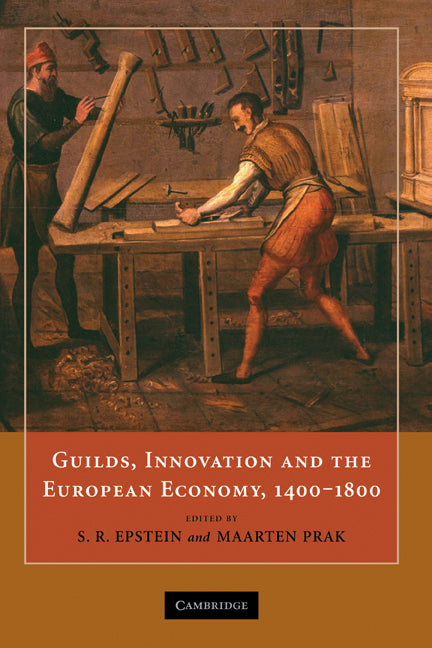
Guilds, Innovation and the European Economy, 1400–1800
Re-examination of the role of guilds in the early modern European economy.
S. R. Epstein (Edited by), Maarten Prak (Edited by)
9780521887175, Cambridge University Press
Hardback, published 31 March 2008
364 pages
23.5 x 16 x 2.7 cm, 0.7 kg
Review of the hardback: 'This is undoubtedly an important collection of essays that brings the vibrancy of the early modern industry to the fore.' The Historical Association
For a long time guilds have been condemned as a major obstacle to economic progress in the pre-industrial era. This re-examination of the role of guilds in the early modern European economy challenges that view by taking into account fresh research on innovation, technological change and entrepreneurship. Leading economic historians argue that industry before the Industrial Revolution was much more innovative than previous studies have allowed for and explore the different products and production techniques that were launched and developed in this period. Much of this innovation was fostered by the craft guilds that formed the backbone of industrial production before the rise of the steam engine. The book traces the manifold ways in which guilds in a variety of industries in Italy, Austria, Germany, Switzerland, France, Belgium, the Netherlands, and Britain helped to create an institutional environment conducive to technological and marketing innovations.
Acknowledgements
List of contributors
Introduction: guilds, innovation, and the European economy, 1400–1800 S. R. Epstein and Maarten Prak
1. Craft guilds, the theory of the firm, and early modern proto-industry Ulrich Pfister
2. Craft guilds, apprenticeship and technological change in pre-industrial Europe S. R. Epstein
3. Subcontracting in guild-based export trades, thirteenth–eighteenth centuries Catharina Lis and Hugo Soly
4. Circulation of skilled labour in late medieval and early modern Central Europe Reinhold Reith
5. Painters, guilds and the art market during the Dutch Golden Age Maarten Prak
6. Craft guilds and technological change: the engine loom in the European silk ribbon industry in the seventeenth and eighteenth centuries Ulrich Pfister
7. Guilds, technology and economic change in early modern Venice Francesca Trivellato
8. Inventing in a world of guilds: silk fabrics in eighteenth-century Lyon Liliane Perez
9. 'Not to hurt of trade': guilds and innovation in horology and precision instrument making Anthony Turner
10. Reaching beyond the city wall: London guilds and national regulation, 1500–1700 Ian Anders Gadd and Patrick Wallis
11. Guilds in decline? London livery companies and the rise of a liberal economy, 1600–1800 Michael Berlin
Index.
Subject Areas: Economic history [KCZ], Labour economics [KCF], Industrialisation & industrial history [HBTK], Early modern history: c 1450/1500 to c 1700 [HBLH], European history [HBJD]