Freshly Printed - allow 10 days lead
Couldn't load pickup availability
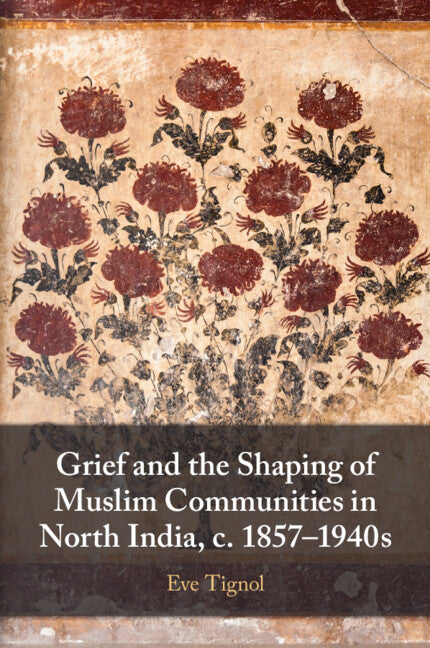
Grief and the Shaping of Muslim Communities in North India, c. 1857–1940s
Eve Tignol investigates the impact of collective grief on Muslim community formation in north India from 1857 to the 1940s.
Eve Tignol (Author)
9781009297677, Cambridge University Press
Paperback / softback, published 14 November 2024
274 pages
22.9 x 15.2 x 1.5 cm, 0.401 kg
'This book has become one of the few works in English - very few on South Asia - which deal with themes related to emotions in history, a fairly recent development in our understanding of history. Notions of nostalgia, memory, melancholia, humiliation, and similar themes, have only recently been analysed in South Asian contexts in English by historians, although there is a huge literature in Urdu - in poetry, prose, around Karbala alone - which has been doing so. Such work is a welcome addition to the ever widening ways we look at the past. Eve Tignol's excellent and extensive bibliography also leads all of us to new and different paths.' S. Akbar Zaidi, Bloomsbury Pakistan
Drawing on approaches from the history of emotions, Eve Tignol investigates how they were collectively cultivated and debated for the shaping of Muslim community identity and for political mobilisation in north India in the wake of the Uprising of 1857 until the 1940s. Utilising a rich corpus of Urdu sources evoking the past, including newspapers, colonial records, pamphlets, novels, letters, essays and poetry, she explores the ways in which writing took on a particular significance for Muslim elites in North India during this period. Uncovering different episodes in the history of British India as vignettes, she highlights a multiplicity of emotional styles and of memory works, and their controversial nature. The book demonstrates the significance of grief as a proactive tool in creating solidarities and deepens our understanding of the dynamics behind collective action in colonial north India.
Introduction
1. A garden lost: grief and pain in 1857 shahr āshob poetry
2. Useful grief: the Aligarh movement
3. Memorials, feelings, and public recognition, c. 1911–1915
4. Empowering grief: poetry and anti-colonial sentiments in the early twentieth century
5. Nostalgia in Delhi: local memory and identity, c. 1910–1940
Epilogue.
Subject Areas: History of ideas [JFCX], Social & cultural history [HBTB], Asian history [HBJF]