Freshly Printed - allow 8 days lead
Couldn't load pickup availability
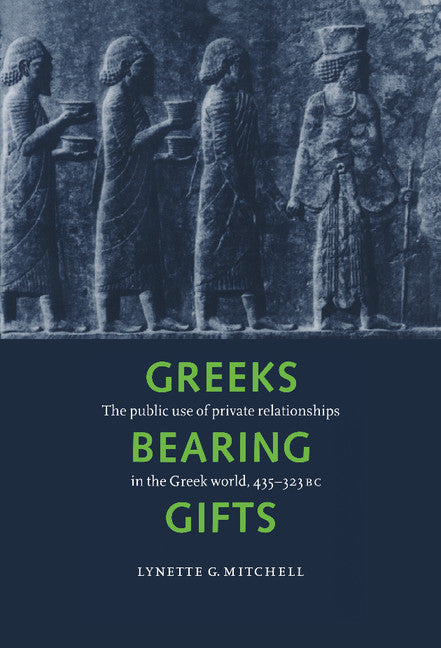
Greeks Bearing Gifts
The Public Use of Private Relationships in the Greek World, 435–323 BC
This book examines the political role of personal relationships in classical Greece.
Lynette G. Mitchell (Author)
9780521554350, Cambridge University Press
Hardback, published 8 January 1998
264 pages, 4 tables
22.9 x 15.2 x 1.9 cm, 0.56 kg
"Along with classical scholars, the book will be especially valuable for biblicists interested in the Persian Period and early Hellinism. It clarifies the Hellenistic moorings of what it meant to be a `friend of Caesal' or to call Abraham `the friend of God'." Religious Studies Review
Using models from social anthropology as its basis, this book looks at the role of personal relationships in classical Greece and their bearing on interstate politics. It begins with a discussion of what friendship meant in the Greek world of the classical period, and then shows how the models for friendship in the private sphere were mirrored in the public sphere at both domestic and interstate level. As well as relations between Greeks (in particular those in Athens and Sparta), Dr Mitchell looks at Greek relations with those on the margins of the Greek world, particularly the state of Macedon, and with neighbouring non-Greeks such as the Thracians and the Persians. She finds that these other cultures did not always have the same understanding of what friendship was, and that this led to misunderstandings and difficulties in the relations between non-Greeks and Greeks.
1. Philia
2. Philia and the polis
3. Philia and political activity
4. Magisterial appointments: Sparta
5. Magisterial appointments: Athens
6. Persia and the Greeks
7. Athenians and Thracians
8. Philip and the Greeks
9. Alexander
10. Friendship and ideology
Appendix I. Magistrates with connections
Appendix II. Notes on magistrates for the years 435–323 BC.
Subject Areas: General & world history [HBG]