Freshly Printed - allow 7 days lead
Couldn't load pickup availability
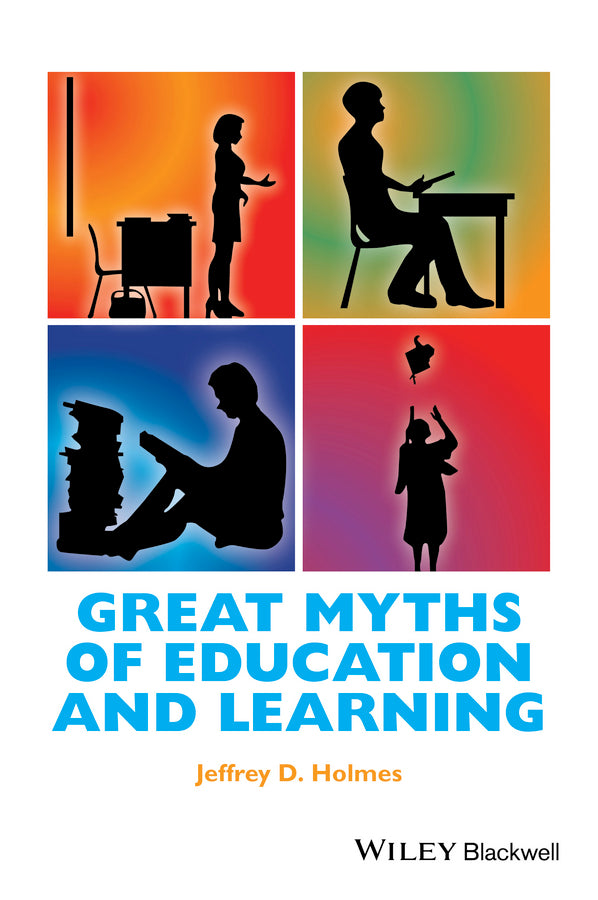
Great Myths of Education and Learning
Jeffrey D. Holmes (Author)
9781118709382, Wiley
Hardback, published 3 May 2016
224 pages
23.6 x 16 x 1.5 cm, 0.422 kg
"Great Myths of Education and Learning is a little gem that should be read by anyone interested in taking an evidence-based approach to education. If you are interested in what the research has to say about how (or how not) to improve education, then this book is for you." "The author uses excellent judgment in his choice of myths, provides a scholarly review of representative studies, and highlights the pitfalls of relying on common knowledge to make instructional decisions. I applaud the author's commitment to showing the important role of scientific evidence in education." "The book highlights the crucial relation between psychology and education—with psychology helping to provide scientific evidence relevant to educational practice and education providing realistic problems that spur psychologists to develop better theories of learning."
—Richard E. Mayer, 2016. 'Taking an Evidence-Based Approach to Education,' PsycCRITIQUES, November 21, 2016, Vol. 61, No. 47, Article 2
—Richard E. Mayer, 2016. 'Taking an Evidence-Based Approach to Education,' PsycCRITIQUES, November 21, 2016, Vol. 61, No. 47, Article 2
—Richard E. Mayer, 2016. 'Taking an Evidence-Based Approach to Education,' PsycCRITIQUES, November 21, 2016, Vol. 61, No. 47, Article 2
Great Myths of Education and Learning reviews the scientific research on a number of widely-held misconceptions pertaining to learning and education, including misconceptions regarding student characteristics, how students learn, and the validity of various methods of assessment.
Introduction ix Acknowledgments xi 1 Students are accurate judges of how much they know 1 2 Students learn better when teaching methods are matched with their learning styles 11 3 Lecturing is broadly inferior to other teaching methods 25 4 Using PowerPoint in the classroom improves student learning 40 5 Minimally guided instruction is superior to traditional direct instruction 54 6 Rewards always undermine students’ intrinsic motivation 67 7 Multitasking does not inhibit academic performance 81 8 People are either left-brained or right-brained 97 9 There are many independent varieties of intelligence 113 10 Self-esteem improves academic performance 128 11 Repetition is a highly effective study strategy 142 12 Multiple-choice exams are inferior to other exam formats 153 13 Students should not change answers on multiple-choice exams 163 14 Coaching produces large gains in college admission test scores 174 15 Standardized tests do not predict academic performance 184 16 Standardized ability tests are biased against some minority groups 194 Index 207
Subject Areas: Psychology [JM]