Special Order - allow 2+ weeks lead
Couldn't load pickup availability
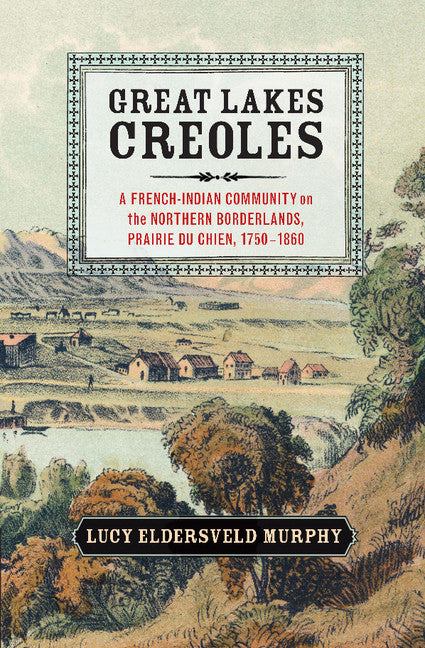
Great Lakes Creoles
A French-Indian Community on the Northern Borderlands, Prairie du Chien, 1750–1860
Great Lakes Creoles examines the ways in which old fur trade families experienced and responded to the colonialism of United States expansion.
Lucy Eldersveld Murphy (Author)
9781107674745, Cambridge University Press
Paperback / softback, published 15 September 2014
326 pages, 25 b/w illus. 6 maps 7 tables
22.8 x 15.2 x 1.8 cm, 0.45 kg
'Lucy Murphy adroitly focuses her lens on the complex tale of Prairie du Chien, Wisconsin, a community peopled by Native Americans, French-Canadian fur traders, British soldiers, and eventually Americans (and even a few African Americans) after the American Revolution … Murphy is very careful to emphasize how important the community's native beginnings were. Twentieth-century Prairie du Chien Creoles remained very conscious of their Native American connections. Murphy concludes that in the end, the town's Creoles assimilated by joining the Anglo culture of politics, education, and religion, while deliberately keeping themselves apart in their own neighborhoods and therein retaining many Native communal traditions. They maintained their position by their impressive adaptability and, by adapting, managed to keep a 'white' status and hold on to land and life, long after 'official' Native American life in the town had been removed.' Margo Lambert, Ohio Valley History
A case study of one of America's many multi-ethnic border communities, Great Lakes Creoles builds upon recent research on gender, race, ethnicity, and politics as it examines the ways that the old fur trade families experienced and responded to the colonialism of United States expansion. Lucy Eldersveld Murphy examines Indian history with attention to the pluralistic nature of American communities and the ways that power, gender, race, and ethnicity were contested and negotiated in them. She explores the role of women as mediators shaping key social, economic, and political systems, as well as the creation of civil political institutions and the ways that men of many backgrounds participated in and influenced them. Ultimately, Great Lakes Creoles takes a careful look at Native people and their complex families as active members of an American community in the Great Lakes region.
Introduction
1. 'The rightful owners of the soil': colonization and land
2. 'To intermeddle in political affairs': new institutions, elections, and lawmaking
3. 'Damned yankee court and jury': more new institutions, keeping order and peace
4. Public mothers: women, networks, and changing gender roles
5. 'A humble type of people': economic adaptations
6. Blanket claims and family clusters: autonomy, land, migration, and persistence
Conclusion
Epilogue.
Subject Areas: Social & cultural history [HBTB], History of the Americas [HBJK], History [HB]