Freshly Printed - allow 7 days lead
Couldn't load pickup availability
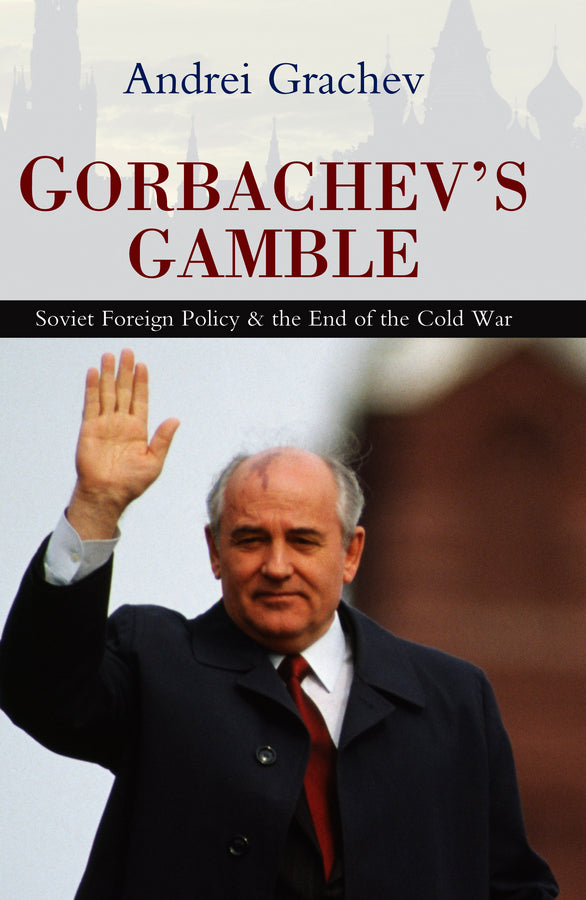
Gorbachev's Gamble
Soviet Foreign Policy and the End of the Cold War
Andrei Grachev (Author)
9780745643465, Polity Press
Paperback / softback, published 18 January 2019
240 pages
22.6 x 15 x 1.8 cm, 0.431 kg
“Written by one of Gorbachev’s closest advisers, this is probably the best account published as yet in any language of what went on within the Soviet government as the Cold War came to an end and the Soviet Union fell apart. No scholar should claim to have a clear view of the events of those years without reading it, but one does not have to be a historian to appreciate Grachev’s clear prose and dispassionate insight. A fine read on a very important subject.”
Jack F. Matlock Jr, United States Ambassador to the Soviet Union, 1987-1991
Gorbachev’s Gamble offers a new and more convincing answer to this question by providing the missing link between the internal and external aspects of Gorbachev’s perestroika. Andrei Grachev shows that the radical transformation of Soviet foreign policy during the Gorbachev years was an integral part of an ambitious project of internal democratic reform and of the historic opening of Soviet society to the outside world.
Grachev explains the motives and the intentions of the initiators of this project and describes their hopes and their illusions. He recounts the story of the internal debates and struggles in the Kremlin and behind-the-scene decisions that led to the Soviet withdrawal from Afghanistan, the fall of the Berlin Wall, the break-up of the Warsaw Pact and eventually the demise of the Soviet Union itself.
The book is based on exclusive interviews with the leaders of the Soviet Union including Gorbachev, personal notes and diaries of their assistants and advisers and transcripts of the discussions inside the Politburo and Secretariat of the Central Committee. Together they constitute a multi-voice political confession of a whole generation of decision-makers of the Soviet Union that enables us better to understand the origin and the breathtaking trajectory of the events that led to the end of the Cold War and the unprecedented transformation of world politics in the closing decades of the 20th century.
The Gorbachev Years: A Chronology vii Preface and Acknowledgements xi Introduction 1 1 Preparing the Change 9 Dual-Track Diplomacy 9 The Military-Diplomatic Complex 17 ‘Moles’ in the Corridors of Power 24 Cracks in the Monolith 34 2 Ambitions and Illusions of the ‘New Political Thinking’ 43 Training for Leadership 43 First Exercises in Foreign Policy 52 Building the New Team 58 Summits in Paris and Geneva 62 A ‘Tail’ of Soviet Diplomacy? 66 ‘New Thinking’ or Ideology Revisited? 70 From Philosophy to Politics 75 Reykjavik – ‘the Failed Summit’? 80 ‘New Political Thinking’: Rules and Tools 86 3 Breaking the Ice 93 Untying the Reykjavik ‘Package’ 93 Withdrawing from Afghanistan and Retiring from the ‘Third World’ 100 ‘Abandoning’ Eastern Europe 114 Destroying the Berlin Wall 131 4 Up to the Peak and Down the Slope 163 Gorbachev’s ‘Anti-Fulton’ Speech at the UN 163 1989 – the Year of ‘the Great Turn’ 169 Malta – a Belated Triumph 176 On the Other Bank of the Rubicon 184 The War in the Gulf and Shevardnadze’s Resignation 191 The G7 in London: The Summit of a Last (Lost) Chance 200 5 The Winds of Change 214 Notes 234 Bibliography 257 Index 261
Subject Areas: Politics & government [JP]