Freshly Printed - allow 10 days lead
Couldn't load pickup availability
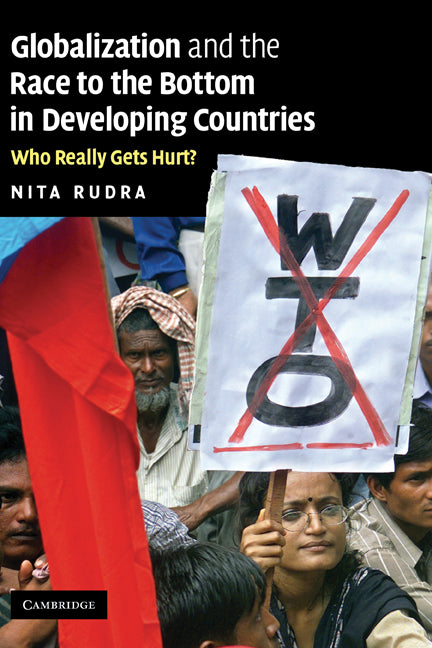
Globalization and the Race to the Bottom in Developing Countries
Who Really Gets Hurt?
Challenges conventional wisdoms surrounding globalisation's effects on developing countries, suggesting that the real losers are the middle classes.
Nita Rudra (Author)
9780521886987, Cambridge University Press
Hardback, published 25 September 2008
316 pages
23.4 x 15.7 x 2.3 cm, 0.62 kg
'This is the best study we have to date of the impact of globalization on social welfare arrangements in developing nations. Rudra deploys statistical analyses and country studies to advance an interesting thesis: yes, there is a race to the bottom, but no, the main losers are the middle classes and not the poor. Rudra is surely correct to stress that the fate of the poor remains largely in the hands of domestic institutions.' Dani Rodrik, Harvard University
The advance of economic globalization has led many academics, policy-makers, and activists to warn that it leads to a 'race to the bottom'. In a world increasingly free of restrictions on trade and capital flows, developing nations that cut public services are risking detrimental effects to the populace. Conventional wisdom suggests that it is the poorer members of these societies who stand to lose the most from these pressures on welfare protections, but this new study argues for a more complex conceptualization of the subject. Nita Rudra demonstrates how and why domestic institutions in developing nations have historically ignored the social needs of the poor; globalization neither takes away nor advances what never existed in the first place. It has been the lower- and upper-middle classes who have benefited the most from welfare systems and, consequently, it is they who are most vulnerable to globalization's race to the bottom.
Preface
1. Introduction
2. The race to the bottom in developing countries
3. Who really gets hurt?
4. LDC welfare states: convergence? What are the implications?
5. Globalization and the protective welfare state: case study of India
6. Globalization and the productive welfare state: case study of South Korea
7. Globalization and the dual welfare state: case study of Brazil
8. Conclusions
Appendices.
Subject Areas: Political economy [KCP], Development economics & emerging economies [KCM], Politics & government [JP]