Freshly Printed - allow 10 days lead
Couldn't load pickup availability
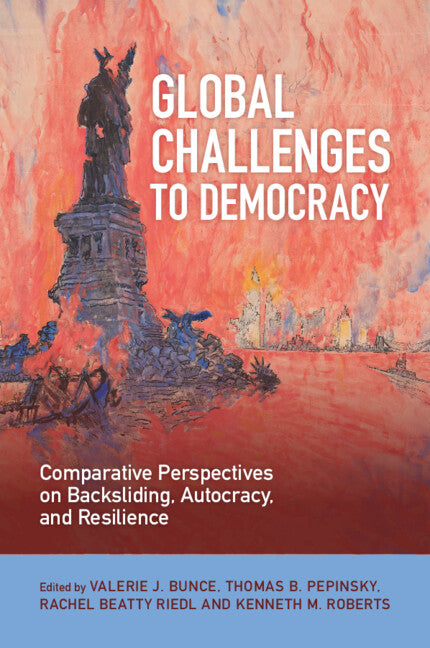
Global Challenges to Democracy
Comparative Perspectives on Backsliding, Autocracy, and Resilience
The first comprehensive, cross-regional comparative study of democratic backsliding and resiliency around the world.
Valerie J. Bunce (Edited by), Thomas B. Pepinsky (Edited by), Rachel Beatty Riedl (Edited by), Kenneth M. Roberts (Edited by)
9781009602563, Cambridge University Press
Paperback / softback, published 15 May 2025
351 pages
22.8 x 15.1 x 1.8 cm, 0.51 kg
'The authors of this book explore the signs of weakness of democracy … they list, among others, the politicization of public employment, the betrayal of promises made by politics to the electorate, the manipulation of electoral laws and related processes. In short, we have deluded ourselves that democracies do not have pockets of totalitarianism within them, without listening to the warning of the young Tocqueville who, already in 1835, in the book he wrote after his trip, noted the possible drifts from democracy towards despotism.' Sabino Cassese, Corriere della Sera
Following democracy's global advance in the late 20th century, recent patterns of democratic erosion or 'backsliding' have generated extensive scholarly debate. Backsliding towards autocracy is often the work of elected leaders operating within democratic institutions, challenging conventional thinking about the logic of democratic consolidation, the enforcement of institutional checks and balances, and the development and reproduction of democratic norms. This volume tackles these challenges head-on, drawing theoretical insights from classic literature on democratic transitions and consolidation to help explain contemporary challenges to democracy. It offers a comparative perspective on the dynamics of democratic backsliding, the changing character of authoritarian threats, and the sources of democratic resiliency around the world. It also integrates the institutional, civil society, and international dimensions of contemporary challenges to democracy, while providing coverage of Western and Eastern Europe, South and Southeast Asia, Africa, Latin America, and the United States.
1. Introduction: global challenges to democracy: backsliding, resiliency, and democratic theory Kenneth M. Roberts, Valerie J. Bunce, Thomas Pepinsky and Rachel Beatty Riedl
Part I. Institutions as Sites of Regime Contestation: 2. Backsliding in India the weakening of referee institutions Milan Vaishnav
3. The (de)democratizing tango: why it's hard to get democracy to stick in Southeast Asia Meredith L. Weiss and Allen Hicken
4. State capacity and accountability in low-income states Jamie Bleck and Nicolas van de Walle
5. Democratic backsliding and the politicization of public employment Bryn Rosenfeld and Frances Cayton
6. Election administration and democratic fragility in the US David A. Bateman, Robert C. Lieberman and Aaron Childree
Part II. Civil Society, Social Media, and Political Messaging: 7. Civil society mobilization against equal citizenship in Latin America Lindsay Mayka
8. Nationalist passion, economic interest, and the moral economy of the Hungarian right, 2002–2010. Béla Greskovits
9. Post-communist democracy, civil society, and the problem of accountability Michael Bernhard
10. Civil society resistance to democratic backsliding Mark R. Beissinger
11. Is democracy broken? Disinformation wants you to think that it is Alexandra Cirone
12. The indispensability of dominance M. Steven Fish
Part III. International Dimensions of the Struggle between Democracy and Autocracy: 13. The security imperative and right nationalist politics in contemporary Europe Mabel Berezin
14. The long shadow of 1968: Christian democracy's struggle for dominance and democratic backsliding in Europe Dorothee Bohle and Aida Hozic
15. Foro Madríd and the transnationalization of the far-right Stefano Palestini and Cristóbal Rovira Kaltwasser
16. Conclusion Valerie Bunce.
Subject Areas: Comparative politics [JPB]