Freshly Printed - allow 7 days lead
Couldn't load pickup availability
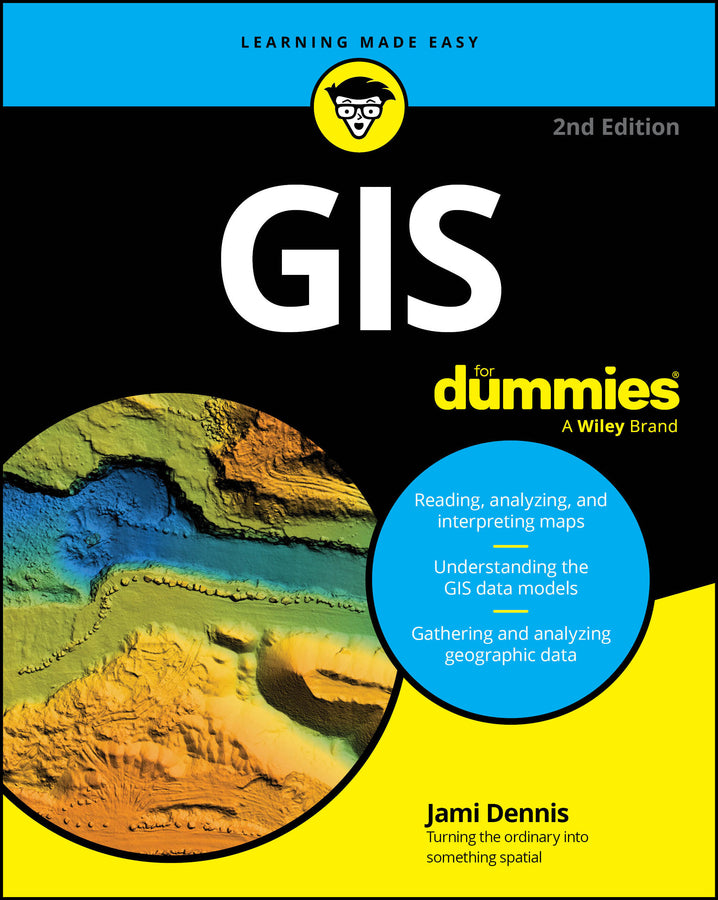
GIS For Dummies
Jami Dennis (Author), Michael N. DeMers (With)
9781394318353, Wiley
Paperback / softback, published 26 May 2025
384 pages
23.1 x 18.5 x 2.8 cm, 0.499 kg
A jargon-free primer on GIS concepts and the essential tech tools Geographic Information Systems (GIS) is the fascinating technology field that's all about understanding and visualizing our world. GIS For Dummies introduces you to the essential skills you'll need if you want to become a geospatial data guru. You'll learn to read, analyze, and interpret maps, and you'll discover how GIS professionals create digital models of landscapes, cities, weather patterns, and beyond. Understand how advances in technology, including AI, are turning GIS tools into powerful assets for solving real-world problems and protecting the planet. This beginner-friendly book makes it easy to grasp necessary GIS concepts so you can apply GIS in your organization, pursue a career in this dynamic field, or just impress others with your geographic knowledge. GIS For Dummies is the perfect starting point for students, professionals, and anyone curious about the potential of GIS as a technology or career choice.
Introduction 1 Part 1: GIS: Geography on Steroids 5 Chapter 1: Understanding GIS 7 Chapter 2: Learning GIS Core Concepts 19 Chapter 3: Reading, Analyzing, and Interpreting Maps 37 Part 2: Geography Goes Digital 55 Chapter 4: Creating a Conceptual Model 57 Chapter 5: Understanding the GIS Data Models 69 Chapter 6: Keeping Track of Attribute Data 85 Chapter 7: Collecting Geographic Data 101 Part 3: Retrieving, Counting, and Characterizing Geography 119 Chapter 8: Exploring the World through Raster Data 121 Chapter 9: Finding Features in Vector Data 133 Chapter 10: Searching for Geographic Objects, Distributions, and Groups 151 Part 4: Analyzing Geographic Patterns 167 Chapter 11: Measuring Distance 169 Chapter 12: Working with Statistical Surfaces 183 Chapter 13: Exploring Topographic Surfaces 199 Chapter 14: Working with Networks 213 Chapter 15: Exploring Map Overlay 233 Chapter 16: Mastering Map Algebra and Cartographic Models 245 Part 5: GIS Output and Application 267 Chapter 17: Generating Output with GIS 269 Chapter 18: Automating GIS 293 Chapter 19: GIS in Organizations and Career Development 303 Part 6: The Part of Tens 317 Chapter 20: Ten GIS Software Options 319 Chapter 21: Ten GIS Data Sources 329 Chapter 22: Ten GIS Trends to Watch 337 Index 345
Subject Areas: Geography [RG]