Freshly Printed - allow 10 days lead
Couldn't load pickup availability
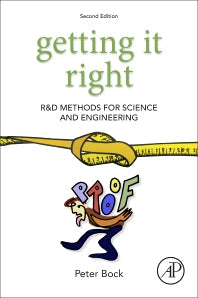
Getting It Right
R&D Methods for Science and Engineering
An authoritative guide to the methodologies that produce coherent, rigorous and comprehensible engineering research projects
Peter Bock (Author)
9780128161654
Paperback, published 26 March 2020
466 pages
23.4 x 19 x 2.9 cm, 0.95 kg
Getting it Right: R&D Methods for Science and Engineering, Second Edition, is an authoritative guide to the methodologies that produce coherent and complete R&D projects. Based on the author’s experience in large industrial firms, this book addresses the avoidance of common pitfalls that engineers and scientists routinely face in industry and academia. Special emphasis is placed on the comprehensive analysis of project problems, requirements, objectives, the use of standard and consistent terminology and procedures, the design of rigorous and reproducible experiments, the appropriate reduction and interpretation of project results, and the effective communication of project design, methods, results, and conclusions, embedded in a clear and modern framework of the Scientific Method. This fully updated new edition also includes an extended case study from industry, additional material about the evolution of knowledge and science and technology and a special focus on the discovery and nurture of technical innovation, both of which reinforce the importance of adherence to the described methodology in both academic and industrial venues. Professional engineers and researchers will find a highly consistent and practical reference for the rigorous conduct and clear communication of complex R&D projects. Students will also find a palatable introduction to the critical concepts of knowing, doing, and Getting it Right.
Part I - Introduction1. Research and Development2. Process and Preparation Part II - Project Organization3. The Project Hierarchy4. The Project Task Part III - Knowledge Representation5. An Epistemological Journey6. Categories and Types of Knowledge7. Roles of Knowledge Propositions8. The Limits of Knowledge Part IV - The Scientific Method 12. Overview13. Analysis14. Hypothesis15. Synthesis16. Validation Appendices Index
Subject Areas: Materials science [TGM]