Freshly Printed - allow 8 days lead
Couldn't load pickup availability
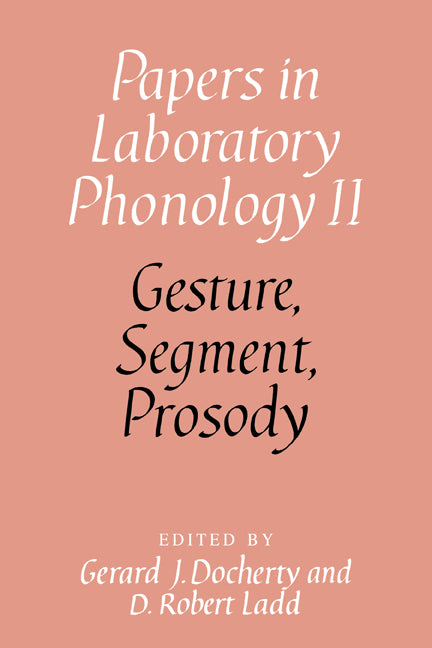
Gesture, Segment, Prosody
This book is a collection of research papers dealing with various aspects of the relationship between phonology and phonetics.
Gerard J. Docherty (Edited by), D. Robert Ladd (Edited by)
9780521137553, Cambridge University Press
Paperback, published 25 February 2010
480 pages
22.9 x 15.2 x 2.7 cm, 0.7 kg
Laboratory Phonology uses speech data to research questions about the abstract categorical structures of phonology. This collection of papers broadly addresses three such questions: what structures underlie the temporal coordination of articulatory gestures? What is the proper role of segments and features in phonological description? And what structures - hierarchical or otherwise - relate morphosyntax to prosody? In order to encourage the interdisciplinary understanding required for progress in this field, each of the three groups of papers is preceded by a tutorial paper (commissioned for this volume) on theories and findings presupposed by some or all of the papers in the group. In addition, most of the papers are followed by commentaries, written by noted researchers in phonetics and phonology, which serve to bring important theoretical and methodological issues into perspective. Most of the material collected here is based on papers presented at the Second Conference on Laboratory Phonology in Edinburgh, 1989. The volume is therefore a sequel to Kingston and Beckman's Papers in Laboratory Phonology I, also published by Cambridge University Press.
Introduction
Part I. Gesture: 1. An introduction to task dynamics Sarah Hawkins
2. 'Targetless' Schwa: an articulatory analysis Catherine P. Browman and Louis Goldstein
3. Prosodic structure and tempo in a sonority model of articulatory dynamics Mary Beckman et al.
4. Lenition of /h/and glottal stop Janet Pierrehumbert and David Talkin
5. On types of coarticulation Nigel Hewlett and Linda Shockey
Part II. Segment: 6. An introduction to feature geometry Michael Broe
7. The segment: primitive or derived? John Ohala
8. Modelling assimilation in non-segmental, rule-free synthesis John Local
9. Lexical processing and phonological representation Aditi Lahiri and William Marslen-Wilson
10. The descriptive role of segments: evidence from assimilation Francis Nolan
11. Psychology and the segment Anne Cutler
12. Trading relations in the perception of stops and their implications for a phonological theory Lieselotte Schiefer
Part III. Prosody: 13. An introduction to intonational phonology D. Robert Ladd
14. Downstep in Dutch: implications for a model Rob Van Den Berg et al.
15. Modelling syntactic effects on downstep in Japanese Haruo Kubozono
16. Secondary stress: evidence from modern Greek Amalia Arvanti.
Subject Areas: Phonetics, phonology [CFH]