Freshly Printed - allow 10 days lead
Couldn't load pickup availability
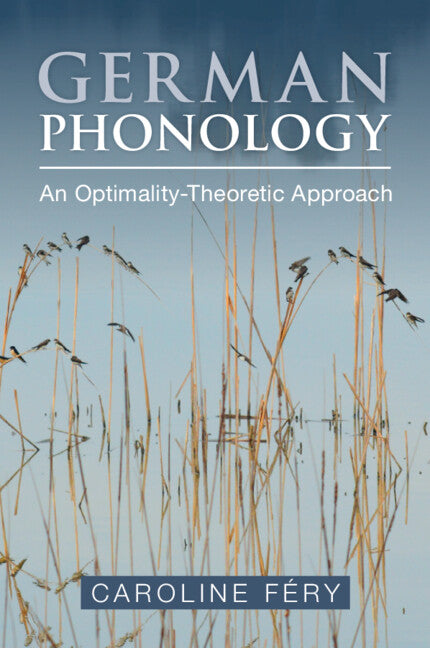
German Phonology
An Optimality-Theoretic Approach
Provides a comprehensive overview of the entire phonology of German in an optimality-theoretic framework, from speech sounds to intonation.
Caroline Féry (Author)
9781009277983, Cambridge University Press
Paperback / softback, published 9 January 2025
480 pages
23 x 15 x 2.5 cm, 0.674 kg
'Through a rigorous (re)analysis of German phonology from top to bottom, this book has succeeded in providing a comprehensive as well as comprehensible overview of German phonology like no other book has ever managed to.' Shinichiro Ishihara, Associate Professor of Japanese, Lund University
Drawing on an optimality-theoretic framework, this book provides a comprehensive overview of the phonology of German, with its idiosyncratic array of sound patterns. It starts with the consonants and vowels and the distinctive features they consist of, moving on to account for allophonic changes in detail, as well as syllables and their weight units. Phonological processes are then explored in depth, with chapter-length explorations of feet, prosodic words, prosodic phrases, and intonation phrases, showing that the prosodic hierarchy provides the domains of most phonological processes. It also includes discussions of the interfaces of morphology and syntax with phonology, as well as prosodic phrasing and intonation. The constraint-based approach allows a new holistic perspective, simultaneously encompassing all aspects of German phonology. Wide-ranging yet accessible, it is essential reading for advanced students of both linguistics and German, as well as individual scholars seeking a one-stop resource on the topic.
Preface
1. Introduction: Background and Optimality Theory
Part I. Lower Prosodic Constituents: Moras, Syllables, Feet
2. The Sounds of German: Phonemes, Allophones, and Distinctive Features
3. Syllables and Moras
4. Segmental Alternations
5. The Foot: Lexical Stress in OT
6. Schwa and Syllabic Sonorants
Part II. The Higher Prosodic Constituents: Prosodic Words, Prosodic Phrases, and Intonation Phrases
7. The Prosodic Word
8. Prosodic Phrasing
9. Intonation Phrase and Tonal Structure
10. Conclusion and Survey of the OT Constraints Used in the Book
References
Index.
Subject Areas: Linguistics [CF]