Freshly Printed - allow 10 days lead
Couldn't load pickup availability
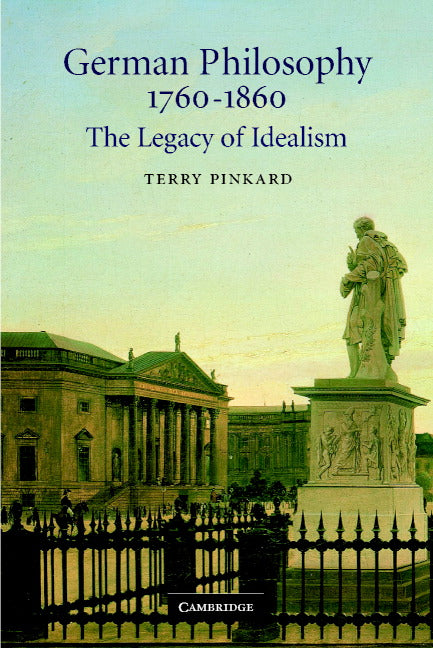
German Philosophy 1760–1860
The Legacy of Idealism
The first comprehensive modern history of the origins and emergence of German philosophy.
Terry Pinkard (Author)
9780521663816, Cambridge University Press
Paperback / softback, published 29 August 2002
394 pages
22.6 x 15 x 1.8 cm, 0.59 kg
"Throughout the study, Pinkard's attention to historical detail is impressive; he presents a portrait of an entire century of German intellectual thought, which, to risk understatement, is no small task." Philosophy Today, Elizabeth MillÂn-Zaibert
In the second half of the eighteenth century, German philosophy came for a while to dominate European philosophy. It changed the way in which not only Europeans, but people all over the world, conceived of themselves and thought about nature, religion, human history, politics, and the structure of the human mind. In this rich and wide-ranging book, Terry Pinkard interweaves the story of 'Germany' - changing during this period from a loose collection of principalities into a newly-emerged nation with a distinctive culture - with an examination of the currents and complexities of its developing philosophical thought. He examines the dominant influence of Kant, with his revolutionary emphasis on 'self-determination', and traces this influence through the development of romanticism and idealism to the critiques of post-Kantian thinkers such as Schopenhauer and Kierkegaard. His book will interest a range of readers in the history of philosophy, cultural history and the history of ideas.
Introduction: 'Germany' and German philosophy
Part I. Kant and the Revolution in Philosophy: 1. The revolution in philosophy I: Human spontaneity and the natural order
2. The revolution in philosophy II: Autonomy and the moral order
3. The revolution in philosophy III: Aesthetic taste, teleology, and the world order
Part II. The Revolution Continued: Post-Kantians: 4. The 1780s: the immediate post-Kantian reaction: Jacobi and Reinhold
5. The 1790s: Fichte
6. The 1790s after Fichte: The romantic appropriation of Kant I: Hölderlin, Novalis, Schleiermacher, Schlegel
7. 1795–1809: The romantic appropriation of Kant II: Schelling
8. 1801–7: The other post-Kantian: Jacob Friedrich Fries and non-romantic sentimentalism
Part III. The Revolution Completed? Hegel: 9. Hegel's Phenomenology of Spirit: post-Kantianism in a new vein
10. Hegel's analysis of mind and world: the Science of Logic
11. Nature and spirit: Hegel's system
Part IV. The Revolution in Question: 12. Schelling's attempt at restoration: idealism under review
13. Kantian paradoxes and modern despair: Schopenhauer and Kierkegaard
Conclusion. The legacy of idealism.