Freshly Printed - allow 10 days lead
Couldn't load pickup availability
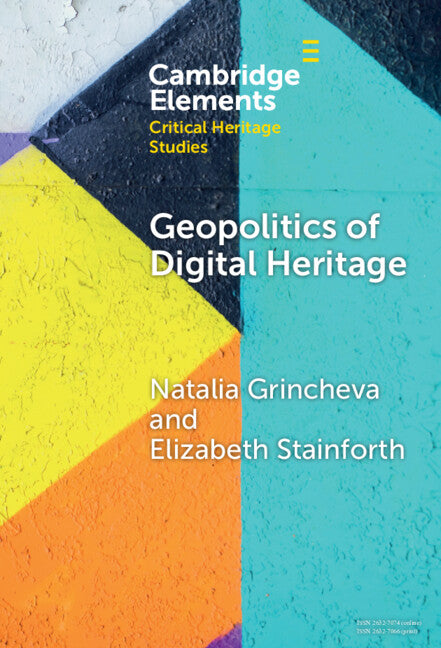
Geopolitics of Digital Heritage
The Element positions digital heritage as a new arena of geopolitical struggle and focuses on strategies of geopolitical space production.
Natalia Grincheva (Author), Elizabeth Stainforth (Author)
9781009500142, Cambridge University Press
Hardback, published 8 February 2024
102 pages
23.5 x 16 x 1.2 cm, 0.295 kg
'The path-breaking Element, Geopolitics of Digital Heritage, opens the conversation on the geopolitical dimension of digital heritage policy and politics. While the role of digitalization of cultural heritages has gained increasing attention, this is the first work to view practices and policies through a geopolitical lens. Digital politics have become a new political arena where information is a major weapon of power and control. The scholars present four case studies with rich research detail and a probing analysis to demonstrate how state and non-state actors are aggregating and curating digital cultural data in pursuit of their geopolitical agendas to shape collective public memories, national images, and cultural consumption. Not all is for the better; the authors raise concerns beyond cultural competition and instrumentalization to dangers of global monopolization, Disneyfication, commodification and digital imperialism.' Rhonda Zaharna, Professor of Global Communications, American University, USA
Geopolitics of Digital Heritage analyzes and discusses the political implications of the largest digital heritage aggregators across different scales of governance, from the city-state governed Singapore Memory Project, to a national aggregator like Australia's Trove, to supranational digital heritage platforms, such as Europeana, to the global heritage aggregator, Google Arts & Culture. These four dedicated case studies provide focused, exploratory sites for critical investigation of digital heritage aggregators from the perspective of their geopolitical motivations and interests, the economic and cultural agendas of involved stakeholders, as well as their foreign policy strategies and objectives. The Element employs an interdisciplinary approach and combines critical heritage studies with the study of digital politics and communications. Drawing from empirical case study analysis, it investigates how political imperatives manifest in the development of digital heritage platforms to serve different actors in a highly saturated global information space, ranging from national governments to transnational corporations.
1. Introduction
2. Crowdsourcing National Identity: Singapore Memory Project
3. Building National Heritage Infrastructure: Trove
4. Constructing Virtual Europe: Europeana
5. Aggregating Global Heritage: Google Arts & Culture
6. Conclusion.
Subject Areas: Archaeology [HD]