Freshly Printed - allow 7 days lead
Couldn't load pickup availability
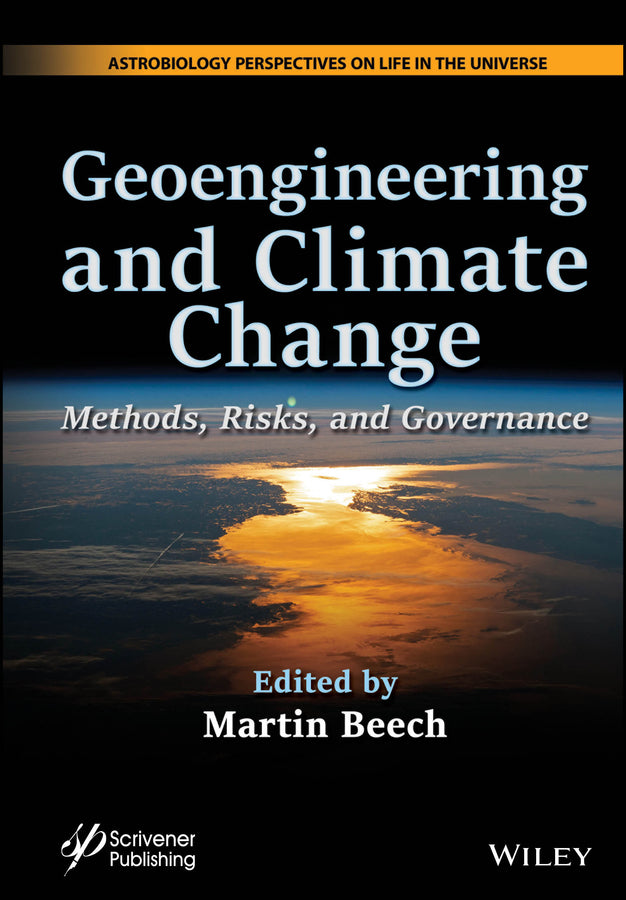
Geoengineering and Climate Change – Methods, Risks, and Governance
Methods, Risks, and Governance
M Beech (Author)
9781394204380, Wiley
Hardback, published 9 January 2025
480 pages
25.4 x 17.8 x 2.6 cm, 1.123 kg
This important and timely book assembles expert scientists from both sides of the debate to discuss Earth-based and space-based climate intervention technologies including the scale, deployment, risk management, and moral philosophy behind these technologies. The role that geoengineering might play, within the context of global warming amelioration, has long been contentious. For all this, geoengineering is about getting down and dirty with respect to the issue of climate intervention. Often dismissed as an option of last resort, geoengineering is now emerging as a key component in humanity’s drive to bring the impacts of global warming under some form of mitigation and control. While geoengineering does not solve the fundamental problem of continued anthropomorphic carbon dioxide emissions, the root cause of global warming, it is an option that can effectively buy humanity some much-needed time. Time, that is, to act positively, and time to introduce meaningful emission reductions, and deploy large-scale sequestration technologies. Indeed, the failure to meaningfully corral greenhouse gas emission levels, and the slow development of large-scale carbon capture technologies, will, by the close of the 21st century, likely see global temperatures increase by at least 2 or 3 degrees above pre-industrial levels. What geoengineering can potentially do for us is to offset the more extreme climate change scenarios that are presently projected to come about. An integrated geoengineering program to cool Earth’s atmosphere, running in parallel with the development of sequestration technologies, and substantial emission reductions, can work to limit the worst effects of climate change that will, without geoengineering, surely come about. Geoengineering is not a neutral or benign action, however, and if it is to be deployed, then much more research, and field testing of ideas and technologies is urgently needed. The authors in this book present a cross-section of philosophies, engineering approaches, and reactions to the idea of geoengineering. Through their words, the reader is introduced to the historical and contemporary debate concerning the potential deployment of geoengineering actions. Indeed, there are many ways in which geoengineering, as a grand worldwide initiative, or as a combined set of independent actions, might proceed in both the near, and the deep future, and here the reader is introduced to these topics by experts in their field. Audience
This book will be of interest to engineers, chemists, geologists, physicists, biologists, environmentalists, meteorologists, philosophers, mathematicians, computer modelers, and policy managers. General readers interested in geoengineering will find the book very readable and scientifically reliable.
Preface xv Acknowledgments xix 1 Prolegomenon: A Geoengineering Primer 1 2 Two Generations of Ethical Debate on Geoengineering 31 3 Risky Business: Complex Risks of Solar Geoengineering 51 4 Climate Justice and the Dangers of Solar Geoengineering 65 5 Solar Geoengineering: An Insoluble Problem? 73 6 Potential Mental Health Risks Associated with Stratospheric Aerosol Injection Methods Using Aluminum Oxide 91 7 What to Consider When Considering Solar Geoengineering 97 8 Moral Hazard of Geoengineering to Decarbonization 117 9 The Preeminent Question of Environmental Philosophy: Where Should We Set the Envirostat? 125 10 Climate Hegemony and Control Over the Global Thermostat 141 11 Designing A Priori Scenarios for Stratospheric Aerosol Injections to Mitigate Climate Change: An Optimal Control Technique Application 151 12 Testing the Limits of the World’s Largest Control Task: Solar Geoengineering as a Deep Reinforcement Learning Problem 171 13 Geochemical Drivers of Enhanced Rock Weathering in Soils 207 14 Geoengineering Cities with Reflective and Pervious Surfaces 231 15 Urban Geoengineering 247 16 Cooling Down the World Oceans and the Earth 265 17 Ice Preservation: A Research Priority for Climate Resilience and Sustainability – Experience in the Field 287 18 Cirrus Cloud Thinning 297 19 Can the COVID-19 Decrease in Aircraft Flights Inform us of Whether the Addition of Efficient INP to Cirrus Altitudes Cools the Climate? 307 20 Biogenic Iron Oxides as a Source of Iron for Ocean Iron Fertilization 331 21 Space Bubbles: The Deflection of Solar Radiation Using Thin-Film Inflatable Bubble Rafts 349 22 Optimal Sunshield Positioning 357 23 Could the Well of an Orbital Lift Be Used to Deposit Greenhouse Gases into Space? 367 24 Ionospheric Perturbations from Satellite Dust 377 25 Geoengineering and Beyond – Planetary Defense, Space Debris, and SETI 387 26 Future Imperative and the Inevitable Technofix 415 Index 445
Martin Beech
Augustine Pamplany
Aaron Tang
Jennie C. Stephens
Patrick Moriarty and Damon Honnery
Giovanni Ghirga
Burgess Langshaw Power
Soheil Shayegh
Mark Walker
John Hickman
Sergei Soldatenko
Eshaan Agrawal and Christian Schroeder de Witt
Xavier Dupla, Susan L. Brantley, Carlos Paulo, Benjamin Möller, Ian M. Power and Stéphanie Grand
Sushobhan Sen
Giles Thomson, Jonathan Fink and Peter Newman
Julian David Hunt, Andreas Nascimento, Fabio A. Diuana, Natália de Assis Brasil Weber, Gabriel Malta Castro, Ana Carolina Chaves, André Luiz Amarante Mesquita, Angéli Viviani Colling and Paulo Smith Schneider
Leslie Field
David L. Mitchell and Ehsan Erfani
Joyce E. Penner, Jialei Zhu and Anne Garnier
David Emerson, Sarabeth George, Amy Doiron and Benjamin S. Twining
Nikita Klimenko, Umberto Fugiglando and Carlo Ratti
Christer Fuglesang
Orfeu Bertolami
Sierra Solter
Martin Beech
Martin Beech
Subject Areas: Jurisprudence & general issues [LA]