Freshly Printed - allow 7 days lead
Couldn't load pickup availability
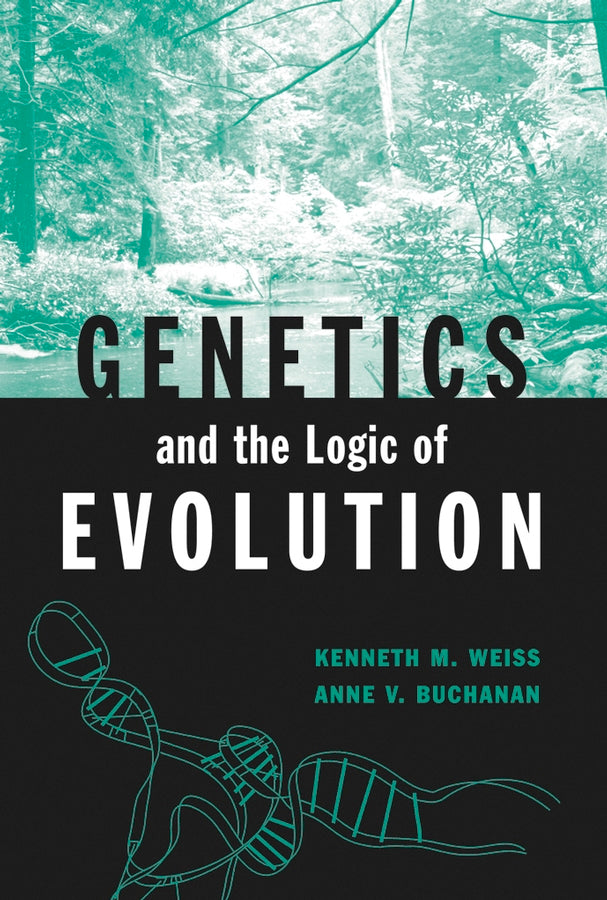
Genetics and the Logic of Evolution
Kenneth M. Weiss (Author), Anne V. Buchanan (Author)
9780471238058, Wiley
Hardback, published 17 February 2004
560 pages, Drawings: 120 B&W, 0 Color; Tables: 12 B&W, 0 Color
28.5 x 15.7 x 3.8 cm, 1.152 kg
"...the book is indeed recommendable..." (The QuarterlyReview of Biology, December 2004)
"for anyone who wishes to know more about genes and evolutionand go beyond the classic, classroom theory--this is the book foryou...[will] take you on a ride you won't regret."(Heredity, February 2005)
"For anyone who wishes to know more about genes andevolution and go beyond the classic, classroom theory - this is foryou..." (Heredity, Vol. 94, 2005)
"This book is well written and would probably be mainly ofinterest to students of evolution who have a more philosophicalperspective or to philosophy students interested inevolution." (American Journal of Human Genetics,September 2004)
"This book is highly suited to students and scientists in arange of fields who want to understand how evolution works throughgenetics." (E-STREAMS, August 2004)
"This book represents a valiant effort in expanding evolutionarythinking in many biological specialties." (Choice, June2004, Vol. 41 No. 10)
In this book the authors draw on what is known, largely from recent research, about the nature of genes and cells, the genetics of development and animal and plant body plans, intra- and interorganismal communication, sensation and perception, to propose that a few basic generalizations, along with the modified application of the classical evolutionary theory, can provide a broader theoretical understanding of genes, evolution, and the diverse and complex nature of living organisms.
Preface.
Acknowledgments.
I. UNDERSTANDING BIOLOGICAL COMPLEXITY: Basic Concepts andPrinciples.
1. Prospect: The Basic Postulates of Life.
2. Conceptual and Analytic Approaches to Evolution.
3. Evolution By Phenotype: How Change Happens in Life.
II. BUILDING BLOCKS OF LIFE: A Genetic Repertoire for EvolvingComplexity.
4. The Storage and Flow of Biological Information.
5. Genotypes and Phenotypes.
6. A Cell is Born.
7. A Repertoire of Basic Genetic Mechanisms.
III. AN INTERNAL AWARENESS OF SELF: Communication withinOrganisms.
8. Making More of Life: The Many Aspects of Reproduction.
9. Scaling Up: How Cells Build an Organism.
10. Communicating Between Cells.
11. Detecting and Destroying Internal Invaders.
IV. EXTERNAL AWARENESS: Information Transfer between Environmentto Organism.
12. Detecting Physical Variability in the Environment.
13. Chemical Signaling and Sensation from the Outside World.
14. Detecting Light.
15. The Development and Structure of Nervous Systems.
16. Perceiving: Integrating Signals from the Environment.
V. FINALE: Evolutionary Order and Disorder between Phenotypesand Genotypes.
17. A Great Chain of Beings.
References.
Index.
Subject Areas: Biology, life sciences [PS]