Freshly Printed - allow 7 days lead
Couldn't load pickup availability
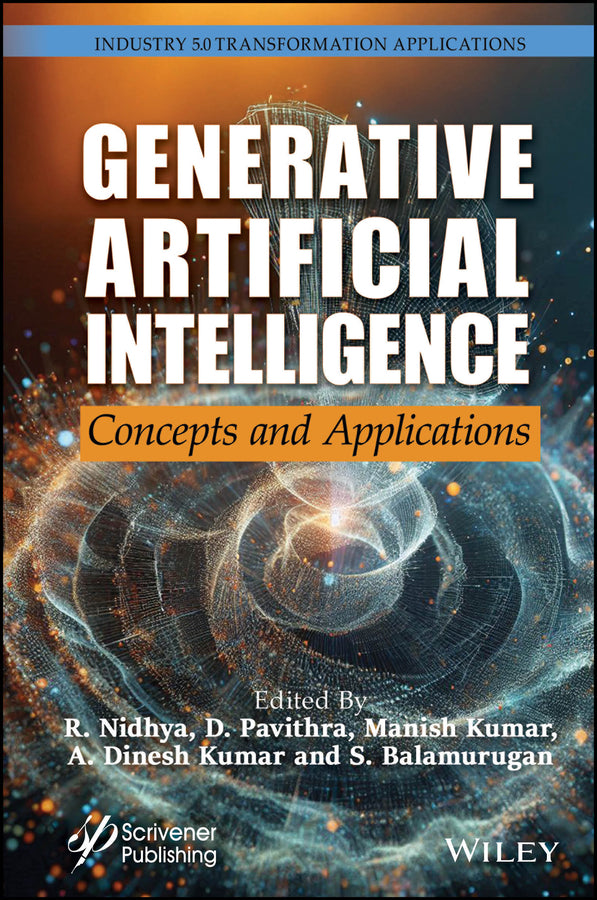
Generative Artificial Intelligence
Concepts and Applications
R. Nidhya (Edited by), D. Pavithra (Edited by), Manish Kumar (Edited by), A. Dinesh Kumar (Edited by), S. Balamurugan (Edited by)
9781394209224, Wiley
Hardback, published 21 May 2025
304 pages
22.9 x 15.2 x 2 cm, 0.68 kg
This book is a comprehensive overview of AI fundamentals and applications to drive creativity, innovation, and industry transformation. Generative AI stands at the forefront of artificial intelligence innovation, redefining the capabilities of machines to create, imagine, and innovate. GAI explores the domain of creative production with new and original content across various forms, including images, text, music, and more. In essence, generative AI stands as evidence of the boundless potential of artificial intelligence, transforming industries, sparking creativity, and challenging conventional paradigms. It represents not just a technological advancement but a catalyst for reimagining how machines and humans collaborate, innovate, and shape the future. The book examines real-world examples of how generative AI is being used in a variety of industries. The first section explores the fundamental concepts and ethical considerations of generative AI. In addition, the section also introduces machine learning algorithms and natural language processing. The second section introduces novel neural network designs and convolutional neural networks, providing dependable and precise methods. The third section explores the latest learning-based methodologies to help researchers and farmers choose optimal algorithms for specific crop and hardware needs. Furthermore, this section evaluates significant advancements in revolutionizing online content analysis, offering real-time insights into content creation for more interactive processes. Audience
The book will be read by researchers, engineers, and students working in artificial intelligence, computer science, and electronics and communication engineering as well as industry application areas.
Preface xiii 1 Exploring the Creative Frontiers: Generative AI Unveiled 1 1.1 Introduction 1 1.1.1 Definition and Significance of Generative AI 1 1.1.2 Historical Overview and Development 2 1.2 Foundational Concepts 4 1.2.1 Neural Networks and Generative Models 4 1.2.2 Variational Autoencoders (VAEs) and Generative Adversarial Networks (GANs) 5 1.3 Applications Across Domains 7 1.3.1 Creative Arts: Music, Visual Arts, Literature 7 1.3.2 Content Generation: Text, Images, Videos 8 1.3.3 Scientific Research and Data Augmentation 9 1.3.4 Healthcare and Drug Discovery 10 1.3.5 Gaming and Virtual Environments 12 1.4 Ethical Considerations 13 1.5 Future Prospects and Challenges 15 1.6 Conclusion 16 Reference 17 2 An Efficient Infant Cry Detection System Using Machine Learning and Neuro Computing Algorithms 19 2.1 Introduction 20 2.2 Literature Survey 21 2.3 Methodology 23 2.3.1 Database 24 2.3.2 Feature Extraction 25 2.3.2.1 Short-Term Energy 25 2.3.2.2 Mel-Frequency Cepstral Coefficients 26 2.3.2.3 Spectrograms 27 2.3.3 Classification 29 2.3.4 Convolutional Neural Network (CNN) 29 2.3.5 Recurrent Neural Network (RNN) 31 2.3.6 Regularized Discriminant Analysis (RDA) 31 2.3.7 Multi-Layer Perceptron (MLP) 33 2.4 Experimental Results 33 2.5 Conclusion 35 References 35 3 Improved Brain Tumor Segmentation Utilizing a Layered CNN Model 39 3.1 Introduction 40 3.2 Related Works 41 3.3 Methodology 42 3.4 Numerical Results 45 3.5 Conclusion 49 References 49 4 Natural Language Processing in Generative Adversarial Network 53 4.1 Introduction 54 4.2 Literature Survey 57 4.3 The Implementation of NLP in GAN for Generating Images and Summaries 61 4.3.1 Working of Sequence Generative Adversarial Network (SeqGAN) 61 4.3.2 Working of Generative Adversarial Transformer (GAT) 63 4.3.2.1 Steps to Incorporate NLP in GAN 64 4.3.3 Implementation of NLP in GAN 65 4.3.4 Generate the Image Using Textual Description 68 4.3.5 Text Summarization 69 4.3.5.1 Graph-Based Summarization 71 4.4 Conclusion 77 References 77 5 Modeling A Deep Learning Network Model for Medical Image Panoptic Segmentation 81 5.1 Introduction 81 5.2 Related Works 84 5.3 Methodology 85 5.3.1 Deep Masking Convolutional Model (DMCM) 85 5.4 Numerical Results and Discussion 87 5.5 Conclusion 91 References 91 6 A Hybrid DenseNet Model for Dental Image Segmentation Using Modern Learning Approaches 93 6.1 Introduction 94 6.2 Related Works 95 6.3 Methodology 96 6.3.1 Dataset 96 6.3.2 Dense Transformer Model 97 6.3.3 DenseNet Model 100 6.4 Numerical Results and Discussion 100 6.4.1 Discussion 103 6.5 Conclusion 104 References 104 7 Modeling A Two-Tier Network Model for Unconstraint Video Analysis Using Deep Learning 107 7.1 Introduction 108 7.2 Related Works 109 7.3 Methodology 110 7.4 Numerical Results and Discussion 113 7.5 Conclusion 117 References 118 8 Detection of Peripheral Blood Smear Malarial Parasitic Microscopic Images Utilizing Convolutional Neural Network 121 8.1 Introduction 122 8.2 Malaria 124 8.2.1 Malaria-Infected Red Blood Cells with Types 124 8.3 Literature Survey 125 8.4 Proposed Methodology and Algorithm 130 8.4.1 Proposed Algorithm 135 8.5 Result Analysis 135 8.5.1 Dataset 135 8.5.2 Preprocessing of Data 135 8.5.3 Splitting of Dataset 137 8.5.4 Classification 137 8.5.5 Model Prediction and Performance Metrics 137 8.5.6 CNN Learning Curves 138 8.6 Discussion 139 8.7 Conclusion 139 8.8 Future Scope 139 References 140 9 Exploring the Efficacy of Generative AI in Constructing Dynamic Predictive Models for Cybersecurity Threats: A Research Perspective 143 9.1 Introduction 144 9.2 Related Works 145 9.3 Methodology 146 9.3.1 Pre-Processing 147 9.3.2 Classifier 147 9.3.3 Optimization 148 9.4 Numerical Results and Discussion 149 9.5 Conclusion 152 References 152 10 Poultry Disease Detection: A Comparative Analysis of CNN, SVM, and YOLO v3 Algorithms for Accurate Diagnosis 155 10.1 Introduction 156 10.2 Literature Review 157 10.3 Objectives 158 10.3.1 Accurate Disease and Early Disease Identification 158 10.3.2 Multi-Class Disease Identification 158 10.3.3 Automation and Real-Time Disease Monitoring 159 10.3.4 Better Accuracy 159 10.4 Methodology 159 10.4.1 Dataset 159 10.4.2 Data Preprocessing 160 10.4.3 Image Preprocessing 161 10.4.4 Data Augmentation 161 10.4.5 Extracting Region of Interest 162 10.5 Results and Discussion 165 10.6 Conclusion 169 References 170 11 Generative AI-Enhanced Deep Learning Model for Crop Type Analysis Based on Clustered Feature Vectors and Remote Sensing Imagery 173 11.1 Introduction 174 11.2 Related Works 176 11.3 Methodology 178 11.3.1 Saliency Analysis 180 11.3.2 Saliency Region Analysis with Belief Networking 181 11.3.3 Group Analysis 182 11.3.4 Classification 183 11.3.5 Parameter Setup 183 11.4 Numerical Results and Discussion 184 11.4.1 Dataset 186 11.4.2 Classification Results and Discussions 187 11.5 Conclusion 190 References 193 12 Cardiovascular Disease Prediction with Machine Learning: An Ensemble-Based Regressive Neighborhood Model 197 12.1 Introduction 197 12.2 Related Works 200 12.3 Methodology 200 12.3.1 Pre-Processing 200 12.3.2 Feature Selection 202 12.3.3 Classification 202 12.4 Numerical Results and Discussion 203 12.5 Conclusion 206 References 207 13 Detection of IoT Attacks Using Hybrid RNN-DBN Model 209 13.1 Introduction 210 13.2 Related Work 212 13.3 Methodology 216 13.3.1 Dataset Used 216 13.3.2 Data Preprocessing 217 13.3.3 Data Normalization 217 13.3.4 Multi-Class Classification 218 13.3.5 Splitting Dataset 219 13.3.6 RNN-DBN 219 13.4 Experiments and Results 221 13.5 Conclusion and Future Scope 224 References 224 14 Identification of Foliar Pathologies in Apple Foliage Utilizing Advanced Deep Learning Techniques 227 14.1 Introduction 228 14.2 Literature Survey 229 14.2.1 Disease Detection Using Machine and Deep Learning Techniques (2015–2021) 229 14.2.2 Disease Detection Using Transfer Learning (2015–2021) 232 14.3 Different Diseases of Leaves 233 14.4 Dataset 236 14.5 Proposed Methodology 239 14.6 Data Analysis 240 14.7 Pre-Processing Technique 241 14.8 Data Visualization 242 14.9 Evolutionary Progression and Genesis of Model 242 14.9.1 Evolution Model 243 14.9.2 Model Performance 244 References 246 15 Enhancing Cloud Security Through AI-Driven Intrusion Detection Utilizing Deep Learning Methods and Autoencoder Technology 249 15.1 Introduction 250 15.2 Related Work 251 15.3 Proposed Methodology 253 15.3.1 DL-Based IDS for Cloud Security 253 15.4 Results and Discussion 254 15.4.1 Performance Analysis 258 15.4.1.1 Accuracy 259 15.4.1.2 Precision 260 15.4.1.3 Recall 260 15.4.1.4 F1 Score 261 15.4.1.5 AUC-Area Under the Curve 261 15.5 Conclusion 262 References 262 16 YouTube Comment Analysis Using LSTM Model 265 16.1 Introduction 266 16.2 Related Work 266 16.3 Literature Survey 267 16.4 Existing System 272 16.5 Methodology 273 16.6 Result and Discussion 275 16.7 Conclusion 280 References 280 Index 283
Generated Using ChatGPT
Swarna Kuchibhotla, Kantheti Mohana, Alapati Yomitha, Sruthi Yedavalli, Hima Deepthi Vankayalapati and Kyamakya Kyandoghere
Bilal Hikmat Rasheed and P. Sudhakaran
P. Dhivya, A. Karthikeyan, S. Pradeep and H. Umamaheswari
Jyothsna Devi Koppagiri and Gouranga Mandal
Pulipati Nagaraju and S. V. Sudha
P. Naga Bhushanam and Selva Kumar S.
Tamal Kumar Kundu, Smritilekha Das and R. Nidhya
T. Manasa and K. Padmanaban
Spoorthi Shetty and Mangala Shetty
B. Bazeer Ahamed, D. Yuvaraj and Saif Saad Alnuaimi
Yuvaraj Duraisamy, Salar Faisal Noori and Shakir Mahoomed Abas
Pavithra D., Bharathraj R., Poovizhi P., Libitharan K. and Nivetha V.
Tamal Kumar Kundu, Smritilekha Das and R. Nidhya
P.V. Sivarambabu, Richa Agrawal, Arepalli Tirumala, Shaik Mahaboob Subani, Veeraswamy Parisae and S. V. L. Sowjanya Nukala
Pavithra D., Poovizhi P., Rokeshkumar G., Bharathvaj T. and Mageshkumar M.
Subject Areas: Computer science [UY]