Freshly Printed - allow 7 days lead
Couldn't load pickup availability
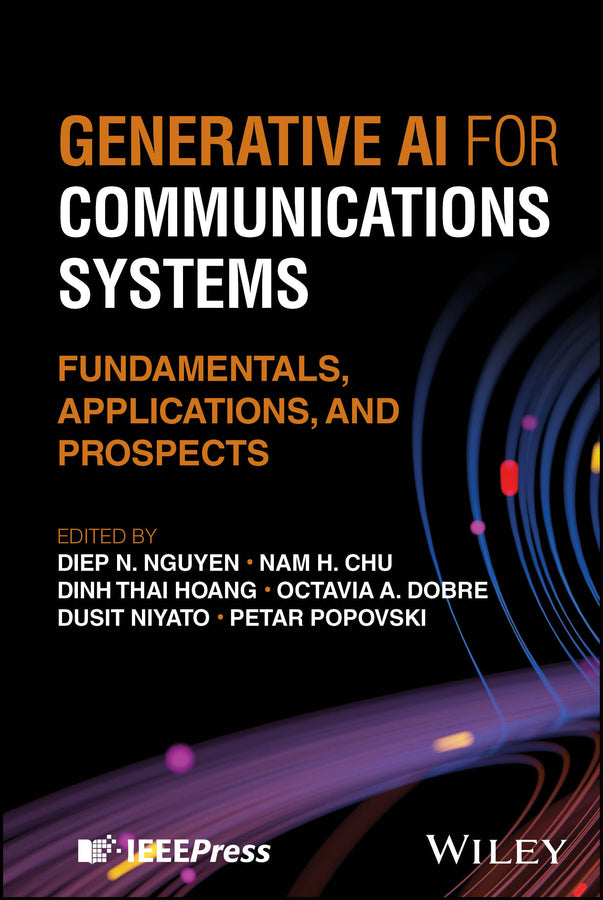
Generative AI for Communications Systems
Fundamentals, Applications, and Prospects
Diep N. Nguyen (Edited by), Dinh Thai Hoang (Edited by), Octavia A. Dobre (Edited by), Dusit Niyato (Edited by), Petar Popovski (Edited by), Nam H. Chu (Edited by)
9781394293902, Wiley
Hardback, published 12 January 2026
368 pages
28 x 19 x 2.6 cm, 0.737 kg
Comprehensive review of state-of-the-art research and development in Generative AI for future communications and networking Generative AI for Communications Systems provides a systematic foundation of knowledge on Generative AI for communications and networking. This book discusses the great potential and challenges in applying Generative AI as promising solutions to future communications systems and enables and facilitates “Generative AI as a Service” by exploring novel communications, networking architectures, protocols, and research trends. The book also includes information on: Generative AI for Communications Systems is an excellent up-to-date resource on the subject for scholars and researchers in the fields of communications, artificial intelligence, machine learning, and network optimization as well as professionals working in the communications industry including engineers, network architects, and system designers.
List of Contributors xiii Preface xxiii Acronyms xxix 1 Future AI-empowered Communications Systems 1 1.1 Fundamental Background of Future Communications Systems 1 1.1.1 Overview of Future Communications Systems 1 1.1.2 Key Challenges and Research Trends 7 1.2 AI-powered Communication Enablers 10 1.2.1 Deep Learning-based Approaches 10 1.2.2 Reinforcement Learning-based Approaches 17 1.2.3 Federated/Distributed Learning-based Approaches 24 1.2.4 Existing Challenges 28 1.2.5 Potential of Generative AI 28 1.3 Conclusion 30 References 30 2 Generative AI Background and Its Potentials for Future Communications Systems 39 2.1 Introduction 39 2.2 A Taxonomy of Generative Models 40 2.2.1 Explicit Density Models 41 2.2.2 Implicit Density Models 41 2.2.3 Ways GenAI Complements Discriminative AI 42 2.3 Prominent Generative Models 42 2.3.1 Generative Adversarial Networks 42 2.3.2 Variational Autoencoders 44 2.3.3 Flow-based Generative Models 47 2.3.4 Diffusion-based Generative Models 49 2.3.5 The Trilemma of GMs 51 2.3.6 Generative Autoregressive Models 52 2.3.7 Generative Transformers and LLMs 54 2.3.8 Strategies to Address LLM Limitations 59 2.4 GenAI Applications to Canonical Problems in Communications Systems 63 2.4.1 Physical Layer Design 63 2.4.2 Network Resource Management 64 2.4.3 Network Traffic Analytics 65 2.4.4 Cross-layer Network Security 65 2.4.5 Localization and Positioning 66 2.5 Future Communication Frontiers for GMs 66 2.5.1 Semantic Communications 66 2.5.2 Integrated Sensing and Communications 67 2.5.3 Digital Twins 68 2.5.4 AI-generated Content for 6G Networks 69 2.5.5 MEC and EAI 69 2.5.6 Adversarial Machine Learning and Trustworthy AI 70 2.6 Regulation and Policy 71 2.7 Summary 71 References 72 3 Key Study Cases of Generative AI Applications to Communications Systems 79 3.1 Overview on the Roles of Generative AI in Communication Systems 79 3.1.1 Use Cases of Generative Adversarial Networks in Communications 79 3.1.2 Use cases of VAEs in Communications 81 3.1.3 Use-cases of Diffusion Models in Communications 82 3.2 Case Study: Diffusion Models in Wireless Communications 83 3.2.1 Working Mechanism of Diffusion Models 83 3.2.2 Case Study: Diffusion Models Applications for Data Reconstruction Enhancement in Communication Systems 89 3.3 Future Implications and Potential Impacts on Communication Systems 98 3.4 Chapter Summary 99 References 99 4 Generative AI at PHY Layer: Native AI or Trainable Radios 105 4.1 Wireless Communications Empowered with Generative Models 105 4.1.1 Motivations of GenAI at the PHY 105 4.1.2 Applications of GenAI at the PHY 106 4.2 Channel Modeling 110 4.2.1 Generative Channel Modeling 111 4.2.2 Site-specific Generative Models 115 4.3 Generative Channel Estimation 116 4.3.1 Narrowband Channel Estimation with Reduced Pilots 120 4.3.2 Wideband Channel Estimation with Reduced Pilots 122 4.4 Channel Compression 123 4.5 Beamforming 125 4.6 Summary 129 References 129 5 Generative AI at the MAC Layer 133 5.1 Introduction 133 5.2 Generative Models 137 5.2.1 Variational Autoencoders 139 5.2.2 Generative Adversarial Networks 140 5.2.3 Diffusion Models 141 5.3 Spectrum Awareness Applications 142 5.3.1 Data Augmentation and Synthetic Data Generation 143 5.3.2 Signal Classification Applications – UAV Classification 147 5.3.3 Anomaly Detection in RF Spectrum 148 5.4 RF Spectrum Security Applications 149 5.4.1 Emitter Identification 149 5.4.2 Wireless Spoofing 151 5.4.3 Enhanced Jamming Attacks 152 5.5 Scheduling Applications 153 5.5.1 Traffic Prediction and Pattern Generation 153 5.5.2 Adaptive Scheduling Algorithms 154 5.5.3 Interference Patterns 154 5.5.4 Fairness and QoS 154 5.5.5 Millimeter-wave Networks 155 5.6 Open Problems and Future Research Directions 155 5.6.1 Reconfigurable Intelligent Surface (RIS)-assisted Networks 156 5.6.2 Spectrum Sharing in the Presence of Interference 157 5.6.3 Integrated Sensing and Communications (ISAC) 159 5.6.4 Link Scheduling in Large Networks 160 5.6.5 Enhancing Wireless MAC-layer Security 160 5.7 Concluding Remarks 162 References 162 6 Generative AI at Network Layer 169 6.1 Introduction 169 6.2 Network Layer in Mobile Networks 172 6.2.1 Radio Access Network 172 6.2.2 Core Network 175 6.3 Generative AI in the Network Layer 177 6.3.1 Introduction 177 6.3.2 Advantages of GenAI Models 177 6.3.3 Short-term Applications (GenAI for Network Layer) 180 6.3.4 Long-term Applications (Network Layer for GenAI) 184 6.4 Challenges and Opportunities for GenAI in the Network Layer 185 6.4.1 Challenges 185 6.4.2 Research Opportunities 186 6.5 Summary 187 References 187 7 Generative AI at Application Layer: Mobile AI-generated Content 191 7.1 Introduction to AIGC 191 7.1.1 General Overview 191 7.1.2 AIGC in the Application Layer 192 7.1.3 AIGC Product Lifecycle 194 7.2 Collaborative Network Infrastructure for Enabling GenAI Services 196 7.2.1 Enabling AIGC – Challenges 196 7.2.2 Infrastructure Components and Capabilities 198 7.2.3 Collaborative Edge-cloud Infrastructure 201 7.3 Network Resource Efficient GenAI Methods 203 7.3.1 Model Optimization Techniques 203 7.3.2 Service Optimization Methods 206 7.4 Security and Privacy at Application Layer 208 7.4.1 Security Threat Models and Privacy Risks 209 7.4.2 Ethical Considerations in AIGC services 211 7.4.3 Enabling Secure AIGC-as-a-Service 212 7.5 Use Cases of Mobile AIGC 213 7.5.1 AI-generated Content in Social Media 213 7.5.2 Immersive Streaming (AR/VR) 215 7.5.3 Personalized AI Services 219 7.6 Conclusion and Research Directions 222 7.7 Summary 223 References 224 8 Applications of GenAI on Wireless and Cybersecurity 239 8.1 Introduction to GenAI in Wireless and Cybersecurity 239 8.2 Adversarial Machine Learning in Wireless Communications 242 8.2.1 Different Types of Attacks Against GenAI-driven Wireless Applications 243 8.2.2 Defense Against Adversarial Attacks for GenAI-driven Wireless Applications 245 8.3 GenAI for Wireless Security and Cybersecurity 245 8.3.1 GenAI for Wireless Security 245 8.3.2 GenAI for Cybersecurity 248 8.3.3 GenAI-driven Attacks Against Wireless and Cybersecurity Applications 249 8.4 Ethical Issues Related to GenAI for Wireless Communications and Cybersecurity 251 8.5 Summary 252 References 253 9 Challenges and Opportunities for Generative AI in Wireless Communications and Networking 261 9.1 Introduction 261 9.2 Challenges of Applying Generative AI in Wireless Communications 262 9.2.1 Efficiency and Robustness 263 9.2.2 Cost and Complexity 267 9.2.3 Standardization, Regulation, and Policy 269 9.3 Adopting Generative AI in NextG Communications: Case Studies 270 9.3.1 Integration of Generative AI and Physical Communications Models 270 9.3.2 Trustworthy Generative AI for Distributed Wireless Communications 277 9.4 Summary 281 References 281 10 Future Research Directions 285 10.1 Introduction 285 10.2 Emerging Foundational Research Frontiers 286 10.2.1 Dedicated GenAI Models for Communication Systems 287 10.2.2 Fusion of GenAI and Emerging Technologies 288 10.3 Enhancing Generative AI Models for Wireless Communication Systems 290 10.3.1 Model Optimization and Generalization 290 10.3.2 Energy Efficiency 291 10.3.3 Generative AI for Spectrum Management 292 10.3.4 AI-driven Network Management and Orchestration 293 10.3.5 Security and Privacy Concerns 295 10.4 Practical Case Studies 296 10.4.1 AI-powered Network Optimization by T-Mobile 296 10.4.2 DeepSig’s Generative AI for Wireless Communications 297 10.5 Conclusion 297 References 298 Index 305
Nguyen Van Huynh, Thien Huynh-The, and Quoc-Viet Pham
Asmaa Abdallah, Abdulkadir Celik, and Ahmed M. Eltawil
Mehdi Letafati, Samad Ali, and Matti Latva-aho
Eren Balevi
Kemal Davaslioglu, Ender Ayanoglu, and Yalin E. Sagduyu
Athanasios Karapantelakis, Pegah Alizadeh, Abdulrahman Alabbasi, Kaushik Dey, and Alexandros Nikou
Paria Mohammadzadeh Hesar, Amirhossein Mohammadi, and Hina Tabassum
Brian Kim, Yalin E. Sagduyu, Tugba Erpek, Yi Shi, and Sennur Ulukus
Songyang Zhang and Zhi Ding
Nam H. Chu, Diep N. Nguyen, Dinh Thai Hoang, Octavia A. Dobre, Dusit Niyato, and Petar Popovski
Subject Areas: Electronics & communications engineering [TJ]