Special Order - allow 2+ weeks lead
Couldn't load pickup availability
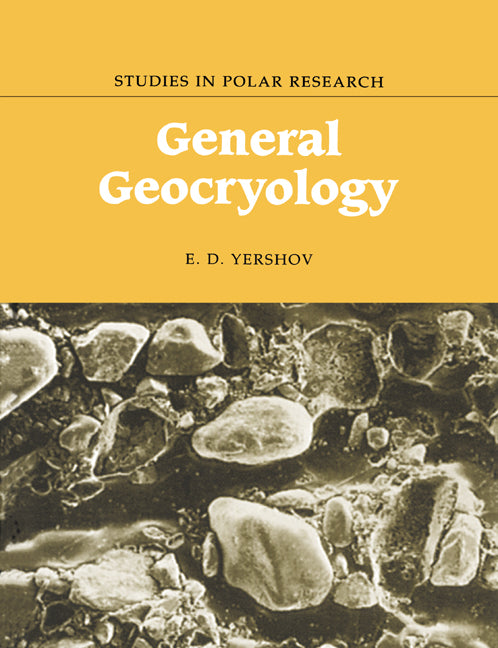
General Geocryology
A wide-ranging and up-to-date review of permafrost science, unique in presenting the Russian viewpoint.
E. D. Yershov (Author), Peter J. Williams (Edited by)
9780521607575, Cambridge University Press
Paperback / softback, published 19 August 2004
608 pages, 183 b/w illus. 17 tables
24.6 x 19 x 3 cm, 1.105 kg
'General Geocryology deserves praise from periglacial scientists and engineers because it makes an unique and authoritative contribution in the English language to our understanding of frozen-ground phenomena.' Julian Murton, Quaternary Science Reviews
In the cold regions, freezing of the ground presents major geotechnical and environmental challenges. In Russia, oil and gas gives these regions special economic and geopolitical significance. After glasnost, it became evident that research there was more comprehensive but the problems far greater than elsewhere. This translation of a wide-ranging account of the effects of freezing and their importance for geotechnical undertakings, has been prepared by an international team of specialists. It makes available a uniquely readable and technically accurate review, especially valuable to international organisations and those involved in joint ventures. The English edition of the 16-sheet geocryological map of Russian has been prepared by the same international team. For more details please see: www.freezingground.org/map or contact Scott Polar Research Institute, (Attn. Prof. P. J. Williams), Lensfield Rd., Cambridge, CB2 1ER, UK. - or e-mail: pjw1005@cus.cam.ac.uk.
Introduction
Part I. Processes in Freezing, Frozen and Thawing Ground: 1. Thermal-physical processes in freezing and thawing ground
2. Water transfer and ice formation in soils
3. Physical-chemical and mechanical processes in freezing and thawing ground
4. Structure and texture of freezing and thawing soils
5. Cryogenic geological processes and phenomena
Part II. Composition, Cryogenic Structure and Properties of Frozen Rocks: 6. Formation of sedimentary materials in the permafrost regions (cryolithogenesis)
7. Composition and structure of frozen earth materials
8. Properties of frozen soils
9. Characteristics of the basic genetic types of frozen ground
Part III. Formation and Development of the Frozen Strata and Layers of Seasonal Freezing and Thawing: 10. Thermodynamic and climatic conditions for formation of the frozen layers
11. Seasonal freezing and thawing of ground
12. Development of the temperature regime and the thickness of the permafrost
13. Taliks and groundwater in the permafrost zone
Part IV. Regional Features and Evolution of Permafrost: 14. Permafrost evolution in the Earth's history
15. Zonal and regional features of present-day geocryological conditions in the territories of the former USSR
16. Principles and methods for regional geocryological investigations
Part V. Economic Development of the Permafrost Regions: 17. The effect of different types of development on the natural geocryological environment
18. Ensuring the stability of engineering structures in the permafrost regions
19. Engineering geology in support of design, construction and operation of structures in the permafrost regions
Index.
Subject Areas: Geological surface processes [geomorphology RBGD]