Freshly Printed - allow 10 days lead
Couldn't load pickup availability
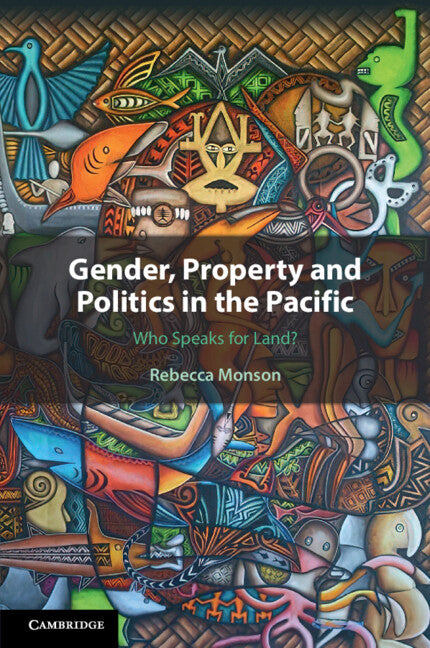
Gender, Property and Politics in the Pacific
Who Speaks for Land?
Outlines how land disputes are entangled with gender, ethnicity and territoriality, shaping public authority and state formation.
Rebecca Monson (Author)
9781108948876, Cambridge University Press
Paperback / softback, published 3 July 2025
296 pages
22.9 x 15.2 x 1.6 cm, 0.431 kg
'… Monson's book contributes to the body of feminist political ecology … [her] highly original interdisciplinary sociolegal research is characterized by impressive scholarly rigor and a policy relevance far beyond her regional focus on the Pacific.' Rachel Sieder, Legal Pluralism and Critical Social Analysis
Legal scholars, economists, and international development practitioners often assume that the state is capable of 'securing' rights to land and addressing gender inequality in land tenure. In this innovative study of land tenure in Solomon Islands, Rebecca Monson challenges these assumptions. Monson demonstrates that territorial disputes have given rise to a legal system characterised by state law, custom, and Christianity, and that the legal construction and regulation of property has, in fact, deepened gender inequalities and other forms of social difference. These processes have concentrated formal land control in the hands of a small number of men leaders, and reproduced the state as a hypermasculine domain, with significant implications for public authority, political participation, and state formation. Drawing insights from legal scholarship and political ecology in particular, this book offers a significant study of gender and legal pluralism in the Pacific, illuminating ongoing global debates about gender inequality, land tenure, ethnoterritorial struggles and the post colonial state.
1. Grounding debates about land: gender inequality, property and the state
2. Navigating custom, church and state: property, territory and authority in the protectorate era
3. Chiefs, Priests and Vuluvulu: selective recognition and the simplification of authority in Marovo Lagoon
4. From Taovia to Trustee: land disputes, insecurity and authority in Kakabona
5. 'Land is our mother': ethno-territorial conflict and state formation
6. Women speak for land: disrupting and re-forming property and authority.
Subject Areas: Property law [LNS], Human rights & civil liberties law [LNDC], Laws of Specific jurisdictions [LN], International human rights law [LBBR], Gender & the law [LAQG], Law [L], Human rights [JPVH], Political science & theory [JPA], Sociology & anthropology [JH]