Freshly Printed - allow 7 days lead
Couldn't load pickup availability
Fundamentals of Small Animal Surgery
Fred Anthony Mann (Edited by), Gheorghe M. Constantinescu (Edited by), Hun-Young Yoon (Edited by)
9780781761185, Wiley
Paperback / softback, published 11 January 2011
448 pages
24.4 x 18.8 x 2.5 cm, 0.907 kg
Clinical Pathology for the Veterinary Team will help experienced veterinary technicians set up various clinical laboratory diagnostic tests. It provides a good explanation of basic laboratory practices, the underlying concepts of many laboratory tests, and the physiology of common disease conditions. This book is well worth the price. (Journal of the American Veterinary Medical Association, December 2010) This book provides a good overall summary of basic clinical pathology in small animals. Although it is fairly short and concise, it contains all the necessary relevant information and includes a CD that takes readers thorough six complicated cases, step by step. This is a useful book that would be a handy reference to have in a practice. It is easy to read, concise, and informative. Although it is aimed at small animal veterinary teams, it includes limited information about large animal species, which is important for a good, general understanding. (Doodys, December 2010) Clinical Pathology for the Veterinary Team offers a fine recourse for technical team members involved in clinical diagnostic evaluation. Machinery calibration, normal anatomy, clinical diagnostics and more are revealed in chapters that provide key technical information for Obtaining and evaluating samples, surveying the disease process, the progress of identification and treatment, and including a DVD with interactive cases. Vet collections need this! (THE MIDWEST BOOK REVIEW, November 2010) Rosenfeld, a veterinarian who is associated with an education corporation that specializes in seminar training for the hospital team, and Dial (veterinary science and microbiology, U. of Arizona) provide a resource for technical veterinary team members performing clinical diagnostic evaluation in small animal lab work. (Book News, September 2010) ReviewUpdater-Profile_15@1326747466641
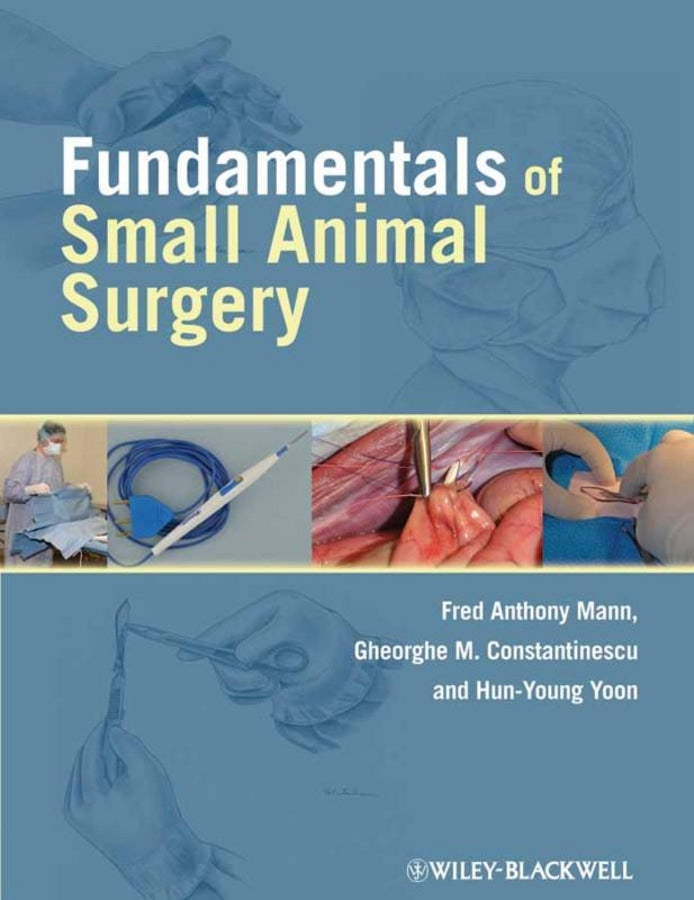
Fundamentals of Small Animal Surgery offers a thorough introduction to the surgical principles essential to good veterinary practice. With many high-quality pencil drawings and clinical photographs to complement the detailed descriptions, the book is a useful resource for building basic surgery skills. Fundamentals of Small Animal Surgery is designed to provide a grounding in the foundations of veterinary surgical practice and an understanding of the practical application of surgical techniques. Covering topics ranging from assessment and surgical pack preparation to aseptic technique and postoperative pain management, the book is a valuable reference for surgical procedure training in veterinary or veterinary technician schools, and serves as a refresher for veterinarians and technicians in practice.
Contributor List viii Introduction xii Section 1 Communication Case Studies 1 Case 1.1 Comsmunicating about a Progressive Diagnosis and Prognosis 5 Case 1.2 Diagnosis/Prognosis Uncomplicated Death at Home 12 Case 1.3 Accommodating Religiosity and Spirituality in Medical Decision-Making 18 Case 1.4 Discussing Cardiopulmonary Resuscitation When it May Be Useful 26 Case 1.5 Discussing CPR When it is a Non-Beneficial Intervention 33 Case 1.6 Discussing Brain Death, Organ Donation, and Donation after Cardiac Death 41 Case 1.7 Discussing Physiological Futility 52 Case 1.8 Wounded Families: Decision-Making in the Setting of Stressed Coping and Maladaptive Behaviors in Health Crises 60 Case 1.9 Notification of an Expected Death 68 Case 1.10 Death Notification after Unexpected Death 73 Section 2 Symptom Management Case Studies 83 Case 2.1 Pain: Cancer in the Home 87 Case 2.2 Treating an Acute, Severe, Cancer Pain Exacerbation 98 Case 2.3 Pain and Advanced Heart Failure 104 Case 2.4 Dyspnea and Advanced COPD 110 Case 2.5 Dyspnea and Heart Failure 117 Case 2.6 Treating Dyspnea during Ventilator Withdrawal 128 Case 2.7 Cough Associated with COPD and Lung Cancer 138 Case 2.8 Hiccups and Advanced Illness 145 Case 2.9 Treating Nausea Associated with Advanced Cancer 152 Case 2.10 Nausea Associated with Bowel Obstruction 161 Case 2.11 Nausea Related to Uremia, Dialysis Cessation 168 Case 2.12 Opioid-Induced Pruritus 176 Case 2.13 Pruritus in End-Stage Renal Disease 183 Case 2.14 Opioid-Induced Constipation 190 Case 2.15 Depression in Advanced Disease 198 Case 2.16 Treating Anxiety 205 Case 2.17 Terminal Secretions 213 Case 2.18 Fungating Wounds and the Palliative Care Patient 220 Case 2.19 Pressure Ulcer Care in Palliative Care 229 Case 2.20 Treating Ascites 239 Case 2.21 Delirium Management in Palliative Care 247 Section 3 Family Care Case Studies 257 Case 3.1 Caring for the Family Expecting a Loss 259 Case 3.2 Anticipatory Grief and the Dysfunctional Family 266 Case 3.3 Acute and Uncomplicated Grief after an Expected Death 277 Case 3.4 Bereavement after Unexpected Death 289 Case 3.5 Complicated Grief 300 Index 309
Margaret L. Campbell
Julia A. Walch
Constance Dahlin
Jennifer Gentry
Kelli Gershon
Judy Passaglia
Christine Westphal and Rebecca Williams
Judy C. Wheeler
Kerstin McSteen
Peg Nelson
Garrett K. Chan
Constance Dahlin
Patrick J. Coyne
Margaret L. Campbell
Margaret L. Campbell
Garrett K. Chan
Margaret L. Campbell
Peg Nelson
Marian Grant
Judy C. Wheeler
Terri L. Maxwell
Linda M. Gorman
Richelle Nugent Hooper
Linda M. Gorman
Grace Cullen Oligario
Todd Hultman
Darrell Owens
Terri L. Maxwell
Laura C. Harmon
Laura C. Harmon
Darrell Owens
Kerstin McSteen
Patricia A. Murphy and David M. Price
Rita J. DiBiase
Rita J. DiBiase
Garrett K. Chan
Rita J. DiBiase
Subject Areas: Veterinary medicine [MZ]