Freshly Printed - allow 8 days lead
Couldn't load pickup availability
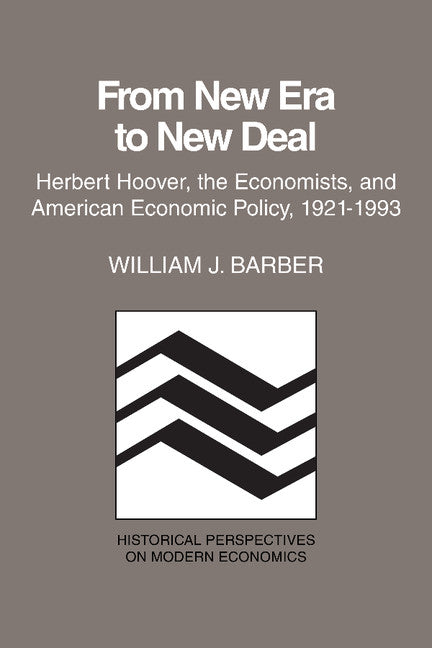
From New Era to New Deal
Herbert Hoover, the Economists, and American Economic Policy, 1921–1933
This book examines Hoover's record as secretary of commerce (1921–9) and economic policy during his Presidency (1929–33).
William J. Barber (Author)
9780521367370, Cambridge University Press
Paperback, published 27 January 1989
252 pages
22.8 x 15.2 x 1.6 cm, 0.413 kg
'This carefuly researched volume is valuable for the insight which it gives into Hoover's changing economic strategy. It also presents, with great clarity, the varied opinions of professional economists.' The Times Higher Education Supplement
In popular imagery, Herbert Hoover is often stereotyped as a 'do-nothing' president who offered only nineteenth-century slogans for the greatest economic catastrophe in twentieth-century American history. Nothing could be further from the truth. This study examines the properties of an innovative approach to economic growth and stability formulated by Hoover and his associates during his years as secretary of commerce (1921–9) and inspects his deployment of this strategy from the White House following the Great Crash in the autumn of 1929. Attention is then focused on Hoover's attempts to reformulate his macro-economic programme as the depression deepened in late 1931 and 1932. Archival materials provide arresting insights into Hoover's aspirations for a new institution - the Reconstruction Finance Corporations - as a vehicle for stimulating investment through a novel form of 'off-budget' financing. To complement the discussion of Hoover's theories of economic policy in their various manifestations, the views of contemporary economists on problems of the day are surveyed.
Preface
Prologue
1. The ingredients of a model of a new economics
2. Challenges to the new economics of the 1920s
3. The new economics at center stage in 1929
4. Activating the stabilization model in late 1929 and 1930
5. Preliminary readings of the results of the stabilization strategy
6. The unraveling of the first official model in 1931
7. Shifting course in late 1931 and early 1932
8. Renewing the offensive in February and March
9. The economists and their views on policy for 1932
10. Official model II as shaped in May 1932 and the aftermath
Epilogue
Notes
Selected bibliography, Index.
Subject Areas: 20th century history: c 1900 to c 2000 [HBLW], History of the Americas [HBJK]