Freshly Printed - allow 10 days lead
Couldn't load pickup availability
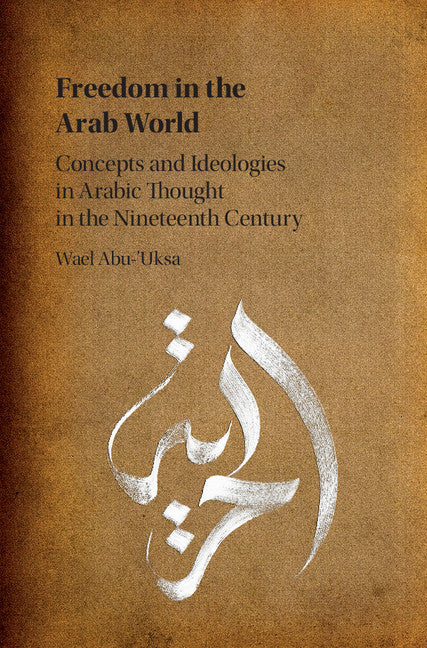
Freedom in the Arab World
Concepts and Ideologies in Arabic Thought in the Nineteenth Century
An examination of the concept of freedom in nineteenth-century Arabic political thought, and how it relates to other modern ideologies.
Wael Abu-'Uksa (Author)
9781107161245, Cambridge University Press
Hardback, published 4 July 2016
245 pages
23.5 x 16 x 1.8 cm, 0.5 kg
A preoccupation with the subject of freedom became a core issue in the construction of all modern political ideologies. Here, Wael Abu-'Uksa examines the development of the concept of freedom (hurriyya) in nineteenth-century Arab political thought, its ideological offshoots, their modes, and their substance as they developed the dynamics of the Arabic language. Abu-'Uksa traces the transition of the idea of freedom from a term used in a predominantly non-political way, through to its popularity and near ubiquity at the dawn of the twentieth century. Through this, he also analyzes the importance of associated concepts such as liberalism, socialism, progress, rationalism, secularism, and citizenship. He employs a close analysis of the development of the language, whilst at the same time examining the wider historical context within which these semantic shifts occurred: the rise of nationalism, the power of the Ottoman court, and the state of relations with Europe.
Introduction
1. The politicization of freedom, 1798–1820
2. A conceptual view of Arabic modernity through two key concepts, 'civilization' and 'progress' (tamaddun and taqaddum)
3. Burdening the political aspects of freedom: the formative period, 1820–60
4. The construction of modern ideologies in Arabic, 1860–82
Conclusion
Bibliography
Index.
Subject Areas: History of ideas [JFCX], Islamic & Arabic philosophy [HPDC], Middle Eastern history [HBJF1]