Freshly Printed - allow 10 days lead
Couldn't load pickup availability
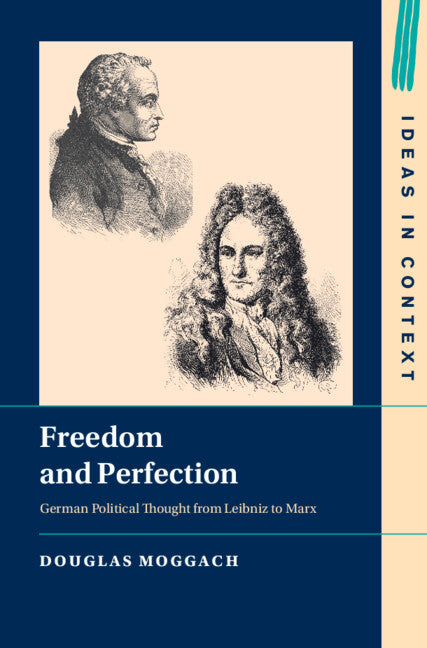
Freedom and Perfection
German Political Thought from Leibniz to Marx
A historical study of perfectionism and its political implications in the German lands, linking Leibniz with German Idealism and Marx.
Douglas Moggach (Author)
9781009590433, Cambridge University Press
Hardback, published 14 August 2025
356 pages
22.9 x 15.2 x 2.1 cm, 0.69 kg
'Moggach's impressive scholarship blends deep and insightful attention to primary sources in the field of German idealism with pervasive bibliographic references from scholarly literature and shows how both of these concepts are operative in reframing a conception of the common good that is based, not on the pursuit of happiness, but, rather, the pursuit of self-perfection. Highly recommended.' J. G. Moore, Choice
Leibniz, this study argues, is the genuine initiator of German Idealism. His analysis of freedom as spontaneity and the relations he establishes among freedom, justice, and progress underlie Kant's ideas of rightful interaction and his critiques of Enlightened absolutism. Freedom and Perfection offers a historical examination of perfectionism, its political implications and transformations in German thought between 1650 and 1850. Douglas Moggach demonstrates how Kant's followers elaborated a new ethical-political approach, 'post-Kantian perfectionism', which, in the context of the French Revolution, promoted the conditions for free activity rather than state-directed happiness. Hegel, the Hegelian School, and Marx developed this approach further with reference to the historical process as the history of freedom. Highlighting the decisive importance of Leibniz for subsequent theorists of the state, society, and economy, Freedom and Perfection offers a new interpretation of important schools of modern thought and a vantage point for contemporary political debates.
1. Thinking freedom
2. Leibniz: spontaneity, justice, and perfection
3. Receptions of Leibniz: Wolff and Herder
4. The Kantian revolution
5. Foundational arguments: Humboldt and Dalberg on the scope and end of the state
6. Friedrich Schiller: perfection, freedom, and beauty
7. Fichte: the labour of spontaneity
8. Hegel as post-Kantian perfectionist
9. Hegelian perfectionism before 1848
10. Karl Marx: historical perfectionism
Conclusion
Select bibliography
Index.
Subject Areas: History of ideas [JFCX]