Freshly Printed - allow 10 days lead
Couldn't load pickup availability
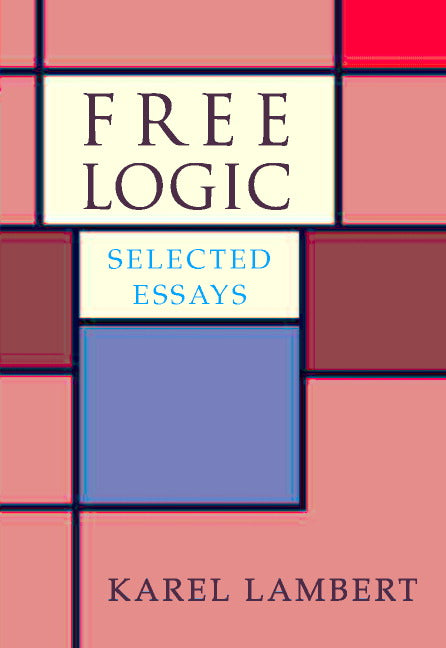
Free Logic
Selected Essays
The essays in this collection explore free logic, an important field of philosophical logic that first appeared in the 1950s.
Karel Lambert (Author)
9780521818162, Cambridge University Press
Hardback, published 31 October 2002
204 pages
23.5 x 16 x 1.8 cm, 0.42 kg
'These essays will be seen to be even more important once mathematicians and software engineers realize that what they thought was new and novel to their fields (E-logic and E+-logic and the various other names that these logics go by in mathematics and computer science) are varieties of free logic and were first discovered 30-45 years ago.' Raymond Gumb, University of Massachusetts, Lowell
Free logic is an important field of philosophical logic that first appeared in the 1950s. J. Karel Lambert was one of its founders and coined the term itself. The essays in this collection (written over a period of 40 years) explore the philosophical foundations of free logic and its application to areas as diverse as the philosophy of religion and computer science. Amongst the applications on offer are those to the analysis of existence statements, to definite descriptions and to partial functions. The volume contains a proof that free logics of any kind are non-extensional and then uses that proof to show that Quine's theory of predication and referential transparency must fail. The purpose of this collection is to bring an important body of work to the attention of a new generation of professional philosophers, computer scientists and mathematicians.
Introduction
1. Russell's version of the theory of definite descriptions
2. Existential import, 'E!' and 'the'
3. The reduction of two paradoxes and the significance thereof
4. The Hilbert–Bernays theory of definite descriptions
5. Foundations of the hierarchy of positive free definite description theories
6. Predication and extensionality
7. Nonextensionality
8. The philosophical foundations of free logic
9. Logical truth and microphysics.
Subject Areas: Philosophy of science [PDA], Mathematics [PB]