Freshly Printed - allow 10 days lead
Couldn't load pickup availability
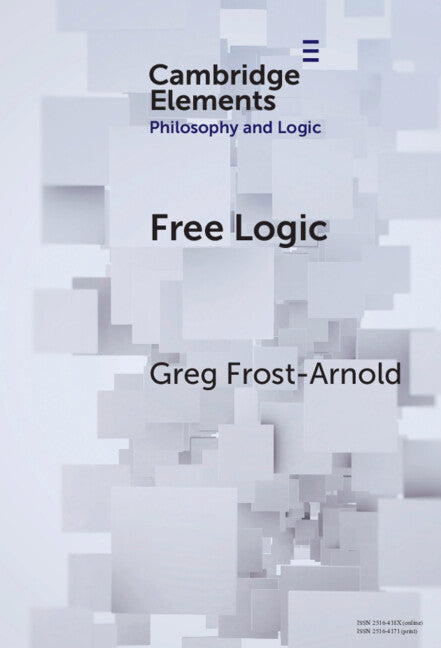
Free Logic
A Generalization
This Element extends classical free logic by covering both terms that refer to nothing, and ambiguous or confused terms.
Greg Frost-Arnold (Author)
9781009517874, Cambridge University Press
Hardback, published 30 January 2025
110 pages
22.9 x 15.2 x 0.8 cm, 0.299 kg
Classical logic assumes that names are univocal: every name refers to exactly one existing individual. This Principle of Univocality has two parts: an existence assumption and a uniqueness assumption. The existence assumption holds that every name refers to at least oneindividual, and the uniqueness assumption states that every name refers to at most one individual. The various systems of free logic which have been developed and studied since the 1960s relax the existence assumption, but retain the uniqueness assumption. The present work investigates violations of both halves of the Principle of Univocality. That is, whereas the free logics developed from the 1960s are called 'free' because they are free of existential assumptions, the current Element generalizes this idea, to study logics that are free of uniqueness assumptions. We explore several versions of free logic, comparing their advantages and disadvantages. Applications of free logic to other areas of philosophy are explored.
1. Introduction
2. Why free logic?
3. Truth and models
4. Proofs and logical consequence
5. Costs and benefits of each system
6. Conclusion: revisiting the motivations
References.
Subject Areas: Philosophy: logic [HPL]