Freshly Printed - allow 6 days lead
Couldn't load pickup availability
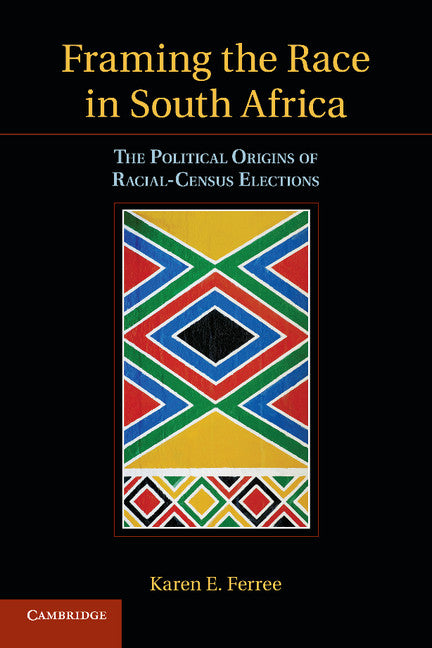
Framing the Race in South Africa
The Political Origins of Racial Census Elections
This book explores the political sources of racially segmented elections and ANC dominance in South Africa.
Karen E. Ferree (Author)
9781107617711, Cambridge University Press
Paperback / softback, published 2 January 2014
314 pages, 49 tables
23.4 x 15.6 x 1.8 cm, 0.49 kg
“Ferree shows that what looks like a simple product of racial arithmetic—white South Africans axiomatically supporting traditionally ‘white’ parties and black South Africans unthinkingly supporting the ANC—is more than just identity voting. It is, instead, the product of a conscious (and highly successful) political strategy on the part of the ANC, achieved through its monopoly of media coverage and its ability to buy off the best African political talent, to prevent its main rivals from escaping their association in voters’ minds with the Apartheid era and the interests of whites. Framing the Race is not just the most insightful and analytically grounded account of South African politics in the post-Apartheid era but also one of the best recent books on how dominant party regimes maintain themselves in power.”
—Daniel Posner, University of California, Los Angeles
Post-apartheid South African elections have borne an unmistakable racial imprint: Africans vote for one set of parties, whites support a different set of parties, and, with few exceptions, there is no crossover voting between groups. These voting tendencies have solidified the dominance of the ruling African National Congress (ANC) over South African politics and turned South African elections into 'racial censuses'. This book explores the political sources of these outcomes. It argues that although the beginnings of these patterns lie in South Africa's past, in the effects apartheid had on voters' beliefs about race and destiny and the reputations parties forged during this period, the endurance of the census reflects the ruling party's ability to use the powers of office to prevent the opposition from evolving away from its apartheid-era party label. By keeping key opposition parties 'white', the ANC has rendered them powerless, solidifying its hold on power in spite of an increasingly restive and dissatisfied electorate.
1. Introduction
2. Voters
3. The 1994 campaign
4. The 1999 campaign
5. The 2004 campaigns
6. Can a leopard change its spots? candidate demographics and party label change
7. Why so slow? the political challenges of candidate transformation
8. Negative framing strategies and African opposition parties
9. Conclusion: South Africa in comparative perspective.
Subject Areas: Comparative politics [JPB]