Freshly Printed - allow 8 days lead
Couldn't load pickup availability
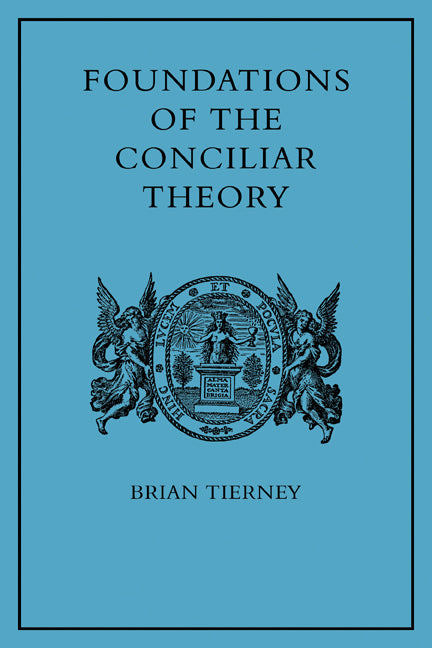
Foundations of the Conciliar Theory
The Contribution of the Medieval Canonists from Gratian to the Great Schism
This book explores the canonistic theories especially with conciliar theory, of Church government between c. 1140 and 1378.
Brian Tierney (Author)
9780521143684, Cambridge University Press
Paperback, published 24 June 2010
294 pages
23 x 15.3 x 2 cm, 0.45 kg
A major problem which occupied thinkers in the later Middle Ages was the question of the internal structure of the Church and the proper interrelationship of its members. Dr Tierney's book is an account of those canonistic theories of Church government which contributed to the growth of the conciliar theory, and which were formulated between Gratian's Decretum (c. 1140) and the Great Schism (1378). It is concerned particularly with the juristic development of the fundamental conciliar doctrine, the assertion that the universal Church was superior to the Church of Rome, with a consequent denial of the Pope's supreme authority.
Preface
List of abbreviations
Introductory: the conciliar theory and the Canonists
Part I. Decretists Theories of Church Goverment: 1. Pope and Church
2. Pope and general council
3. Pope and Cardinals
Part II. Aspects of Thirteenth-Century Ecclesiology: 4. Changing views of Church government
5. The structure of a medieval ecclesiastical corporation
6. The whole church as corporation
Part III. Conciliar Ideas in the Fourteenth Century: 7. John of Paris
8. Conflicting criticisms of Papal monarchy
9. The attitude of the academic Canonists
10. Franciscus Zabarella
Conclusion
Appendices
List of works cited
Index.
Subject Areas: History [HB]