
Freshly Printed - allow 7 days lead
Couldn't load pickup availability
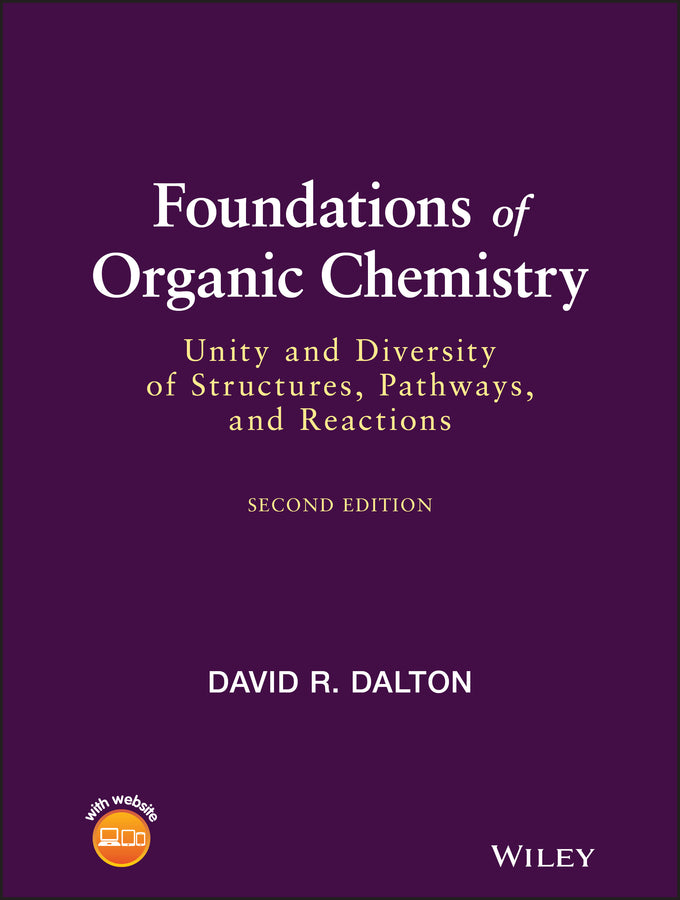
Foundations of Organic Chemistry
Unity and Diversity of Structures, Pathways, and Reactions
David R. Dalton (Author)
9781119656425, Wiley
Hardback, published 21 September 2020
1376 pages
25.7 x 21.1 x 5.6 cm, 2.563 kg
Learn the fundamentals and foundations of modern organic chemistry with this comprehensive guide Foundations of Organic Chemistry: Unity and Diversity of Structures, Pathways, and Reactions, 2nd Edition, is a substantive guide for students beginning their study of organic chemistry and instructors, as well as senior undergraduates and graduate students seeking to further their understanding of the subject. Foundations of Organic Chemistry is a serious attempt to show students who want to learn organic chemistry how we know what we know about the subject and to guide them to learn. In this work, the emphasis of the discussion of structures, pathways, and reactions is placed on the original literature and the fundamentals and use of spectroscopic and kinetic tools. Application of the resulting working knowledge of the substance of organic chemistry will lead the serious student to ask additional questions and, ultimately, to solve problems we face. The book also includes solutions guides for instructors and lecturers, as well as access to a companion website for furthering the reader’s knowledge of organic chemistry.
PROLOGUE xix PART I BACKGROUND 1 1. An Introduction to Structure and Bonding 5 2. An Introduction to Spectroscopy and Selected Spectroscopic Methods in Organic Chemistry 49 3. Structure: The Nomenclature of Hydrocarbons and the Shape of Things to Come 83 4. An Introduction to Dynamics 119 5. Classes of Organic Compounds: A Survey Along with an Introduction to Solvents, Acids and Bases, and to More About Computational Chemistry 173 PART II MIDDLEGROUND 261 6. The Reactions of Hydrocarbons: Oxidation, Reduction, Substitution, Addition, Elimination, and Rearrangement 271 7. The Reactions of Alkyl, Alkenyl, and Aryl Halides: Oxidation, Reduction, Substitution, Addition, Elimination, and Rearrangement 423 8. Part I. The Reactions of Alcohols, Enols, and Phenols: Oxidation, Reduction, Substitution, Addition, Elimination, and Rearrangement Part I. Alcohols, Enols, and Phenols 526 9. Part I. The Reactions of Aldehydes and Ketones: Oxidation, Reduction, Addition, Substitution, and Rearrangement Part I. Aldehydes and Ketones 676 10. Part I. The Reactions of Amines: Oxidation, Reduction, Addition, Substitution, and Rearrangement Part I. The Reactions of Amines: Introduction and Comments on the Synthesis of Amines 865 PART III FOREGROUND 941 11. An Introduction to Carbohydrates, Acetogenins, and Steroids 945 12. An Introduction to Amino Acids, Peptides and Proteins, Enzymes, and Coenzymes and Metabolic Processes 1045 13. An Introduction to Alkaloids and Some Other Heterocyclic Compounds 1179 14. Part I. On the Genetic Code: Unity and Diversity Part I. The Genetic Code 1249 Part I. On The Genetic Code: Unity and Diversity 1250 EPILOGUE 1297
ACKNOWLEDGMENTS xxi
ABOUT THE COMPANION WEBSITE xxiii
Part II. Ethers
Part III. Selected Reactions of Alkyl and Aryl Thiols and Thioethers 523
Part II. Ethers 624
Part III. Thiols, Thioethers, and Some Products of Their Oxidation 638
Part II. The Reactions of Carboxylic Acids and Their Derivatives: Oxidation, Reduction, Addition, Substitution, Elimination, and Rearrangement 667
Part II. Carboxylic Acids And Their Derivatives 778
Part II. Some Organophosphorus Chemistry
Part III. Some Organosilicon Chemistry 865
Part II. Some Organophosphorus Chemistry 915
Part III. Some Organosilicon Chemistry 921
Part II. The Tetrapyrrolic Cofactors and Other Metal–Organic Frameworks 1249
Part II. Metal–Organic Frameworks 1250
Part II. The Tetrapyrrolic Cofactors and Other Metal–Organic Frameworks 1274
APPENDIX I THE SCHRÖDINGER EQUATION 1299
APPENDIX II THE LITERATURE 1303
INDEX 1305
Subject Areas: Chemistry [PN]