Special Order - allow 2+ weeks lead
Couldn't load pickup availability
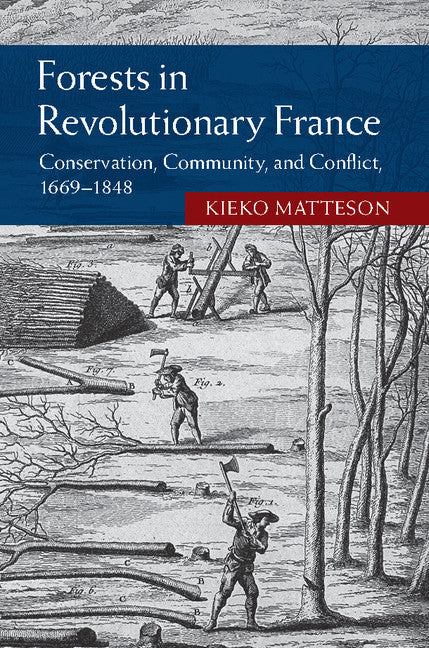
Forests in Revolutionary France
Conservation, Community, and Conflict, 1669–1848
This book investigates the economic, strategic, and political importance of forests in early modern and modern Europe.
Kieko Matteson (Author)
9781107043343, Cambridge University Press
Hardback, published 16 April 2015
326 pages, 3 b/w illus. 2 maps
22.9 x 15.2 x 2.2 cm, 0.6 kg
'… Matteson's book not only offers an important contribution to the growing body of literature on the cultural significance of forests and other national landscapes; it also problematizes environmental debates on forest protection.' Tanya Bakhmetyeva, Environmental History
This book investigates the economic, strategic, and political importance of forests in early modern and modern Europe and shows how struggles over this vital natural resource both shaped and reflected the ideologies and outcomes of France's long revolutionary period. Until the mid-nineteenth century, wood was the principal fuel for cooking and heating and the primary material for manufacturing worldwide and comprised every imaginable element of industrial, domestic, military, and maritime activity. Forests also provided essential pasturage. These multifaceted values made forests the subject of ongoing battles for control between the crown, landowning elites, and peasantry, for whom liberty meant preserving their rights to woodland commons. Focusing on Franche-Comté, France's easternmost province, the book explores the fiercely contested development of state-centered conservation and management from 1669 to 1848. In emphasizing the environmental underpinnings of France's seismic sociopolitical upheavals, it appeals to readers interested in revolution, rural life, and common-pool-resource governance.
Introduction
1. The lay of the land
2. 'Agromania' and silvicultural science
3. 'A necessity as vital as bread'
4. 'Seduced by the word 'liberty''
5. 'Nothing is more respected than the right of property'
6. 'Not even a branch of wood has been granted to us'
7. Epilogue: 'homo is but arbor inversa'.
Subject Areas: Social & cultural history [HBTB], Modern history to 20th century: c 1700 to c 1900 [HBLL], Early modern history: c 1450/1500 to c 1700 [HBLH], European history [HBJD]