Freshly Printed - allow 10 days lead
Couldn't load pickup availability
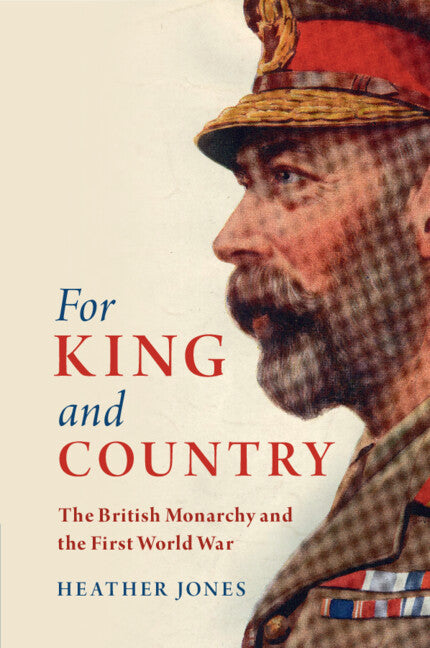
For King and Country
The British Monarchy and the First World War
Was the First World War really 'For King and Country'? This is the first full history of the monarchy's role.
Heather Jones (Author)
9781108454094, Cambridge University Press
Paperback / softback, published 26 October 2023
592 pages
22.7 x 15.2 x 3.1 cm, 0.83 kg
'A thoroughly absorbing read, this book is a fascinating, in-depth study of the British monarchy that offers us a new perspective on the wartime roles, responsibilities and influence of the royal family and their courtiers. The extensive and impressive research helps us understand the war through the royal cultural lens while also appreciating how soldiers and civilians in wider British society valued their collective and individual relationship to the monarch in meaningful and lasting ways.' Matthew Barrett, Canadian Military History
This is a ground-breaking history of the British monarchy in the First World War and of the social and cultural functions of monarchism in the British war effort. Heather Jones examines how the conflict changed British cultural attitudes to the monarchy, arguing that the conflict ultimately helped to consolidate the crown's sacralised status. She looks at how the monarchy engaged with war recruitment, bereavement, gender norms, as well as at its political and military powers and its relationship with Ireland and the empire. She considers the role that monarchism played in military culture and examines royal visits to the front, as well as the monarchy's role in home front morale and in interwar war commemoration. Her findings suggest that the rise of republicanism in wartime Britain has been overestimated and that war commemoration was central to the monarchy's revered interwar status up to the abdication crisis.
Introduction
Prelude: The monarchy and wartime political power. Part I. The role of the British monarchy in cultural mobilisation for war: 1. Monarchist mentalities and British mobilisation, 1914–1916
2. Monarchist culture and combatant practices. Part II. The emperor's new clothes: Changing cultures of deference: 3. The royal body in wartime
4. De-sacralisation discourses – challenges to the monarchy's status, 1916–1918. Part III. The unknown soldier: The role of the monarchy in post-war commemoration
5. The monarchy and the armistice: Ritualising victory, channelling war grief
6. The monarchy's role in sacralising post-war commemoration
Conclusion.
Subject Areas: Military history [HBW], 20th century history: c 1900 to c 2000 [HBLW], British & Irish history [HBJD1]