In Stock - dispatch within 48 hours
Couldn't load pickup availability
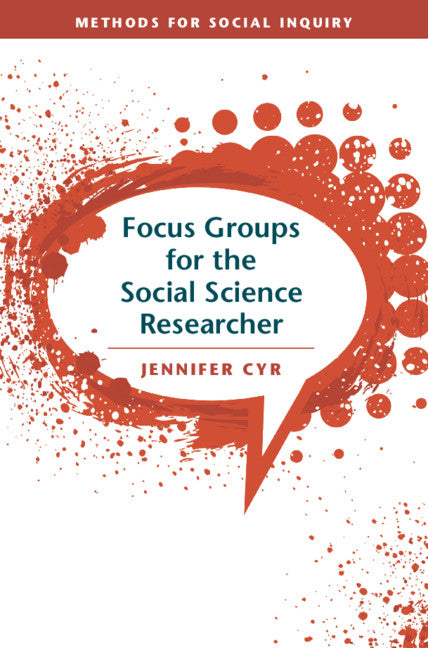
Focus Groups for the Social Science Researcher
In highlighting the unique features of focus groups, Cyr explains how they can help social science researchers effectively answer certain research questions.
Jennifer Cyr (Author)
9781107189164, Cambridge University Press
Hardback, published 28 March 2019
142 pages, 9 b/w illus.
23.5 x 15.8 x 1.1 cm, 0.33 kg
'Cyr's book is a unique and significant contribution to qualitative social science methodology. Her analysis not only provides step-by-step guidance on how to organize and facilitate a focus group but highlights why a scholar might take on what can be a daunting set of logistical, ethical and analytic challenges. Cyr unpacks what is distinctive about the method and shows us how to maximize the analytic leverage provided by the social interactions of focus group discussions.' Lauren M. MacLean, Arthur F. Bentley Chair, Indiana University, Bloomington
What is a focus group? Why do we use them? When should we use them? When should we not? Focus Groups for the Social Science Researcher provides a step-by-step guide to undertaking focus groups, whether as a stand-alone method or alongside other qualitative or quantitative methods. It recognizes the challenges that focus groups encounter and provides tips to address them. The book highlights three unique, inter-related characteristics of focus groups. First, they are inherently social in form. Second, the data emerge organically through conversation; they are emic in nature. Finally, focus groups generate data at three levels of analysis: the individual, group, and interactive level. The book builds from these three characteristics to explain when focus groups can usefully be employed in different research designs. This is an essential text for students and researchers looking for a concise and accessible introduction to this important approach to data collection.
Introduction
1. When to use focus groups
2. Preparing for the focus groups
3. Undertaking focus groups
4. Analyzing focus groups and presenting the results
Conclusion.
Subject Areas: Political science & theory [JPA], Social & cultural anthropology, ethnography [JHMC], Research methods: general [GPS], Research & information: general [GP]