
Freshly Printed - allow 7 days lead
Couldn't load pickup availability
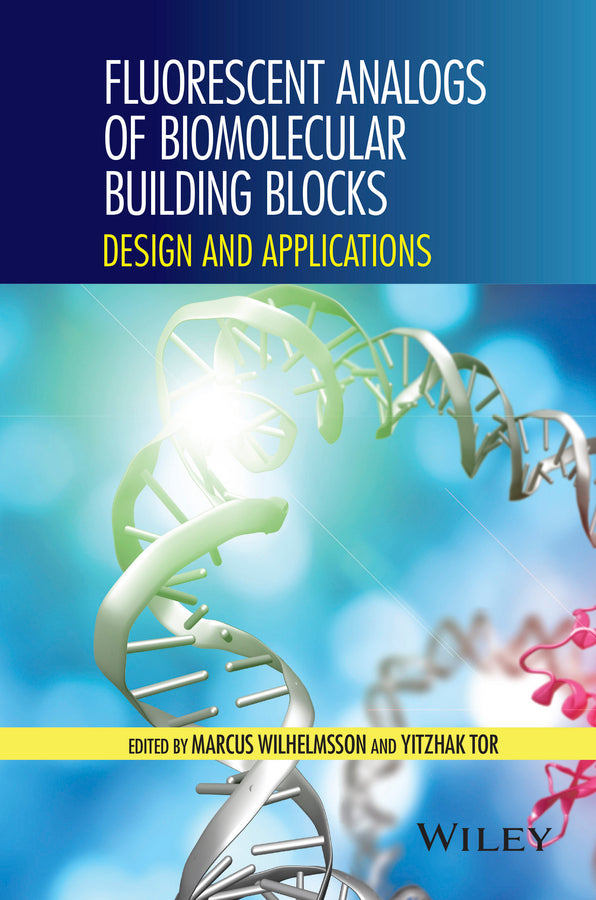
Fluorescent Analogs of Biomolecular Building Blocks
Design and Applications
Marcus Wilhelmsson (Edited by), Yitzhak Tor (Edited by)
9781118175866, Wiley
Hardback, published 6 May 2016
472 pages
23.6 x 15.8 x 3.1 cm, 0.816 kg
"This book provides a thorough overview on the design and application of fluorescent analogs of biomolecular building blocks...The way the book is written makes reading enjoyable and relatively easy for readers who already have some knowledge on the subject as well as for beginners...Overall, the book is very well achieved, and I strongly recommend reading." (Angewandte Chemie International Edition May 2017)
Fluorescent Analogs of Biomolecular Building Blocks focuses on the design of fluorescent probes for the four major families of macromolecular building blocks. Compiling the expertise of multiple authors, this book moves from introductory chapters to an exploration of the design, synthesis, and implementation of new fluorescent analogues of biomolecular building blocks, including examples of small-molecule fluorophores and sensors that are part of biomolecular assemblies.
List of Contributors xv Preface xix 1 Fluorescence Spectroscopy 1 1.1 Fundamentals of Fluorescence Spectroscopy 1 1.2 Common Fluorescence Spectroscopy Techniques 3 1.3 Summary and Perspective 10 References 10 2 Naturally Occurring and Synthetic Fluorescent Biomolecular Building Blocks 15 2.1 Introduction 15 2.2 Naturally Occurring Emissive Biomolecular Building Blocks 16 2.3 Synthetic Fluorescent Analogs of Biomolecular Building Blocks 18 2.4 Summary and Perspective 31 References 32 3 Polarized Spectroscopy with Fluorescent Biomolecular Building Blocks 40 3.1 Transition Moments 40 3.2 Linear Dichroism 41 3.3 Magnetic Circular Dichroism 45 3.4 F̈orster Resonance Energy Transfer (FRET) 46 3.5 Fluorescence Anisotropy 47 3.6 Fluorescent Nucleobases 47 3.7 Fluorescent Peptide Chromophores 48 3.8 Site-Specific Linear Dichroism (SSLD) 50 3.9 Single-Molecule Fluorescence Resonance Energy Transfer (smFRET) 50 3.10 Single-Molecule Fluorescence-Detected Linear Dichroism (smFLD) 51 References 53 4 Fluorescent Proteins: The Show Must go on! 55 4.1 Introduction 55 4.2 Historical Survey 55 4.3 Photophysical Properties 57 4.4 Photochemical Reactions 71 4.5 Ion Sensitivity 75 4.6 Relation Microscopy–Spectroscopy for Fluorescent Proteins 77 4.7 Prospects and Outlook 82 Acknowledgments 82 References 82 5 Design and Application of Autofluorescent Proteins by Biological Incorporation of Intrinsically Fluorescent Noncanonical Amino Acids 91 5.1 Introduction 91 5.2 Design and Synthesis of Fluorescent Building Blocks in Proteins 97 5.3 Application of Fluorescent Building Blocks in Proteins 111 5.4 Conclusions 117 5.5 Prospects and Outlook 118 Acknowledgments 120 References 120 6 Fluoromodules: Fluorescent Dye–Protein Complexes for Genetically Encodable Labels 124 6.1 Introduction 124 6.2 Fluoromodule Development and Characterization 126 6.3 Implementation 132 6.4 Conclusions 134 6.5 Prospects and Outlook 134 Acknowledgments 134 References 134 7 Design of Environmentally Sensitive Fluorescent Nucleosides and their Applications 137 7.1 Introduction 137 7.2 Solvatochromic Fluorescent Nucleoside Analogs 140 7.3 Fluorescently Labeled Nucleosides and Oligonucleotide Probes: Covalent Attachment of Solvatochromic Fluorophores Onto the Natural Bases 141 7.4 Nucleosides with Dual Fluorescence for Monitoring DNA Hybridization 153 7.5 Approach for Developing Environmentally Sensitive Fluorescent (ESF) Nucleosides 154 7.6 Base-Selective Fluorescent ESF Probe 163 7.7 Molecular Beacon (MB) and ESF Nucleosides 167 7.8 Summary and Future Outlook 169 Acknowledgments 170 References 170 8 Expanding The Nucleic Acid Chemist’s Toolbox: Fluorescent Cytidine Analogs 174 8.1 Introduction 174 8.2 Design and Characterization of Fluorescent C Analogs 176 8.3 Implementation 190 8.4 Conclusions 202 8.5 Prospects and Outlook 202 Acknowledgments 203 References 203 9 Synthesis and Fluorescence Properties of Nucleosides with Pyrimidopyrimidine-Type Base Moieties 208 9.1 Introduction 209 9.2 Discovery, Design, and Synthesis of Pyrimidopyrimidine Nucleosides 209 9.3 Implementation 215 9.4 Conclusions 220 9.5 Prospects and Outlook 221 References 221 10 Förster Resonance Energy Transfer (FRET) Between Nucleobase Analogues – a Tool for Detailed Structure and Dynamics Investigations 224 10.1 Introduction 224 10.2 The Tricyclic Cytosine Family 226 10.3 Development of the First Nucleic Acid Base Analog FRET Pair 234 10.4 Conclusions 238 10.5 Prospects and Outlook 238 Acknowledgments 239 References 239 11 Fluorescent Purine Analogs that Shed Light on DNA Structure and Function 242 11.1 Introduction 242 11.2 Design, Photophysical Properties, and Applications of Purine Mimics 244 11.3 Implementation 258 11.4 Conclusions 265 11.5 Prospects and Outlook 265 Appendix 268 References 268 12 Design and Photophysics of Environmentally Sensitive Isomorphic Fluorescent Nucleosides 276 12.1 Introduction 276 12.2 Designing Environmentally Sensitive Emissive Nucleosides 279 12.3 Two Isomorphic Environmentally Sensitive Designs 282 12.4 Probing Environmental Sensitivity 283 12.5 Recent Advancements in Isomorphic Fluorescent Nucleoside Analogs 291 12.6 Summary 293 12.7 Prospects and Outlook 294 Acknowledgments 294 References 294 13 Site-Specific Fluorescent Labeling of Nucleic Acids by Genetic Alphabet Expansion Using Unnatural Base Pair Systems 297 13.1 Introduction 297 13.2 Development of Unnatural Base Pair Systems and Their Applications 299 13.3 Implementation 310 13.4 Conclusions 315 13.5 Prospects and Outlook 316 Acknowledgments 317 References 317 14 Fluorescent C-Nucleosides and their Oligomeric Assemblies 320 14.1 Introduction 320 14.2 Design, Synthesis, Characterization, and Properties of Fluorescent C-Glycoside Monomers 322 14.3 Implementation of Fluorescent C-Glycoside Monomers 327 14.4 Oligomers of Fluorescent C-Glycosides: Design, Synthesis, and Properties 335 14.5 Implementation of Fluorescent C-Glycoside Oligomers 342 14.6 Conclusions 353 14.7 Prospects and Outlook 353 Acknowledgments 354 References 354 15 Membrane Fluorescent Probes: Insights and Perspectives 356 Abbreviations 356 15.1 Introduction 357 15.2 NBD-Labeled Lipids: Monitoring Slow Solvent Relaxation in Membranes 358 15.3 n-AS Membrane Probes: Depth-Dependent Solvent Relaxation as Membrane Dipstick 359 15.4 Pyrene: a Multiparameter Membrane Probe 362 15.5 Conclusion and Future Perspectives 362 Acknowledgments 364 References 364 16 Lipophilic Fluorescent Probes: Guides to the Complexity of Lipid Membranes 367 16.1 Introduction 367 16.2 Lipids, Lipid Bilayers, and Biomembranes 368 16.3 Lipid Phases, Phase Separation, and Lipid Ordering 370 16.4 Fluorescent Probes for Membrane Studies 370 16.5 Conclusions 386 16.6 Prospects and Outlook 386 Acknowledgments 386 References 387 17 Fluorescent Neurotransmitter Analogs 393 17.1 Introduction 393 17.2 Design and Optical Properties of Fluorescent Neurotransmitters 397 17.3 Applications of Fluorescent Neurotransmitters 400 17.4 Conclusions 404 17.5 Prospects and Outlook 405 Acknowledgments 405 References 406 Index 409
Renatus W. Sinkeldam, L. Marcus Wilhelmsson, and Yitzhak Tor
Renatus W. Sinkeldam and Yitzhak Tor
Bo Albinsson and Bengt Nordén
Gregor Jung
Patrick M. Durkin and Nediljko Budisa
Bruce A. Armitage
Subhendu Sekhar Bag and Isao Saito
Kirby Chicas and Robert H.E. Hudson
Kohji Seio, Takashi Kanamori, Akihiro Ohkubo, and Mitsuo Sekine
L. Marcus Wilhelmsson
Anaëlle Dumas, Guillaume Mata, and Nathan W. Luedtke
Renatus W. Sinkeldam and Yitzhak Tor
Michiko Kimoto, Rie Yamashige, and Ichiro Hirao
Pete Crisalli and Eric T. Kool
Amitabha Chattopadhyay, Sandeep Shrivastava, and Arunima Chaudhuri
Marek Cebecauer and Radek Šachl
James N. Wilson
Subject Areas: Chemistry [PN]