Freshly Printed - allow 4 days lead
Couldn't load pickup availability
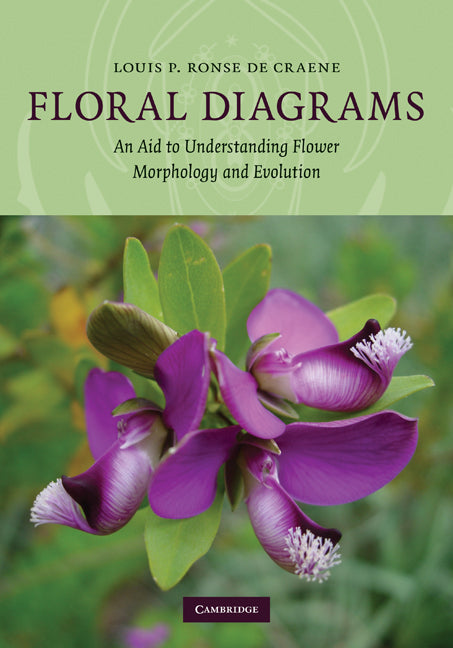
Floral Diagrams
An Aid to Understanding Flower Morphology and Evolution
Guide to using floral diagrams for the identification of flowering plants, and to understand flower structures, their diversity and evolution.
Louis P. Ronse De Craene (Author)
9780521493468, Cambridge University Press
Hardback, published 4 February 2010
458 pages, 182 b/w illus. 2 tables
25.3 x 17.9 x 2.6 cm, 1.5 kg
'… a seemingly simple idea which has proved to be a powerful and effective way to describe and understand one of the great bounties of nature … This volume comprises a modern treatment of this deceptively simple technique in the context of the latest developments in angiosperm evolution and taxonomy, including recent molecular and phylogenetic advances. … a valuable and insightful resource for researchers, students and the general botanist.' The Biologist
Floral morphology remains the cornerstone for plant identification and studies of plant evolution. This guide gives a global overview of the floral diversity of the angiosperms through the use of detailed floral diagrams. These schematic diagrams replace long descriptions or complicated drawings as a tool for understanding floral structure and evolution. They show important features of flowers, such as the relative positions of the different organs, their fusion, symmetry, and structural details. The relevance of the diagrams is discussed, and pertinent evolutionary trends are illustrated. The range of plant species represented reflects the most recent classification of flowering plants based mainly on molecular data, which is expected to remain stable in the future. This book is invaluable for researchers and students working on plant structure, development and systematics, as well as being an important resource for plant ecologists, evolutionary botanists and horticulturists.
1. Introduction: flower morphology
2. Floral diagrams
3. Floral diagrams used in this book
4. Systematic significance of floral diagrams
5. Conclusions
6. References
7. Glossary
Index.
Subject Areas: Botany & plant sciences [PST]