Freshly Printed - allow 7 days lead
Couldn't load pickup availability
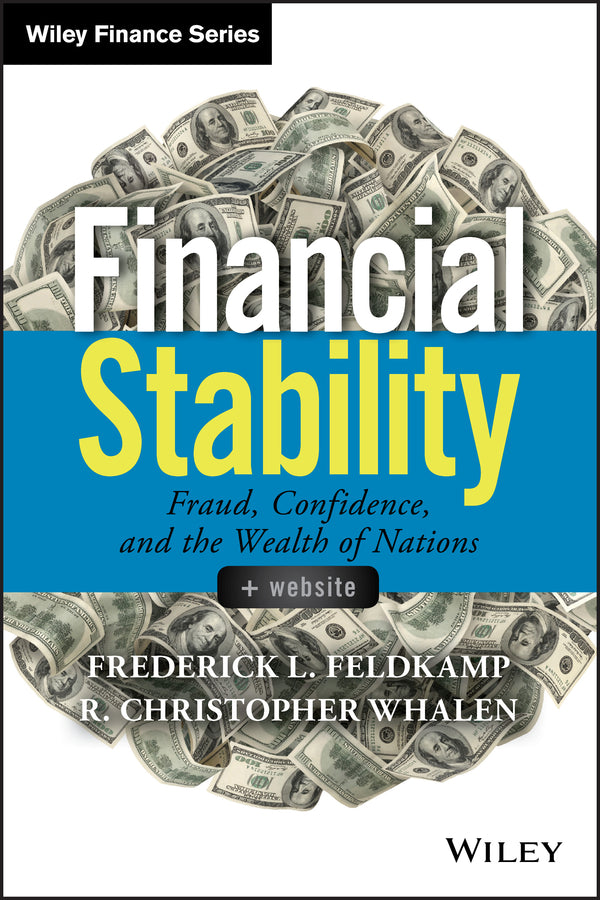
Financial Stability, + Website
Fraud, Confidence and the Wealth of Nations
Frederick L. Feldkamp (Author), R. Christopher Whalen (Author)
9781118935798, Wiley
Hardback, published 31 October 2014
256 pages
23.6 x 16 x 2.3 cm, 0.435 kg
Applying the Lessons of History to Understanding Fraud Today and Tomorrow Financial Stability provides a roadmap by which the world can anticipate and avoid future financial disruptions. This unique discussion of past and present financial events offers new insights that explain economic, political, and legal antecedents of financial crises in Western markets. With a detailed discussion of the history of finance, this book shows modern investors and finance professionals how to learn from past successes and failures to gauge future market threats. Readers will gain new insight into the antecedents of todays financial markets and the political economy that surrounds them. Armed with this knowledge, they will be able to craft a strategy that steers away from financial disorder and toward maximum stability. Coverage includes discussion of capital, forecasting, and political reaction, and past, present, and future applications within all realms of business. The companion website offers additional data and research, providing a complete resource for those seeking a better understanding of the risk at hand. As the world struggles to emerge from the latest financial crisis, professionals in finance, the law and other disciplines, and the people they advise, are searching for understanding to avoid future crises. Financial Stability argues that the best lessons are learned from our own mistakes, and that the ability to look ahead depends upon our willingness to look back. Readers will: Everywhere around the globe, at all points in history, financial crises have always been rooted in the confluence of politics, finance, and law. Financial Stability puts the latest global financial crisis in perspective, highlighting the lessons we have already learned, and those we need to internalize today.
Preface
Introduction
Part 1: A Flight through Financial Market History—Freedom and Fraud
Chapter 1. The First Few Millennia
Chapter 2. The Bank of England and the Scottish Enlightenment
Chapter 3. U.S. Banking, from British Colonies to 1865
Chapter 4. Bagehot's Dictum (a.k.a. the "Greenspan Put")
Chapter 5. U.S. Financial Markets from 1865 to the Great Depression
Chapter 6. Depression, War, and Aftermath—Reflecting on Finance from 1929 to 1973
Chapter 7. Early Deregulation: The Transactions that Replaced Depression Era Thrifts
Chapter 8. Riskless Arbitrage—Stand-alone Collateralized Mortgage Obligations ("CMOs")
Chapter 9. Paradise Gained, Lost, Regained, and Destroyed—1992 to 2008
Chapter 10. Resurrection, Recovery and Reform—2008-2013
Chapter 11. Different Circumstances Require Different Solutions
Part 2: The Theory of Financial Stability
Chapter 12. Statement: Rule of Law + Freedom + Transparency → Equilibrium
Chapter 13. Saying vs. Doing
Part 3: Proofs of the Theory of Financial Stability
Chapter 14. Mathematics: (1 + i)x > (E = mc2)
Chapter 15. Law: Incomplete "Sale" ≡ Secured Borrowing
Chapter 16. Economics: Savings ≡ Investment
Chapter 17. Accounting: Assets ≡ Liabilities + Capital
Chapter 18. International Trade: Current Account Deficit ≡ Capital Investment — Domestic Savings
Chapter 19. Philosophy: Benevolence > Self Interest > Fraud
Part 4: The Future
Chapter 20. Achieving Wisdom While Avoiding Mistakes of Experience
Chapter 21. Capital Needs
Chapter 22. Sources of Capital
Chapter 23. Managing the Water Balloon
Chapter 24. Balancing the Bubbles
Epilogue: Truth and Consequences
References
About the Companion Website
About the Authors
Index
Subject Areas: Finance & accounting [KF]