Freshly Printed - allow 7 days lead
Couldn't load pickup availability
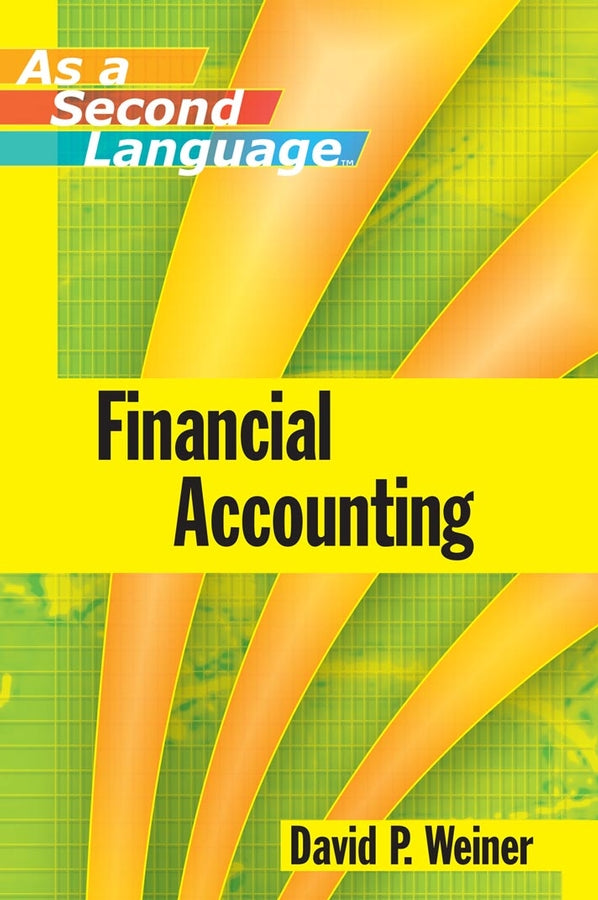
Financial Accounting as a Second Language
David P. Weiner (Author)
9780470043882, Wiley
Paperback / softback, published 16 September 2008
320 pages
22.6 x 15.2 x 1.6 cm, 0.34 kg
Accounting may be challenging, but with training and practice students can come out of a financial accounting course having achieved success! With David Weiner’s Financial Accounting as a Second Language, students will get the practice and training they need to better understand fundamental principles, build confidence, and solve problems. The goal of this title is to: introduce the language of accounting, explain the core concepts of accounting, and learn how to apply these core concepts to solve accounting problems. Developed by David Weiner through his forty year teaching career, this text is filled with study skills, techniques, and strategies used help students learn the core concepts of accounting and get the grades they deserve.
Preface ix Chapter 1 Basic Financial Accounting Concepts 1 Learning Objectives 1 Accounting as the Language of Business 2 Objectives of Financial Reporting 4 Basic Accounting Concepts 5 The Basic Financial Statements 8 Using Financial Statement Information 17 Review Questions 18 Practice Multiple Choice Questions 21 Chapter 2 The Accounting Cycle 24 Learning Objectives 24 Transaction Analysis 26 The Accounting Cycle 29 Summary of the Seven Types of Accounts 30 The Rules for Debits and Credits 30 The Chart of Accounts 32 Cash Basis versus Accrual Basis 33 The Journal Entry 33 Recording Journal Entries 38 Posting to the Ledger 40 The Trial Balance 41 Adjusting Entries 41 The Closing Process 45 Balancing the Permanent Accounts 47 Correcting Errors 47 Preparing the Financial Statements 48 Comprehensive Illustration 49 Review Questions 59 Practice Multiple Choice Questions 61 Chapter 3 Internal Controls, Cash, and Receivables 64 Learning Objectives 64 The Sarbanes–Oxley Act Requirements 65 Sarbanes–Oxley and Internal Control 66 Reporting Cash 68 The Bank Reconciliation 70 Accounts Receivable 73 Notes Receivable 77 Getting Cash for Receivables 78 Summary of Journal Entries 79 Review Questions 80 Practice Multiple Choice Questions 83 Chapter 4 Inventory 85 Learning Objectives 85 Basic Inventory Issues 86 Purchasing and Selling Inventory 89 The Cost of Goods Sold Model 91 The Periodic Method versus the Perpetual Method 92 Taking Inventory and the Cost Flow Assumptions 95 Lower of Cost or Market (LCM) 102 Impact of Inventory Errors 104 Review Questions 107 Practice Multiple Choice Questions 109 Chapter 5 Noncurrent Assets and Depreciation 113 Learning Objectives 113 Noncurrent Assets 114 Long-Term Investments 114 Property, Plant, and Equipment 116 Declining-Balance Method 121 Depreciation Conventions 123 Intangible Assets 126 Impairment 129 Accounting for Research and Development 131 Summary of Journal Entries 132 Review Questions 133 Practice Multiple Choice Questions 135 Chapter 6 Current and Noncurrent Liablities 139 Learning Objectives 139 Liabilities 140 Current Liabilities 140 Long-Term Liabilities 147 Summary of Journal Entries 154 Review Questions 155 Practice Multiple Choice Questions 158 Chapter 7 Stockholders’ Equity 160 Learning Objectives 160 Stockholders’ Equity 162 Summary of Journal Entries 173 Review Questions 174 Practice Multiple Choice Questions 176 Chapter 8 the Statement of Cash Flows 178 Learning Objectives 178 Objectives of the Statement of Cash Flows 179 Format of the Statement of Cash Flows 180 A Step-by-Step Approach to Solving Statement of Cash Flows Problems 182 Review Questions 202 Practice Multiple Choice Questions 203 Chapter 9 Review of Financial Statements and Financial Statement Analysis 205 Learning Objectives 205 Horizontal and Vertical Analysis 206 DuPont Method 207 Financial Ratio Analysis 208 Review Questions 217 Practice Multiple Choice Questions 218 Appendix A Basic College Skills 221 Learning Objectives 221 College Skills 222 Appendix B the Time Value of Money 239 Learning Objectives 239 Introduction 239 Basic Concepts 239 Making Present Value and Future Value Calculations: A Summary 245 Practice Multiple Choice Questions 260 Appendix C Gross Profit Inventory Computation 262 The Gross Profit Method 262 Appendix D Advanced Topics for Chapter Five: Capitalization Of Interest and Nonmonetary Exchanges 266 Capitalization of Interest on Self-Constructed Assets 266 Nonmonetary Exchanges 268 Appendix E The Cpa and the Auditor’s Report 272 Introduction 272 Generally Accepted Auditing Standards 273 Glossary 277 Index 299
Subject Areas: Finance & accounting [KF]