Special Order - allow 2+ weeks lead
Couldn't load pickup availability
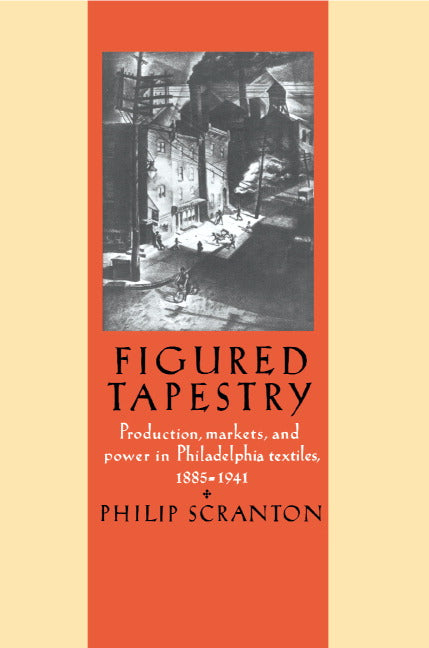
Figured Tapestry
Production, Markets and Power in Philadelphia Textiles, 1855–1941
A study of industrial maturity and decline, focused on the Philadelphia textile trades.
Philip Scranton (Author)
9780521342872, Cambridge University Press
Hardback, published 28 July 1989
536 pages
23.6 x 16.1 x 3.3 cm, 0.908 kg
"In presenting the results of his prodigious research effort, Scranton has produced a book of 500 pages that is dense with facts and figures. It is without any doubt the definitive reference work on the subject. As in many detailed historical accounts, the sheer quantity and diversity of factual information that Scranton presents could have come at the expense of an analytical perspective. Fortunately, such is not the case here. Scranton's overriding perspective on the evolution of the Philadelphia textile region in the U.S. economy, as well as his understanding of the relations among economic, business, labor, and technological history at each stage of that evolution, make this book a masterpiece of historical analysis: that is, details do not just document the historical record; they serve an analytical purpose." William Lazonick, Journal of Economic History
Figured Tapestry is a study of industrial maturity and decline, focused on the Philadelphia textile trades from the era of the Knights of Labor through World War II. Unlike the bulk fabric enterprises of New England and the South, Quaker City textile firms were 'flexible specialists,' combining skilled labor, versatile technologies, and quick responsiveness to demand shifts to create a vast array of seasonal goods. Scranton assesses the significance and limits of industrial versatility, owner-operated businesses, craft labor and its organizations, and the agglomeration of specialist mills in urban districts. An interdisciplinary blend of business, labor, urban, and economic history, industrial geography, and the history of technology, Figured Tapestry illuminates the hidden world of batch production, the 'other side' of American industrialization, and highlights both the benefits and the hazards of flexibility, a matter of moment to those who seek to reorient current manufacturing away from the rigidities of mass production.
List of figures
List of tables
Preface
1. Introduction
2. Advantage, proprietors, 1886–93
3. Inside the mill: flexible production and the family firm
4. From crisis to crisis, 1893–1904
5. Peace and war, 1904–18
6. The changing time, 1919–33
7. Long nights, false dawns, 1933–41
8. Conclusion
Index.
Subject Areas: Economic history [KCZ]