Freshly Printed - allow 10 days lead
Couldn't load pickup availability
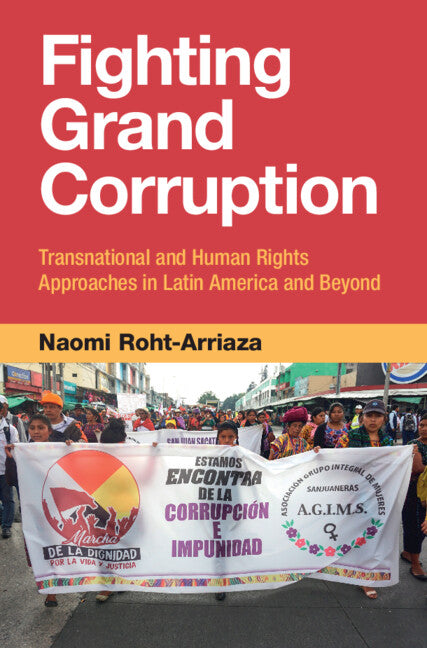
Fighting Grand Corruption
Transnational and Human Rights Approaches in Latin America and Beyond
How to fight systemic, large-scale corruption better: frame it as a human rights issue, identify victims and reparations, focus on overlaps with atrocities.
Naomi Roht-Arriaza (Author)
9781009550581, Cambridge University Press
Hardback, published 10 April 2025
284 pages
22.9 x 15.2 x 1.8 cm, 0.576 kg
'[A] crucial text on the ever-expanding interconnections among corruption, human rights violations, inequalities, environmental destruction, and democratic backsliding, and ways to combat these pervasive, inextricably linked problems. … Essential.' K. Sorensen, Choice
Grand corruption-systemic, large-scale, and top-down misappropriation of public resources for private gain-remains a pervasive problem around the world. It affects the ability of governments to educate, feed, and care for their people. It undermines human rights, perpetuates impunity, and erodes trust in government and the judiciary. It strengthens disgruntlement, authoritarianism, and insurgency. Corruption, however, is not a static force. In this work, Naomi Roht-Arriaza explores how corruption has changed, and how new anti-corruption thinking, especially in Latin America, centers human rights, victims' access to justice, and reparations. Roht-Arriaza shows how activists have used outside pressure and support for local actors where state institutions have been captured and foregrounds anti-corruption considerations in dealing with transitional justice and atrocity crimes. Written with engaging stories and examples, this book will appeal to lawyers, scholars of Latin America, and anyone else interested in fighting kleptocrats with the goal of reclaiming the common good.
Part I. Setting the Stage: International and Transnational Law and Policies: 1. The grand corruption problem
2. Treaty law on corruption and on human rights: convergence and gaps
3. Transnational approaches I: sizing up Guatemala's CICIG
4. Transnational approaches II: sanctions, standards and third-party states
Part II. Putting Victims at the Center of Anti-Corruption Work: 5. Fraud on the river: victim access to corruption proceedings
6. Giving it back: transnational asset recovery and repurposing
7. Reparations for victims of grand corruption: applying a human rights framework
Part III. A Corruption Lens on Human Rights-Related Issues: 8. Transitions, transitional justice and grand corruption
9. A corruption lens on atrocity crimes: seeing behind the slaughter
10. Conclusions: where to, and what to watch out for?
Subject Areas: Human rights & civil liberties law [LNDC]