Freshly Printed - allow 10 days lead
Couldn't load pickup availability
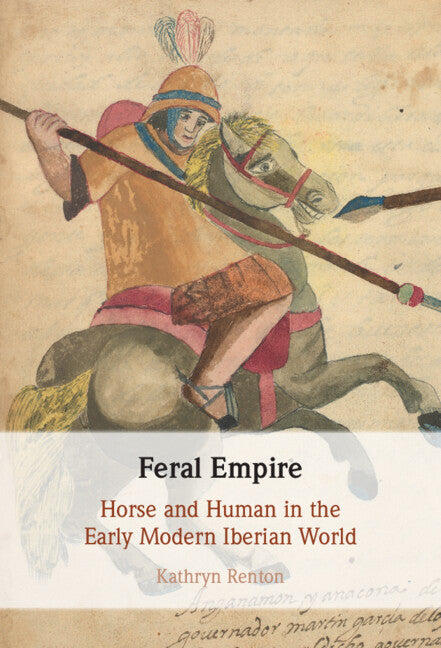
Feral Empire
Horse and Human in the Early Modern Iberian World
Examines how horses shaped society, politics, and imperial control during the first century of conquest and colonization in Spanish America.
Kathryn Renton (Author)
9781316515075, Cambridge University Press
Hardback, published 6 June 2024
260 pages
23.5 x 15.9 x 1.9 cm, 0.52 kg
'Renton's book is a triumph of archival research. … A must-read for anyone interested in animal history, Renton's book has set down a new marker for the field.' Mackenzie Cooley, The Journal of Modern History
By tracing the dramatic spread of horses throughout the Americas, Feral Empire explores how horses shaped society and politics during the first century of Spanish conquest and colonization. It defines a culture of the horse in medieval and early modern Spain which, when introduced to the New World, left its imprint in colonial hierarchies and power structures. Horse populations, growing rapidly through intentional and uncontrolled breeding, served as engines of both social exclusion and mobility across the Iberian World. This growth undermined colonial ideals of domestication, purity, and breed in Spain's expanding empire. Drawing on extensive research across Latin America and Spain, Kathryn Renton offers an intimate look at animals and their role in the formation of empires. Iberian colonialism in the Americas cannot be explained without understanding human-equine relationships and the centrality of colonialism to human-equine relationships in the early modern world. This title is part of the Flip it Open Program and may also be available Open Access. Check our website Cambridge Core for details.
Introduction: horse and human in the early modern world
1. The equine imprint in Iberian history, tenth to fifteenth centuries
2. A politics of horses: scarcity and colonization in the new world
3. The paradox of abundance and illusion of control: an equine political ecology
4. Indigenous equestrianism: a 'New World' frontier model
5. Ferality and breed in 'New World' horses
6. Defining Casta and Raza: horse breeding and the language of race
Conclusion: feral empire
Works cited
Index.
Subject Areas: History of the Americas [HBJK]