Freshly Printed - allow 8 days lead
Couldn't load pickup availability
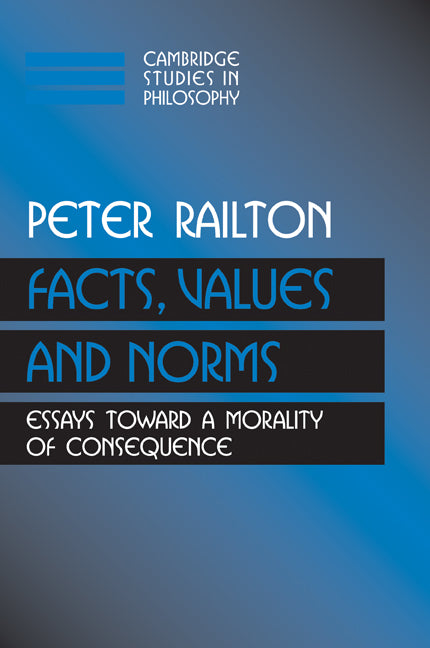
Facts, Values, and Norms
Essays toward a Morality of Consequence
In this collection, Peter Railton shows how a naturalistic view of the world might incorporate objective values and moral knowledge.
Peter Railton (Author)
9780521426930, Cambridge University Press
Paperback, published 17 March 2003
410 pages
23.2 x 15.3 x 2.5 cm, 0.54 kg
'This is a book the serious ethicist should not be without, and I particularly recommend it for those interested in metaethics.' Milltown Studies
In our everyday lives we struggle with the notions of why we do what we do and the need to assign values to our actions. Somehow, it seems possible through experience and life to gain knowledge and understanding of such matters. Yet once we start delving deeper into the concepts that underwrite these domains of thought and actions, we face a philosophical disappointment. In contrast to the world of facts, values and morality seem insecure, uncomfortably situated, easily influenced by illusion or ideology. How can we apply this same objectivity and accuracy to the spheres of value and morality? In the essays included in this collection, Peter Railton shows how a fairly sober, naturalistically informed view of the world might nonetheless incorporate objective values and moral knowledge. This book will be of interest to professionals and students working in philosophy and ethics.
Part I. Realism about Value and Morality: 1. Moral realism
2. Facts and values
3. Noncognitivism about rationality
4. Aesthetic value, moral value, and the ambitions of naturalism
5. Red, bitter, good
Part II. Normative Moral Theory: 6. Alienation, consequentialism, and the demands of morality
7. Locke, stock, and peril
8. How thinking about character and utilitarianism might lead to rethinking the character of utilitarianism
9. Pluralism, dilemma, and the expression of moral conflict
Part III. The Authority of Ethics and Values - The Problem of Normativity: 10. On the hypothetical and non-hypothetical in reasoning about thought and action
11. Normative force and normative freedom
12. Morality, ideology, and reflection
or, the duck sits yet.
Subject Areas: Philosophy [HP]