Special Order - allow 2+ weeks lead
Couldn't load pickup availability
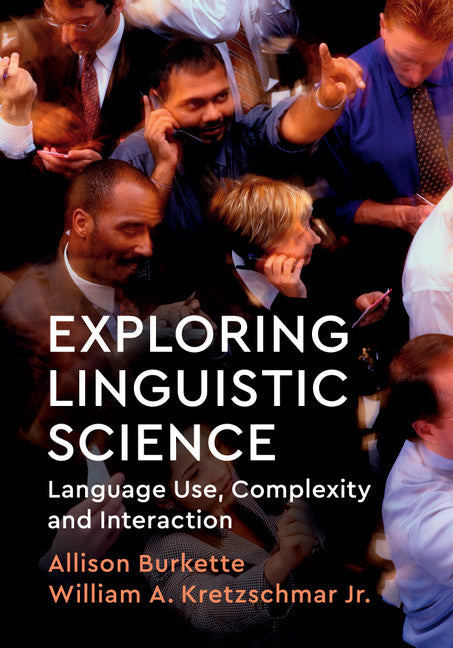
Exploring Linguistic Science
Language Use, Complexity, and Interaction
Introduces students to the scientific study of language, using the basic principles of complexity theory.
Allison Burkette (Author), William A. Kretzschmar Jr. (Author)
9781108440950, Cambridge University Press
Paperback / softback, published 15 March 2018
252 pages, 62 b/w illus.
24.5 x 17.3 x 1.3 cm, 0.45 kg
'… this introductory book is essential reading for undergraduate students who are new to the field of linguistics and those who wish to get a modern perspective on linguistics as a science. It will also prove valuable for language teachers who wish to demonstrate the relevance of linguistics to the real world.' Xueliang Chen, Language in Society
Exploring Linguistic Science introduces students to the basic principles of complexity theory and then applies these principles to the scientific study of language. It demonstrates how, at every level of linguistic study, we find evidence of language as a complex system. Designed for undergraduate courses in language and linguistics, this essential textbook brings cutting-edge concepts to bear on the traditional components of general introductions to the study of language, such as phonetics, morphology and grammar. The authors maintain a narrative thread throughout the book of 'interaction and emergence', both of which are key terms from the study of complex systems, a new science currently useful in physics, genetics, evolutionary biology, and economics, but also a perfect fit for the humanities. The application of complexity to language highlights the fact that language is an ever-changing, ever-varied product of human behavior.
1. A new science
2. Complex systems in nature and human behavior
3. Complex systems in language
4. Language basics: sounds
5. Sounds: IPA and acoustic phonetics
6. Sounds: atlas evidence
7. Language basics: morphology
8. Morphemes: empirical data
9. Parts of speech
10. Language basics: grammar and discourse
11. Grammar: sentences and construction grammar
12. Cognitive linguistics
13. Language acquisition
14. Language evolution
15. Text type
16. Style
17. Sociolinguistics
18. Big data: using a corpus
19. Historical linguistics
20. Conclusion: the future of interaction and emergence.
Subject Areas: Grammar, syntax & morphology [CFK], Sociolinguistics [CFB]