Freshly Printed - allow 8 days lead
Couldn't load pickup availability
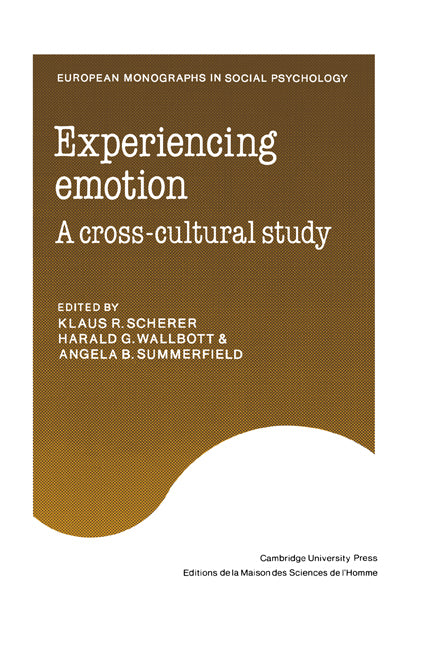
Experiencing Emotion
A Cross-Cultural Study
This 1986 book describes a cross-cultural study of emotional experience and reaction in seven European countries and Israel.
Klaus R. Scherer (Edited by), Harald G. Wallbott (Edited by), Angela B. Summerfield (Edited by)
9780521155014, Cambridge University Press
Paperback, published 21 July 2011
318 pages
22.9 x 15.2 x 1.8 cm, 0.47 kg
This book describes a large-scale, cross-cultural study of emotional experience and emotional reaction which was conducted in Israel and seven European countries: the UK, West Germany, France, Belgium, Switzerland, Italy, and Spain. Until the publication of this book in 1986, most research on emotion has been conducted under laboratory conditions, but the contributors to this study used a questionnaire approach to gather material covering a wide range of topics. Do certain situations elicit emotion-specific responses? Do emotion-specific symptom and reaction patterns exist? Do the common stereotypes of Northern and Southern emotional responses reflect the existence of real cross-cultural differences in emotional experiences and responses? Four emotions were studied - joy, sadness, fear and anger - and the results provide not only a wealth of quantitative data, but also, at the descriptive level, a fascinating overview of the ways in which people experience emotion.
List of contributors
Preface
Part I. Asking about Emotional Experiences: Rationale and Methods: 1. Studying emotion empirically: issues and a paradigm for research K. R. Scherer
2. Measuring emotional experiences: questionnaire design and procedure, and the nature of the sample V. Aebischer and H. G. Wallbott
3. The coding of reported emotional experiences: antecedents and reactions H. Ellgring and E. Bänniger-Huber
4. Categories of emotion-eliciting events: a qualitative overview A. B. Summerfield and E. J. Green
Part II. Patterns of Results across Cultures: 5. The antecedents of emotional experiences H. G. Wallbott and K. R. Scherer
6. The physiological patterns of reported emotional states B. Rimé and D. Giovannini
7. Non-verbal reactions to emotional experiences H. G. Wallbott, P. Ricci-Bitti and E. Bänniger-Huber
8. The verbalisation of emotional experiences J. Cosnier, J. M. F. Dols and A. J. Fernandez
9. Interrelations between antecedents, reactions, and coping responses P. Ricci-Bitti and K. R. Scherer
10. Individual differences in emotional reactions H. Ellgring and B. Rimé
11. The effects of social factors on emotional reactions E. Y. Babad and H. G. Wallbott
12. Emotion experiences across European cultures: a summary statement K. R. Scherer
Appendix A. Notes on results for specific countries: A1. The British case: the pleasures of life and the art of conversation A. B. Summerfield, R. J. Edelman and E. J. Green
A2. The French case: emotion and rationality V. Aebischer and J. Cosnier
A3. The German case: personality correlates of emotional reactivity H. G. Wallbott and H. Ellgring
A4 The Italian case: a stereotype confirmed? D. Giovannini and P. Ricci-Bitti (Translated by J. A. Oliver)
A5. The Swiss case: down to earth E. Bänniger-Huber
A6. The Belgian case: overt emotions in intimate contexts B. Rimé
A7. The Spanish case: the written expression of emotional routes J. M. F. Dols and A. J. Fernandez
A8. The Israeli case: minority status and politics E. Y. Babad
Appendix B. English version of the emotion questionnaire
Appendix C. Antecedent and reaction codes
Appendix D. Statistical analyses
References
Index.
Subject Areas: Physiological & neuro-psychology, biopsychology [JMM]