Freshly Printed - allow 10 days lead
Couldn't load pickup availability
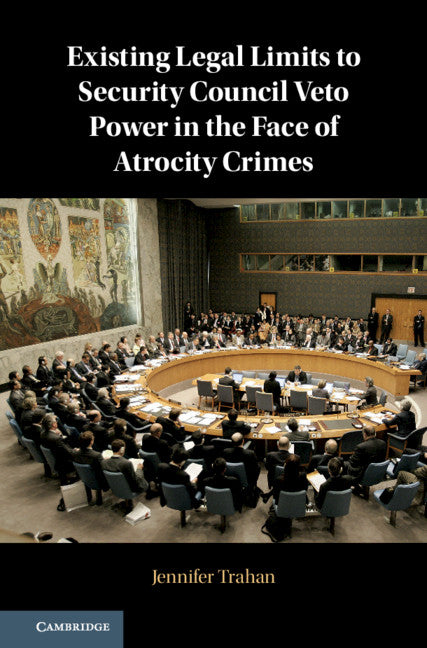
Existing Legal Limits to Security Council Veto Power in the Face of Atrocity Crimes
The book outlines legal limits to the veto power of UN Security Council permanent members while atrocity crimes are occurring.
Jennifer Trahan (Author)
9781108487016, Cambridge University Press
Hardback, published 13 August 2020
374 pages
15 x 23.5 x 2.5 cm, 0.68 kg
'… deals with a topic of exceptional importance-how to break the deadlock [of the] U.N. Security Council and its consequent and chronic toleration for international aggression and human rights violations. Its solution to the seemingly hopeless problem is at once original, creative, and credible. Her reasoning is sound and based on reliable and complete evidence. Her research into both the law and relevant scholarship is thorough. The structure of the book's argument is tightly focused on proving its thesis. And her language is lucid without sacrificing lawyerly precision.' Aaron Fellmeth, ABILA
In this book, the author outlines three independent bases for the existence of legal limits to the veto by UN Security Council permanent members while atrocity crimes are occurring. The provisions of the UN Charter creating the veto cannot override the UN's 'Purposes and Principles', nor jus cogens (peremptory norms of international law). There are also positive obligations imposed by the Geneva and Genocide Conventions in situations of war crimes and genocide - conventions to which all permanent members are parties. The author demonstrates how vetoes and veto threats have blocked the Security Council from pursuing measures that could have prevented or alleviated atrocity crimes (genocide, crimes against humanity, war crimes) in places such as Myanmar, Darfur, Syria, and elsewhere. As the practice continues despite regular condemnation by other UN member states and repeated voluntary veto restraint initiatives, the book explores how the legality of this practice could be challenged.
Foreword Richard J. Goldstone
Acknowledgments
Introduction
1. The origins and history of the veto and its use
2. Acting in the face of atrocity crimes humanitarian intervention and the responsibility to protect
3. Initiatives to voluntarily restrain veto use in the face of atrocity crimes
4. Questioning the legality of veto use in the face of genocide, crimes against humanity, and/or war crimes
5. Case studies veto use related to the situation in Syria and veto threats related to the situation in Darfur
Index.
Subject Areas: Settlement of international disputes [LBH], Responsibility of states & other entities [LBBV], International humanitarian law [LBBS], International human rights law [LBBR]