Freshly Printed - allow 7 days lead
Couldn't load pickup availability
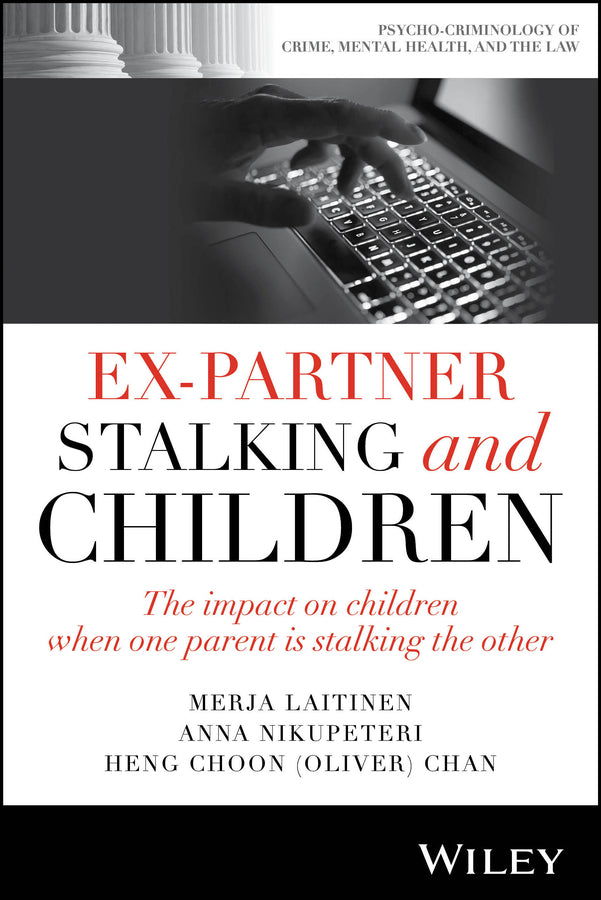
Ex-Partner Stalking and Children
The Impact on Children When One Parent is Stalking the Other
Merja Laitinen (Edited by), M Laitinen (Author), Anna Nikupeteri (Edited by), Heng Choon (Oliver) Chan (Edited by)
9781394185269, Wiley
Paperback / softback, published 7 November 2024
192 pages
22.9 x 15.3 x 3.6 cm, 0.284 kg
PROVIDES AN AUTHORITATIVE OVERVIEW OF STALKING BEHAVIOR PERPETRATED BY PARENTS AND ITS IMPACTS ON CHILDREN Stalking targeted at one of the child’s parents by the other poses a major psychosocial and physical threat to children’s wellbeing and security. Although interdisciplinary research on stalking has expanded in recent decades, intimate partner/ex-partner stalking has been viewed as an “adults only” problem. Ex-Partner Stalking and Children brings together scholars and practitioners from different disciplines in the field to examine ex-partner stalking as a psychosocial and criminological issue in children’s and young people’s lives. Providing both theoretical and practical perspectives, this comprehensive volume explores approaches for increasing awareness of parental stalking, addressing its impacts on children and young people, and advancing interventions and methods of support for them. Throughout the text, the authors challenge existing conceptions of intimate partner/ex-partner stalking as a phenomenon that exists only between the partners, rather than a form of gendered violence that creates a victimizing environment for the children. A novel contribution to both scholarly and practical understandings of ex-partner stalking, this important book: Part of the acclaimed Psycho-Criminology of Crime, Mental Health, and the Law series, Ex-Partner Stalking and Children: The Impact on Children When One Parent is Stalking the Other is essential reading for undergraduate and graduate students in disciplines such as criminology, social work, healthcare, psychology, and education, and an invaluable resource for law enforcement staff, nurses, psychologists, therapists, social workers, teachers, and other professionals who work with victims of stalking.
List of Figures xv List of Tables xvi About the Editors xvii About the Contributors xx Foreword xxiv Acknowledgments xxvi 1 Why Shed Light on Children in Cases of Ex-Partner Stalking? 1 Research Background 1 Definition of Key Concepts 4 Structure of the Book 6 References 10 Part 1 Ex- Partner Stalking as a Multifaceted Phenomenon in Children’s Lives 17 2 Children as Collateral Victims of Separation/Divorce Stalking 19 Introduction 19 Conceptualizing Separation/Divorce 20 Definition of Stalking 22 The Consequences of Child Exposure to Separation/Divorce Stalking 24 What is to be Done? 26 Conclusion 28 Notes 29 References 29 3 Manifestations of Ex-Partner/Parental Stalking in Children’s and Young People’s Lives 35 Introduction 35 Methods 37 Manifestations of Stalking and Their Impacts on Children 40 Children’s Experiences of Ex-Partner/Parental Stalking 41 Impacts of Stalking on Children’s Everyday Lives and Agency 44 Children in the Service System and Their Expectations of Being Helped 48 Conclusion 51 Note 53 References 53 4 The Impacts of Ex-Partner Stalking on Children: A Psychological and Trauma Perspective on Stalking 57 Introduction 57 Children and Trauma 58 Stalking as a Form of Domestic Violence That Impacts Children’s Well-Being 62 The Consequences of Parental Stalking: Findings from the Danish Research 64 Living Alongside the Stalked Mother 64 Risks for the Children 65 Conclusions 67 Note 69 References 69 Part 2 Challenges in Identifying Children’s Needs for Help 73 5 Factors Preventing Children from Receiving Help: Barriers of the Service System and Gaps in Professional Expertise in the Cases of Ex-Partnership/Parental Stalking and Coercive Control 75 Introduction 75 Data and Methods 77 Qualitative Survey 77 Data Analysis 79 Results and Discussion 79 Barriers of the Service System 79 Gaps in Expertise 85 Conclusion 89 Note 92 References 93 6 Challenges in Identifying the Child’s Experiences and Assessing Adverse Consequences of Stalking from the Child’s Perspective: Insights from the Finnish Practice 97 Introduction 97 Identifying the Social Boundary Conditions for Helping the Child 98 Ensuring the Importance of Listening to the Child’s Experiences and Views 100 The Importance of Risk Assessment 102 Managing the Challenges of the Service and Legal Systems 106 Conclusion 110 References 111 Part 3 Encountering Ex- Partner Stalking from the Child’s Perspective 113 7 A Child Perspective on Risk Management for Intimate Partner Violence and Stalking in Sweden 115 Introduction 115 How Children are Affected by IPV and Stalking 117 Perpetrators Impact on Children 118 The Risk Principle: Conducting Risk Assessment for Violence 119 Assessing and Managing Risk for IPV and Stalking in Sweden 120 The Need Principle: Creating a Risk Management Strategy in Collaboration 122 The Responsivity Principle: Victim and Perpetrator Cooperation 123 The RNR-Based RISKSAM Model 124 Risk Assessment’s Effect on Children 125 Risk and Vulnerability Factors for Children 125 Protective Factors for Children 125 Risk Management and Children 127 Conclusion 128 References 129 8 Best Practices and Working Methods for Children and Young People: The Finnish Experience of Supporting a Child’s Coping 135 Introduction 135 Supporting the Child’s Safety and Coping 136 A Child-Focused Safety Plan 139 Home Safety 139 Safety of the Immediate Environment 141 Self-Regulation of Alertness Levels 143 Safe Relationships 144 Other Factors to Consider When Drafting a Safety Plan 145 Model for Enabling Contact Based on Strong Support 145 The Purpose and Content of the Strong Support-Based Contact-Enabling Model 146 One-on-One Work with Parties Engaged in or Exposed to Stalking 147 Practices Related to Supervised Contact between the Child and the Parent 148 Cooperation between Professionals 149 Possibilities and Challenges of the Contact-Enabling Model 149 Conclusion 151 Note 152 References 153 9 Conclusions and Future Directions: Promoting Children’s and Young People’s Rights in Ex-Partner Stalking 155 References 159 Index 161
Merja Laitinen, Anna Nikupeteri, and Heng Choon (Oliver) Chan
Walter S. DeKeseredy
Merja Laitinen and Anna Nikupeteri
Didde Hauch and Ask Elklit
Birgitta Vinkka, Anna Nikupeteri, and Merja Laitinen
Eveliina Nilosaari, Salla Kaikkonen, Tiina Arpiainen, and Minna Goman
Susanne Strand, Åsa Källström, and Martina Vikander
Eveliina Nilosaari, Salla Kaikkonen, Pirjo Ervasti, and Minna Goman
Merja Laitinen, Anna Nikupeteri, and Heng Choon (Oliver) Chan
Subject Areas: Sociology & anthropology [JH]