Freshly Printed - allow 10 days lead
Couldn't load pickup availability
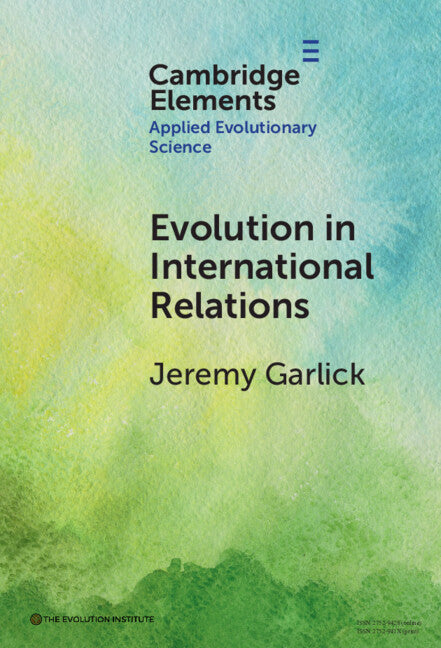
Evolution in International Relations
This Element applies key insights from evolutionary biology, evolutionary psychology, and neuroscience to International Relations.
Jeremy Garlick (Author)
9781009464161, Cambridge University Press
Hardback, published 6 March 2025
86 pages
22.9 x 15.2 x 0.6 cm, 0.265 kg
Scholars of international relations (IR) and evolution pay little attention to each other's fields. However, there is a need to examine evolution's impacts in IR. International actors such as nations are made up of people, so evolved human nature has an impact on relations within and between states. Accordingly, this pathbreaking Element will attempt to apply insights from evolutionary biology, evolutionary psychology, neuroscience, and archaeogenetics to IR. Among such insights are the evolved role of emotions in decision-making, intergroup competition as a driver of in-group cooperation, and culture, morality, and language as group-binding mechanisms. Homo sapiens is a primate, so comparison with the behaviours of other great apes reveals some commonalities in terms of group dynamics, status, and hierarchies, as well as the enduring human capacity for both in-group cooperation and organised violence against other groups. These have an evolutionary basis that is relevant to IR theory and practice.
1. Foreword
2. Introduction
3. The implications of evolution for international relations
4. IR's evidential deficits: evolution enters the picture
5. Applying evolutionary science to IR
6. Conclusion
References.
Subject Areas: Physiological & neuro-psychology, biopsychology [JMM]