Freshly Printed - allow 8 days lead
Couldn't load pickup availability
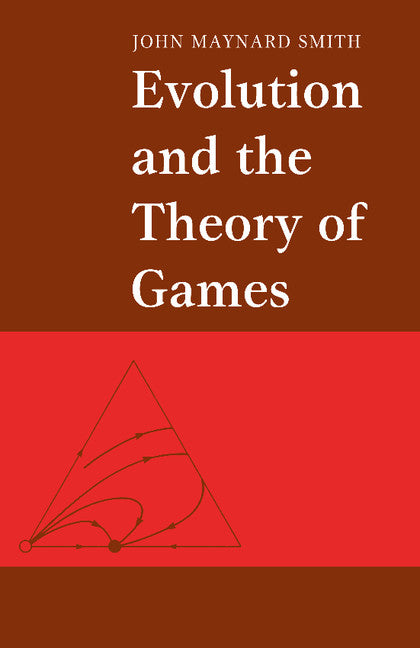
Evolution and the Theory of Games
This 1982 book is an account of an alternative way of thinking about evolution and the theory of games.
John Maynard Smith (Author)
9780521288842, Cambridge University Press
Paperback, published 21 October 1982
234 pages
21.5 x 14.4 x 1.3 cm, 0.33 kg
"Of those two near-contradictory things publishers say about a book, that it is 'seminal' and that it is 'long-awaited', Evolution and the Theory of Games somehow manages to make me think of both at once....This is a book that must be read by every serious ethologist/sociobiologist....It is unmistakably a brilliant book by one of the most important contributors to ethology in its history, still at the height of his powers. The only reason we don't call him an ethologist is that he is so much else besides....the gems of wisdom and biological insight are still there on every page, and ethologists can spend many happy field sessions testing the ideas here." Richard Dawkins, Animal Behaviour
In this 1982 book, the theory of games, first developed to analyse economic behaviour, is modified so that it can be applied to evolving populations. John Maynard Smith's concept of an evolutionarily stable strategy is relevant whenever the best thing for an animal or plant to do depends on what others are doing. The theory leads to testable predictions about the evolution of behaviour, of sex and genetic systems, and of growth and life history patterns. This book contains a full account of the theory, and of the data relevant to it. The account is aimed at senior undergraduate and graduate students, teachers and research workers in animal behaviour, population genetics and evolutionary biology. The book will also be of interest to mathematicians and game theorists; the mathematics has been largely confined to appendixes so that the main text may be easily followed by biologists.
1. Introduction
2. The basic model
3. The war of attrition
4. Games with genetic models
5. Learning the ESS
6. Mixed strategies-I. A classification of mechanisms
7. Mixed strategies-II. Examples
8. Asymmetric games-I. Ownership
9. Asymmetric games-II. A classification, and some illustrative examples
10. Asymmetric games-III. Sex and generation games
11. Life history strategies and the size game
12. Honesty, bargaining and commitment
13. The evolution of cooperation
14. Postscript
Appendices.
Subject Areas: Evolution [PSAJ]