Freshly Printed - allow 10 days lead
Couldn't load pickup availability
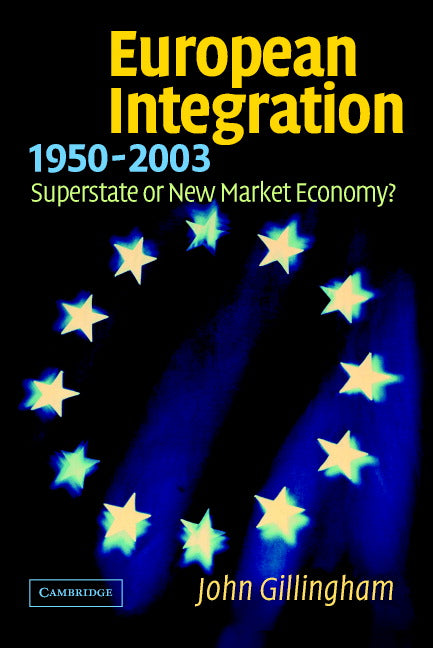
European Integration, 1950–2003
Superstate or New Market Economy?
Considers European integration from a historical perspective, and speculates on where it might be headed.
John Gillingham (Author)
9780521012621, Cambridge University Press
Paperback / softback, published 2 June 2003
608 pages
22.9 x 15.2 x 3.8 cm, 0.812 kg
'Few previous works are so extensive or so up-to-date. His is thus a significant work that is likely to be widely read, and is worthy of a close critical examination … impressive sweep of this work … should be warmly welcomed … of substantial value to students, as well as a broader educated public seeking a comprehensive source of information about integration.' International Affairs
Integration is the most significant European historical development in the past fifty years, eclipsing in importance even the collapse of the USSR. Yet, until now, no satisfactory explanation is to be found in any single book as to why integration is significant, how it originated, how it has changed Europe, and where it is headed. Professor Gillingham's work corrects the inadequacies of the existing literature by cutting through the genuine confusion that surrounds the activities of the European Union, and by looking at his subject from a truly historical perspective. The late-twentieth century has been an era of great, though insufficiently appreciated, accomplishment that intellectually and morally is still emerging from the shadow of an earlier one of depression, and modern despotism. This is a work, then, that captures the historical distinctiveness of Europe in a way that transcends current party political debate.
Part I. A German Solution to Europe's Problems? The Early History of European Communities, 1950–1965: Introduction to part one: a new global setting
1. The liberal project for an integrated Europe
2. The rise and decline of monetarism
3. More or less liberal Europe: the institutional origins of integration
4. All or nothing? The founding of the EEC and the ending of an era, 1958–1966
Conclusion of part one: Needed: a new integration scenario
Part II. From Embedded Liberalism to Liberalism - A Step Forward: European Integration and Regime Change in the 1970s: Introduction to part two: a new European situation
5. Realm of theory to sphere of action
6. Better than muddling through
Conclusion of part two: needed: a new integration theory
Part III. Seeking the New Horizon: European Integration from the Single European Act to the Maastricht Treaty: Introduction to part three: a new realm of possibility
7. Forces of change, forces of resistance
8. Thatcherism, and the reform of Britain
9. The crisis of the welfare state and the challenge of modernization in Europe in the 1980s
10. Maastricht ho! by air, land, or SEA?
11. The Delorean agenda
Conclusion of part three: Needed: a new integration direction
Part IV: A False Dawn? Challenge and Promise in Europe of the 1990s: Introduction to part four: a new global framework
12. Almost a road to nowhere
13. No open and shut cases: member-states and the European community in the 1990s
14. Shrinking enlargement: betrayal of a pledge or new opportunity?
15. The new market economy and Europe's future
Conclusion to part four: Needed: a new European Union?
Subject Areas: Political economy [KCP], Postwar 20th century history, from c 1945 to c 2000 [HBLW3], European history [HBJD]