Freshly Printed - allow 7 days lead
Couldn't load pickup availability
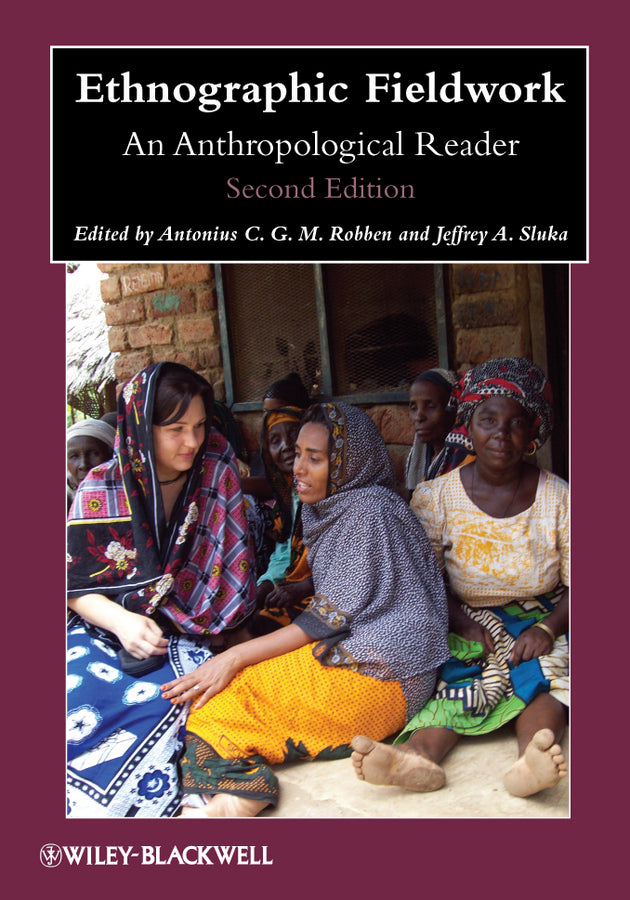
Ethnographic Fieldwork
An Anthropological Reader
"This collection captures the inescapable situatedness of ethnographic field practice, in which personal commitments can both guide and mislead. Varied perspectives, many of them highly personal, provide an epistemic kaleidoscope to match the riotously emotional and sensory chaos of the field experience." "I was visited recently by a brilliant former student who is teaching anthropology in Tehran under challenging conditions. She asked for a foundational text to motivate her students. I pulled my copy of Robben and Sluka from my crowded shelves and presented it to her. I intend to do the same with the revised edition. What more to say?"
—Michael Herzfeld, Harvard University
—George E. Marcus, Co-editor of Fieldwork Is Not What It Used To Be
Antonius C. G. M. Robben (Edited by), Jeffrey A. Sluka (Edited by)
9780470657157, Wiley
Paperback / softback, published 30 December 2011
672 pages
24.4 x 17 x 2.8 cm, 1.021 kg
"This final section serves to bring full circle many of the central issues about the relationship between ethnographers and their research subjects and, thus, is a fitting conclusion to an extraordinary collection." (Anthropos, 2 October 2013)
Newly revised, Ethnographic Fieldwork: An Anthropological Reader Second Edition provides readers with a picture of the breadth, variation, and complexity of fieldwork. The updated selections offer insight into the ethnographer’s experience of gathering and analyzing data, and a richer understanding of the conflicts, hazards and ethical challenges of pursuing fieldwork around the globe.
About the Editors x Editors’ Acknowledgments xi Acknowledgments to Sources xii Fieldwork in Cultural Anthropology: An Introduction 1 Part I Beginnings 49 Introduction 51 1 The Observation of Savage Peoples 56 2 The Methods of Ethnology 63 3 Method and Scope of Anthropological Fieldwork 69 Part II Fieldwork Identity 83 Introduction 85 4 A Woman Going Native 92 5 Fixing and Negotiating Identities in the Field: The Case of Lebanese Shiites 103 6 Being Gay and Doing Fieldwork 114 7 Automythologies and the Reconstruction of Ageing 124 Part III Fieldwork Relations and Rapport 135 Introduction 137 8 Champukwi of the Village of the Tapirs 143 9 Behind Many Masks: Ethnography and Impression Management 153 10 The Politics of Truth and Emotion among Victims and Perpetrators of Violence 175 Part IV The “Other” Talks Back 191 Introduction 193 11 Custer Died for Your Sins 199 12 Here Come the Anthros 207 13 When They Read What the Papers Say We Wrote 210 14 Ire in Ireland 219 Part V Fieldwork Confl icts, Hazards, and Dangers 235 Introduction 237 15 Ethnology in a Revolutionary Setting 244 16 The Ethnographer’s Tale 256 17 Anthropology from the Bones: A Memoir of Fieldwork, Survival, and Commitment 274 18 Reflections on Managing Danger in Fieldwork: Dangerous Anthropology in Belfast 283 Part VI Fieldwork Ethics 297 Introduction 299 19 The Life and Death of Project Camelot 306 20 Confronting the Ethics of Ethnography: Lessons From Fieldwork in Central America 318 21 Ethics versus “Realism” in Anthropology 331 22 Worms, Witchcraft and Wild Incantations: The Case of the Chicken Soup Cure 353 23 Code of Ethics (2009) 359 Part VII Multi-Sited Fieldwork 365 Introduction 367 24 Beyond “Culture”: Space, Identity, and the Politics of Difference 374 25 Afghanistan, Ethnography, and the New World Order 387 26 Being There … and There … and There! Reflections on Multi-Site Ethnography 399 27 A New Form of Collaboration in Cultural Anthropology: Matsutake Worlds 409 Part VIII Sensorial Fieldwork 441 Introduction 443 28 Balinese Character: A Photographic Analysis 450 29 The Taste of Ethnographic Things 465 30 Dialogic Editing: Interpreting How Kaluli Read Sound and Sentiment 480 31 On Rocks, Walks, and Talks in West Africa: Cultural Categories and an Anthropology of the Senses 496 Part IX Refl exive Ethnography 511 Introduction 513 32 Fieldwork and Friendship in Morocco 520 33 The Way Things Are Said 528 34 Transmutation of Sensibilities: Empathy, Intuition, Revelation 540 35 “At the Heart of the Discipline”: Critical Reflections on Fieldwork 547 Part X Engaged Fieldwork 563 Introduction 565 36 Introduction – 1942 573 37 Scholarship, Advocacy, and the Politics of Engagement in Burma (Myanmar) 579 38 “Human Terrain”: Past, Present and Future Applications 593 39 The Gaza Freedom Flotilla: Ethnographic Notes on “Othering Violence” 605 Appendix 1: Key Ethnographic, Sociological, Qualitative, and Multidisciplinary Fieldwork Methods Texts 612 Appendix 2: Edited Cultural Anthropology Volumes on Fieldwork Experiences 615 Appendix 3: Reflexive Accounts of Fieldwork and Ethnographies Which Include Accounts of Fieldwork 618 Appendix 4: Leading Cultural Anthropology Fieldwork Methods Texts 620 Appendix 5: Early and Classic Anthropological Writings on Fieldwork, including Diaries and Letters 622 Index 623
Jeffrey S. Sluka and Antonius C. G. M. Robben
Antonius C. G. M. Robben
Joseph-Marie Degérando
Franz Boas
Bronislaw Malinowski
Antonius C. G. M. Robben
Hortense Powdermaker
Roschanack Shaery-Eisenlohr
Walter L. Williams
Paul Spencer
Jeffrey A. Sluka
Charles Wagley
Gerald D. Berreman
Antonius C. G. M. Robben
Jeffrey A. Sluka
Vine Deloria, Jr.
Cecil King
Ofra Greenberg
Nancy Scheper-Hughes
Jeffrey A. Sluka
June Nash
Neil L. Whitehead
Cynthia Keppley Mahmood
Jeffrey A. Sluka
Jeffrey A. Sluka
Irving Louis Horowitz
Philippe Bourgois
Gerald D. Berreman
Jeffrey David Ehrenreich
American Anthropological Association
Antonius C. G. M. Robben
Akhil Gupta and James Ferguson
David B. Edwards
Ulf Hannerz
Matsutake Worlds Research Group
Antonius C. G. M. Robben
Gregory Bateson and Margaret Mead
Paul Stoller and Cheryl Olkes
Steven Feld
Kathryn Linn Geurts
Antonius C. G. M. Robben
Paul Rabinow
Jeanne Favret-Saada
Thomas J. Csordas
Vincent Crapanzano
Jeffrey A. Sluka
Margaret Mead
Monique Skidmore
Roberto J. González
Nikolas Kosmatopoulos
Subject Areas: Archaeology [HD]