Freshly Printed - allow 10 days lead
Couldn't load pickup availability
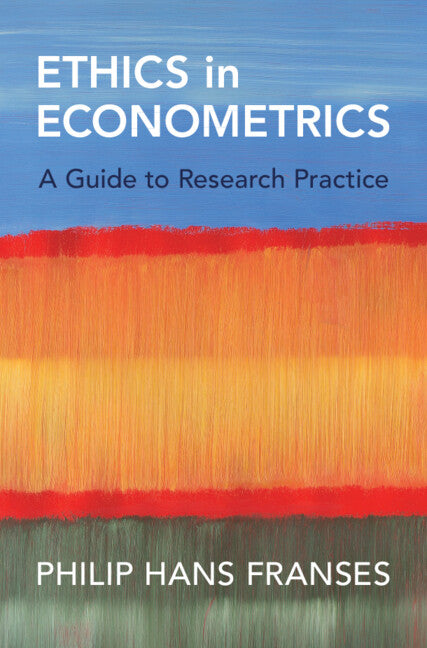
Ethics in Econometrics
A Guide to Research Practice
Econometricians make choices on data, models, and estimation routines. Using various examples, this book shows the consequences of choices.
Philip Hans Franses (Author)
9781009428040, Cambridge University Press
Hardback, published 28 November 2024
310 pages
23.5 x 15.9 x 2.3 cm, 0.58 kg
'Philip Franses' latest book is a unique and indispensable resource for practical econometricians, offering a wealth of knowledge that is both comprehensive and accessible. I am delighted to include this book in my reading list for upper-division undergraduate and master courses in Time Series Econometrics at U. Carlos III de Madrid. It serves as an excellent complement to standard textbooks in Econometrics. Two thumbs up for its exceptional contribution to the field of econometrics.' Jesus Gonzalo, Economics Professor, U. Carlos III de Madrid
Applied econometrics uses the tools of theoretical econometrics and real-word data to develop predictive models and assess economic theories. Due to the complex nature of such analysis, various assumptions are often not understood by those people who rely on it. The danger of this is that economic policies can be assessed favourably to suit a particular political agenda and forecasts can be generated to match the needs of a particular customer. Ethics in Econometrics argues that econometricians need to be aware of potential ethical pitfalls when carrying out their analysis and that they need to be encouraged to avoid them. Using a range of empirical examples and detailed discussions of real cases, this book provides a guide for research practices in econometrics, illustrating why it is imperative that econometricians act ethically in terms of the way they conduct their analysis and treat their data.
Introduction
1. Ethical guidelines
2. Scientific misconduct
3. Influential observations
4. Model selection
5. Estimation and interpretation
6. Missing data
7. Spurious relations
8. Blinded by the data
9. Predictability
10. Adjustment of forecasts
11. Big data
12. Algorithms.
Subject Areas: Econometrics [KCH]